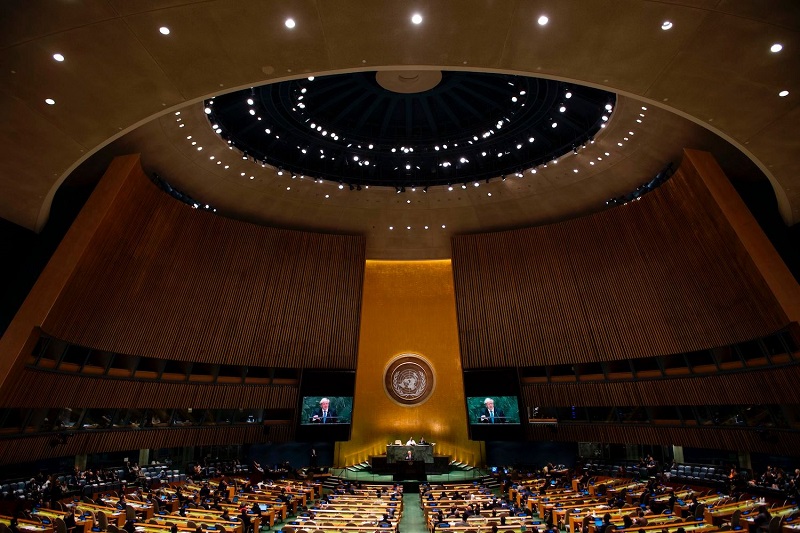
African leaders were among the world leaders of 193 member states present at the official opening of the General Debate of the 76th session of the United Nations General Assembly at the UN headquarters on Tuesday, September 14, 2021, in New York.
The UNGA is an avenue for all leaders of member states to present and debate salient and complex issues affecting the world and all individual member states, is the only world organization where all members have representatives.
In accordance with the main objective of its establishment, as enshrined in the UN Charter, the body has conducted a series of assemblies in the past that witnessed talks on matters related to international peace and security not currently being addressed by the UN Security Council (UNSC). However, as a post-pandemic assembly, this year’s assembly has witnessed perhaps the most inclusive discussions, debates, and deliberations.
Here is the crux of the assertion: African leaders voiced various urgent issues that need to be scaled up in wake of a post-pandemic era, an era that is witnessing unprecedented loss in Africa’s system of operations, spanning from the security crisis, climate change, health, and economic development of the continent amongst others. It also debates matters of human rights, international law, and cooperation in social and cultural fields, especially from the present African leaders.
Vaccine shortage and widening global inequality
The World Health Organization (WHO) had earlier declared that the target of the full vaccination of 10% of Africans by the end of September won’t be realized, this is evidenced of the fact that only a lesser 5% of Africa’s population has been fully vaccinated, compared to US 54% and UK’s 65%.
This perhaps had a great influence in speeches of African leaders at the U.N. General Assembly as they all sounded an alarm on vaccine shortages and widened inequality that has tampered upon its distribution across the globe.
Like representatives from Zambia and DR Congo, the Rwandan President, Paul Kagame called for vaccine equity and distribution.
“We can and must do more to speed up vaccine distribution in Africa. Doing so benefits the entire world. The positive steps from various partners and companies toward building local vaccine manufacturing capacity is also very welcome.” He told the assembly in a prerecorded speech.
Okonjo-Iweala said her top two priorities were to get countries who have an excess of vaccines to donate them to COVAX – the initiative led by the Coalition for Epidemic Preparedness Innovations, the Vaccine Alliance Gavi, and the World Health Organization. The second, she said, was to “get richer countries to swap places with poorer countries on the waiting list for vaccines.”
Health infrastructure
Africa has the lowest infrastructural capacity in key indicators of health capacities. And as part of sessions at the assembly, the Future Investment Initiative Institute hosted a virtual event that entertained voices on Africa’s Health infrastructure system. The whole discussion represented the fact that Africans get the consequences of low vaccinations and funding for medical supplies as a result of stunning health infrastructure.
These voices were further amplified by African Development Bank President Akinwumi A. Adesina, World Trade Organization director-general Ngozi Okonjo-Iweala. Both took part in a panel that looked at balancing the scales of African health systems and the consequences of the novel coronavirus.
Adesina exemplified the need for Africa to work on its manufacturing and healthcare capacity to guard the continent against future health disdain and crises. Through this, an outstanding result has been birthed- the African Development Bank would contribute $3 billion to the development of Africa’s pharmaceutical industry over the next 10 years.
“Africa cannot outsource its health to the rest of the world. We’ve got to build Africa’s indigenous manufacturing capacity.…we need to secure ourselves,” Adesina noted when addressing the need for Africa to stand on itself.
Nigeria’s Iweala too wasn’t left out, she reiterated the fact that trade barriers, intellectual property rights, and lack of raw materials, are the restrictions barring Africa’s health care capacity which in turn makes it challenging for African countries to get into the track.
She said “We are taking action…supply chains for vaccines are very complicated…making sure supply chains flow… We need to lift restrictions so that manufacturers can get what they need,”
Economic developmental goals
The devastating effects of COVID-19 on Africa’s flourishing economy, including increased poverty levels, and decreased economic growth was considered worthy of discussion with other world leaders.
African leaders more than any other world leaders believed that many African countries have been stuck in the twilight of guarding lives and livelihoods, and African livelihoods being the most important needs to be kept afloat. For them, the $33 billion earmarked for Africa is inadequate in light of the enormity of its economic stimulation needs, even despite having gotten $100 billion support from the African Union for the Paris goal support.
Like other leaders, Tanzania’s President, Samia Suluhu Alhassan said during her address “After the onset of the pandemic, we in Tanzania, and I believe in many other developing countries, were stuck in the twilight of protecting lives and livelihoods. Measures advocated by the WHO was geared towards protecting lives, however, an economy like Tanzania, consists of a bigger proportion of people living on subsistence economies whom we need to keep afloat,”.
The deliberations between world leaders resulted in outlandish initiatives relating to the financing of the economies, most especially for members of the G20 on debt suspension and a uniform framework for debt restructuring, as well as the International Monetary Fund’s grant of $650 billion in special drawing rights.
The pervasive problem of insecurity
Security challenges and successes in Africa were also discussed during the assembly speeches, with acknowledgments to fact that
the international community has had some successes fighting terrorism. Endorsements from President Alassane Ouattara of Côte d’Ivoire on the successful U.N. and French peacekeeping operations in his country are straight indications.
Despite this being an inspiration for the United Nations to increase its initiatives in the security sector, some other African leaders recognized that the efforts are still far from the annihilation of the insecurity scourge. They argued that while fights against terrorism succeeded in some regions in Africa, terrorism is still gaining more ground in countries like Mali, Niger, Nigeria, Cameroon, Chad, and Burkina Faso.
For instance, Secretary-General Antonio Guterres stressed that the slow and delayed implementation of the Agreement on Peace and Reconciliation in Mali was concerning, and how the scourge of insecurity caused by the cohorts of coups, armed groups, mercenaries, and criminals of all stripes is undermining the institutional stability of young democracies and destroying the efforts of many African leaders to develop their countries.
These amongst others sum to the worries in African leaders in areas of insecurity and their thirst to seek global collaboration and efforts for concerted solutions to the scourge.
Climate change concern
With less than seven weeks ahead 2021 global climate summit (COP26), African leaders spoke extensively at the United Nations General Assembly on the urgent need to finance climate adaptation in Africa, noting that the African continent will need $30 billion yearly to adapt and cope with the negative traces of climate change. Through speeches and discussions, they called on the international community to fulfill their promises of $100 billion per year for climate change in Africa.
For example, the president of DR Congo, Mr. Felix Tshilombo when commenting on Africa’s agriculture climate, said Africa will be marked by a drop in GDP of up to 15 percent reduction in agricultural yields and a sharp increase in the risk of coastal flooding by 2030.
“Africa does not need charity,” but constructive win-win partnerships to make better use of its collective national wealth and improve the living conditions of its people, he stressed.