For over 50 years, the United States of America and the Federal Republic of Nigeria have maintained a strong security partnership, built upon unlimited cooperation and collaboration on military professionalization, counterterrorism, and maritime and border security; over the years, both countries have shown keen focus and cordial cooperation on counterterrorism efforts against Boko Haram and ISIS-West Africa (ISWAP). The two countries have also strengthened their mutual ties by establishing a sophisticated governance system for the security sector.
The U.S. views its relationship with Nigeria as most important, considering Nigeria’s status as Africa’s most populous country, largest economy, and a pioneer of regional stability. Through tangible commitments, the partnership between the two countries continues to deepen, which includes high-level intelligence sharing, joint combat operations, and massive defense hardware deals.
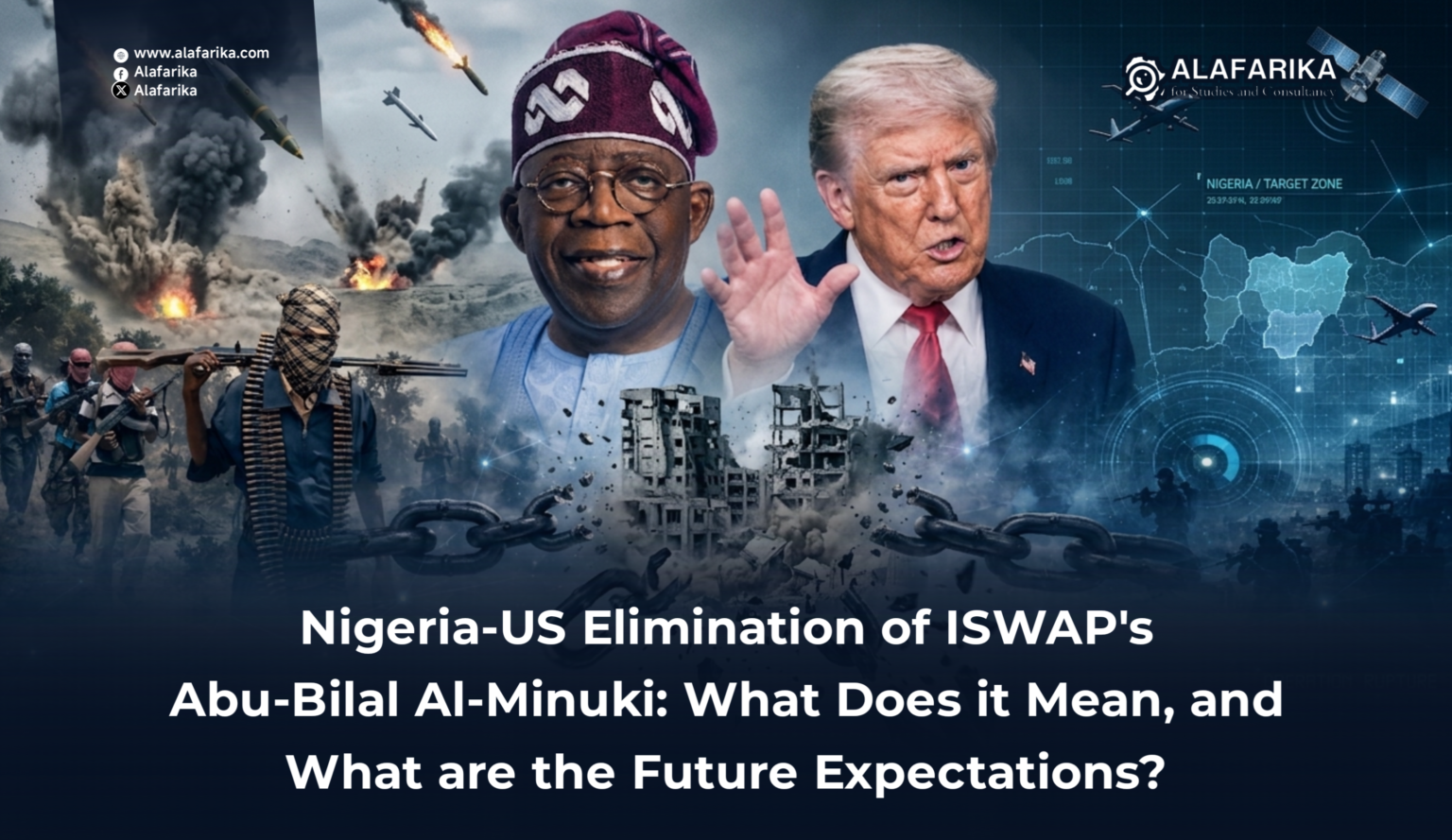
Recently, the highly integrated counterterrorism partnership recorded a massive win in its war against terrorism in the northern part of Nigeria, eliminating a top ISWAP leader, Abu-Bilal Al-Minuki, in a joint operation.
Escalation of U.S.-Nigeria Defense Ties (2025-2026)
The recent phase of cooperation between the U.S. and Nigeria on counterterrorism, which took on an operationally integrated form, was a result of a strategic transformation that the security partnership between the two countries underwent over the past year, evolving from diplomatic dialogue into direct operational collaboration.
The establishment of the U.S.-Nigeria Joint Working Group (JWG) in late 2025 formalized this escalation in defense ties. Top diplomats and defense officials, including Nigeria’s National Security Adviser Nuhu Ribadu and U.S. defense chiefs, lead the group. Its primary objectives include the coordination of strategic communications, border security, and regional stabilization.
In February 2026, Nigerian President Bola Tinubu received a high-level delegation from the United States Africa Command (AFRICOM) at the State House, Abuja, led by AFRICOM Commander General Dagvin Anderson. In March 2026, the Nigerian government confirmed that the U.S. deployed 200 troops and MQ-9 drones in Bauchi to provide intelligence and training support to Nigeria’s military.
On May 6, 2026, Nigeria and the U.S. inaugurated Defense Institutional Technical Working Groups (DITWGs) under the 2026 Defense Cooperation Roadmap, as disclosed by Samaila Usa, the spokesperson for Nigeria’s Defense Headquarters (DHQ). On May 16, 2026, Nigerian and U.S. forces executed a daring collaborative strike that significantly weakened the ISWAP terror group, with initial reports confirming the death of the wanted IS senior leader, Abu-Bilal Al-Minuki, or Al-Mainoki, and several of his lieutenants, in a coordinated attack on his compound in the Lake Chad Basin, marking one of the most significant counterterrorism strikes in African history.
Abu-Bilal Al-Minuki: A Key Figure in International Terrorism Networks
He is Abu Bakr Ibn Muhammad Ibn Ali al-Mainoki, popularly known as Abu-Bilal Al-Minuki. He was born in 1982 in Mainok, a town located in Borno State, Nigeria. He was neither a mere frontline foot soldier nor an ordinary regional warlord for insurgency groups, but the most active terrorist in the world, who has a significant history of involvement in planning attacks and directing hostage-taking, as described by AFRICOM.
According to the Counter Extremism Project, he rose through the ranks of terrorist networks operating in the Lake Chad Basin and Sahel region and became associated with ISWAP. Following the elimination of the previous leader of the Islamic State branch in West Africa, Mamman Nur, Al-Minuki took control of the group and became a master strategist, a financier, and an architect of the IS expansion in West Africa.
In 2023, the U.S. sanctioned Al-Minuki, including him on the Specially Designated Nationals and Blocked Persons List (SDN List). However, in early 2026, Nigerian military intelligence indicated that he might have been elevated to the position of head of the General Directorate of Provinces, placing him as the second most senior leader within the IS global network structure. The operation that neutralized him was carried out between midnight and 4am local time in Metele, in Borno State.
While the killing of Al-Minuki does not mean the end of ISIS in West Africa, it is a significant event, as it is considered the first assassination of a figure of this high level in the organization by a security apparatus. Given that the operation took place in one of ISIS’s traditional strongholds, this development may also incite unrest within the organization.
The Controversy of a Death Announced Twice
The announcement of al-Minuki’s death was barely hours old before a wave of skepticism swept through Nigerian social media and press circles. Screenshots of archives began to unfold, spreading claims that the death of Abu Bilal Al Minuki had once been announced two years ago and that the May 2026 announcement makes it the second announcement of his elimination.
Reports proved that in April 2024, the Nigerian Defense Headquarters had publicly listed Abu Bilal Minuki among top terrorist commanders neutralized during military operations across the North between January and March 2024. The announcement, made by the then director of Defense Media Operations, Major General Edward Buba, identified Minuki as the “Head of IS-Al Furqan Province (ISGS and ISWAP).” He was listed alongside several other commanders allegedly killed in coordinated operations across multiple theaters of conflict and was said to have been eliminated on February 21, 2024, during clearance operations.
For critics and citizens on social media, the alignment of name, alias, and position description between the 2024 and 2026 announcements was too precise to be easily dismissed. They tagged the new announcement as a recycled lie, accusing the Nigerian government of staging a propaganda victory alongside the Trump White House.
The Nigerian government swiftly took drastic steps to clarify the matter. Bayo Onanuga, special adviser to President Tinubu on information and strategy, issued a formal explanation on behalf of the presidency, stating that security officials had clarified that the earlier listing was a case of mistaken identity or misattribution in the fog of sustained counterinsurgency operations and that intelligence had since established that the Birnin Gwari area was never part of al-Minuki’s known operational territory, thereby discrediting the earlier assessment.
The presidency further cited a similar global example. Onanuga mentioned in the statement: “For example, even in the global campaign against ISIS leadership, early reports of the death of Abu Bakr al-Baghdadi were later proven incorrect, with his actual death confirmed four years after the first successful killing was announced.”
Another clarification came from the defense headquarters itself. The Director of Defense Information, Major General Samaila Uba, stated that within the North East region and across the Lake Chad Basin, the use of similar or identical names, aliases, and nom de guerre is common among ISWAP and Boko Haram terrorists. According to him, this practice aims at concealing identities and complicating intelligence tracking by security forces.
The DHQ further reiterated the fact that Abu-Bilal Al-Minuki, eliminated in the latest operation, was positively identified through a combination of human intelligence and technical surveillance as a senior global operative within the Islamic State network with direct involvement in international terrorist coordination, funding, and operations across the Sahel region.
The Controversy of Joint Military Strikes: Analysis of Conflicting Claims
Even as the Nigerian government worked to settle the question of al-Minuki’s identity, a fresh and arguably more politically sensitive and controversial contradiction emerged this time from within the military itself, concerning who actually carried out the ground operation.
Both the Nigerian and American governments had framed the strike as a joint, coordinated mission. President Trump announced on Truth Social that “brave American forces and the Armed Forces of Nigeria flawlessly executed” the operation. President Tinubu, in his personally signed statement, described it as “a daring joint operation” conducted by Nigerian troops working alongside United States forces. The clear implication of both heads of state was that American personnel were actively and physically present on the ground during the strike.
The Nigerian Army, however, moved decisively to reframe that narrative. Major General Michael Onoja, Director of Defense Media Operations, stated in a television program that no foreign soldier participated in the operation that eliminated Abu-Bilal Al-Minuki. Onoja said the United States only provided intelligence and surveillance assistance, stating, “There were no foreign boots on the ground during this operation. What we received was intelligence, surveillance, reconnaissance support, and other force enablers.”
From an analytical lens, this comment may be viewed as a direct contradiction of what the two sitting presidents had announced to the world and thus raised some uncomfortable questions: If no American soldier set foot on operational ground, why did President Trump frame it as a mission executed by “brave American forces”? Was the language of joint execution a deliberate diplomatic inflation—designed to boost Trump’s foreign policy narrative at home and reinforce Tinubu’s image of decisive international partnership?
Looking from another angle, the army’s insistence that no foreign boots were on the ground may itself be a matter of national sovereignty optics. Probably, they view it as a deliberate effort to assert that the Nigerian military, not American forces, executed the strikes. Also, the comment may reflect domestic political management in a country where the presence of foreign soldiers had already generated significant public debate and outcry when the AFRICOM partnership was being formalized in early 2026.
For a counterterrorism milestone of this magnitude, both governments owe the public a cleaner, reconciled account of what role each nation’s forces actually played, not for the sake of credit, but for the sake of institutional credibility.
Implications
The successful neutralization of Abu-Bilal al-Minuki carries three profound implications for the security landscape of West Africa and the global fight against terrorism, namely disruption of command, logistics, and external networks; a major breakthrough in infiltration and intelligence penetration; and escalated global commitment to fight the Sahel extremist surge.
The elimination of a globally connected strategist like al-Minuki could slow down ISWAP’s tactical evolution and temporarily weaken its ability to coordinate sophisticated operations. The fact that the military successfully struck his exact location sends a terrifying “nowhere is safe” message to the remaining leadership, indirectly telling other ISWAP commanders that even the most senior leaders are vulnerable. The military acknowledgment of precise tracking intelligence acts as a psychological weapon to trigger suspicion of internal betrayal and destabilize mistrust among the remaining ranks.
For the Nigerian troops, the elimination of Al Minuki is a morale booster and evidence that sustained pressure is yielding strategic results and, at the same time, gives civilians across the Northeast cautious hope that the operational space for extremist leaders is shrinking.
Future Expectations
Following the successful elimination of Al Minuki, it is wrong to view the operation that led to his neutralization as a finishing blow to insurgency in Nigeria. The war against insurgency in Nigeria’s northeast has not been won yet; rather, it has just begun. This is because the insurgency does not pause to mourn its dead; instead, when a head is gone, the body continues to move. The history of Nigeria’s insurgency proves clearly that killing a leader never kills the movement. When Boko Haram founder Mohammed Yusuf was killed in police custody in 2009, the group did not collapse. It came back deadlier under Abubakar Shekau, who transformed the sect from a local religious group into one of Africa’s most feared terrorist organizations.
Nigerian authorities announced Shekau’s death multiple times over the years, yet he kept reappearing. When he finally died in May 2021, detonating a suicide vest to avoid ISWAP capture, a new commander, Bakura Doro, emerged almost immediately, and the group continued operating. Within months of Shekau’s confirmed death, ISWAP’s leader Abu Musab al-Barnawi was also killed, followed almost immediately by his reported successor Malam Bako. The pattern is consistent and deeply instructive: these groups treat leadership succession not as a crisis but as a planned contingency.
In summary, it is highly predictable that ISWAP will move swiftly to designate a successor and consolidate command, just as it did after every previous leadership loss, meaning a retaliatory strike against Nigerian military or civilian targets in the Northeast should be anticipated as the group seeks to reassert its relevance and strength.
Thus, the Nigerian government must therefore aggressively accelerate intelligence-driven operations, tightening surveillance across the Lake Chad Basin and blocking the financial channels al-Minuki once controlled before a replacement reactivates them. If the government treats this moment as a victory to celebrate rather than an opportunity to press deeper, ISWAP will recover, regroup, and return, as it has done after every fallen commander before al-Minuki.
Conclusion
The joint Nigerian–US elimination of Abu-Bilal al-Minuki on May 16, 2026, represents an historic milestone. It is the highest-value counterterrorism strike in Nigeria’s history, executed with a level of precision, intelligence depth, and international coordination that would have been unimaginable in the early years of the Boko Haram crisis. It validates the strategic logic of the Nigeria–US military partnership, demonstrates that the Lake Chad Basin is no longer impenetrable terrain, and sends an unambiguous message to the global ISIS network that seniority offers no guaranteed protection.
But milestones are not endpoints. History has strongly proved that groups like ISWAP do not collapse with the elimination of a leader; they fracture, regroup, recruit, and return more powerful and brutal. The Nigeria-US military cooperation in its current form must continue to exist.
Also, the controversies that trailed this operation also serve as a reminder that in counterterrorism, credibility is as important as capability. A military that cannot speak with one voice about its own victories will struggle to hold the confidence of the citizens it protects.