Mali witnessed series of protests in the last four years, among which is that of June 5, 2020, where protesters called for the resignation of President Ibrahim Boubacar Keïta. These protests eventually led to the 2020 Malian coup d’état when elements of the Malian Armed Forces on the 18th of June 2020 stormed the presidential buildings, arresting Mr. Keïta, his prime minister, Mali’s speaker, and the foreign and finance minister, then took them to Kati Camp.
Mr. Keïta, who won a second term in elections in 2018, was faced then with alleged corruption, mismanagement of the economy, a dispute over legislative elections, anger between and among troops about pay, and conflict with the terrorists. He was forced to resigned alongside dissolving his government and parliament on the 19th of August, saying he did not want “blood to be spilled to keep me in power”.
In a statewide television address, Mr. Keïta said: “If today, certain elements of our armed forces want this to end through their intervention, do I have a choice?” he asked. “I hold no hatred towards anyone, my love of my country does not allow me to,” he added. “May God save us.”
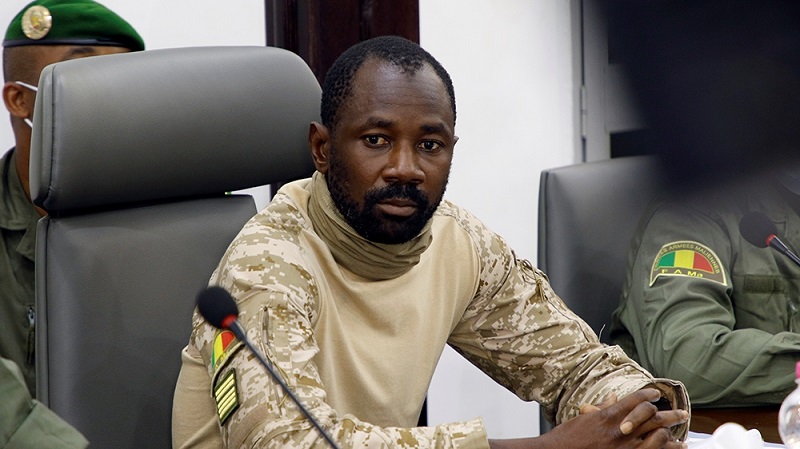
Led by Colonel Assimi Goïta, the Soldiers who pride themselves as the National Committee for the Salvation of the People, through the group’s spokesman, Colonel Ismaël Wagué said they had acted to prevent the country erupting further into disability.
“Our country is sinking into chaos, anarchy, and insecurity mostly due to the fault of the people who are in charge of its destiny,” he said.
However, the Economic Community of West African States (ECOWAS) condemned the coup and instituted sanctions against Mali, including suspending all its financial transactions and cross-border activities. Demanding a civilian‑led transition, ECOWAS – comprised of 15 member nations – sent a high-level delegation led by Nigeria’s former president, Goodluck Jonathan to Bamako to press its demands for the “immediate return to constitutional order.”
Transitional government
After series of negotiations between the ECOWAS delegates and Mali’s military junta, the military junta agreed to an 18-month transitional government, which eventually led to the appointment of interim president Bah Ndaw and prime minister Moctar Ouane on October 5th, 2020, while Goïta was appointed vice president.
Three days of meetings with political and civil society leaders also resulted in a transition charter that included a vice president and a transitional council that operated as the National Assembly.
The president and vice president were chosen by a panel of nominated persons with the aim that these interim leaders would pave the way to elections and proper transition into civilian rule. Thus, Goïta, vice president (and the coup leader) requested that the ECOWAS economic sanctions be lifted, citing the appointment of an interim president.
ECOWAS relaxed sanctions on Mali on October 6, 2020, in order to help the transition to civilian administration, and the African Union also lifted Mali’s suspension on October 9, 2020, noting “significant advances” towards a return to democracy in the country.
Distrust among leaders
From the start of the transition government, many analysts believe the transitional administration tried to follow in Ibrahim Boubacar Keïta’s footsteps in terms of clan-based management. There were criticisms from several political parties and civil society organizations that the army wields excessive influence on the government. This might also influence the distrust from some quarters towards the army since the start of the transition government, as some believe it is to blame for the country’s current state.
Besides, before the transitional government announced that the presidential and legislative elections would take place in February 2022, six people were being investigated for plotting against the government, including Boubou Cissé, the prime minister before the August 2020 coup.
On May 14, 2021, Moctar Ouane resigned as Prime Minister, just days after the M5-RFP (Rally for Patriotic Forces) opposition movement sought the resignation of the transitional government, citing growing public dissatisfaction with the military’s prominent involvement and the slow pace of reforms. But in the face of mounting criticism, Ouane was reappointed to carry out a reshuffle as the country’s interim administration prepares to form a new cabinet.
Second coup in a year
On May 24, 2021, the cabinet reshuffle was announced. The military in the new cabinet preserves the crucial posts it held during the previous administration, but two coup leaders were replaced: ex-Defense Minister Sadio Camara and ex-security Minister Colonel Modibo Kone. However, soldiers detained both Ndaw and Ouane hours later.
Detaining the president and prime minister further explains who is in control of the interim government. Colonel Goïta claimed he was not “consulted” about the cabinet reorganization, and that he should have been named vice-president. It was also reported that M5 RFP, the opposition group that organized the 2020 protests was also enraged that it was not given any ministerial seats.
In a statement aired on public television on May 25, Goïta said Ndaw and Ouane have been relieved of their roles for attempting to “sabotage” the transition, which would “proceed as normal, and the scheduled elections will be held in 2022.”
The detained leaders were released after resigning from their positions.
According to Jean-Herve Jezequel from the Crisis Group, “the new crisis highlights the absence of a strong coalition supporting the actions of the transition, notably its declared ambition to reform the Malian political system,” he added. “This aspect is perhaps the most worrying: after having undergone all these crises, Mali still does not know which political forces are capable of bringing about the change that the country needs.”
Two days after seizing power in his second coup in nine months, Colonel Goïta declared himself interim president on May 26, 2021. The constitutional court has also confirmed his new role saying the decision was due to the “vacancy in the presidency”.