- Understanding Statehood Crisis in the Sahel
- Chad’s Fragility and the Political Transition After Idriss Déby
- The Chad’s Security Role in Sahel
- Sudan Crisis and Regional Spillover
- Climate Change and Human Security
- Economic Fragility and the Resource Curse
- Resilience or Authoritarian Adaptation?
- Regional Implications for the Sahel
- Future Scenarios for Chad
- Conclusion
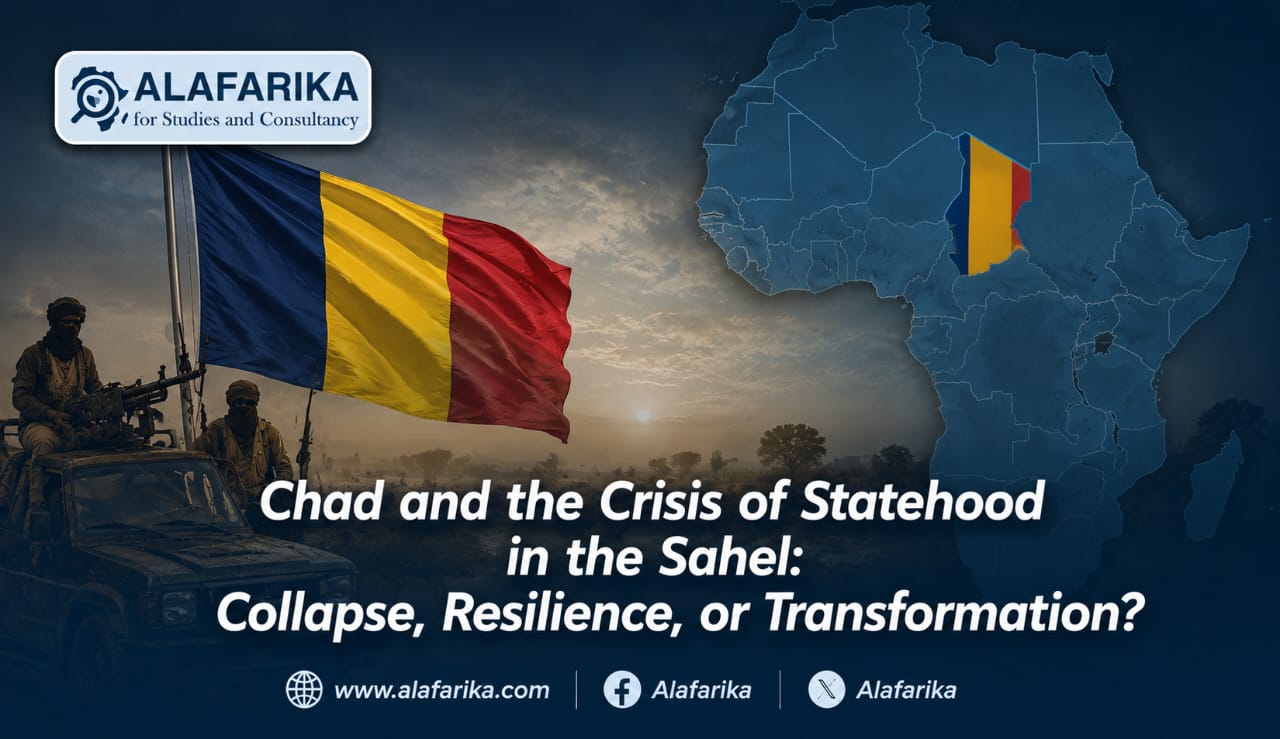
The Sahel has appeared as one of the most geopolitically unstable regions in the modern-day international system. Stretching from the Atlantic coast of West Africa to the Red Sea, the region has become identical with state fragility, insurgency, military coups, humanitarian crises, climate stress, and geopolitical competition. Within this landscape, Chad occupies a distinctively strategic and paradoxical position.
This article studies Chad’s crisis of statehood via an academic and geopolitical perspective. It contends that Chad is neither a fully collapsing state nor a united resilient one. In its place, it characterises a hybrid political establishment in which military authority, external security partnerships, ethnic balancing, and survival politics sustain the state in spite of deep structural fragility.
Understanding Statehood Crisis in the Sahel
The concept of statehood crisis denotes to the erosion of a state’s ability to sustain territorial control, make available public goods, monopolise violence, and maintain political legitimacy. This crisis in the Sahel has become all the time more evident through military coups, insurgencies, humanitarian emergencies, and weakening democratic institutions.
The G5 Sahel has been plagued by violence and conflicts for years. The last decade saw an alarming surge of violence and conflict that spilt beyond national boundaries, posing a considerable threat to other countries in the region and beyond (Center for Preventive Action, 2024). The Liptako-Gourma region in the borderlands of Burkina Faso, Mali and Niger and the Lake Chad Basin is the epicentre of the violence and conflict. Insurgency in the last decade has displaced 2.6 million people in Liptako-Gourma and 2.8 million people in the Lake Chad Basin (Center for Preventive Action, 2024).
Chad’s Fragility and the Political Transition After Idriss Déby
After the death of Idriss Déby in 2021, Chad passed in a political transition led by Mahamat Idriss Déby. Instead of constitutional succession as expected, the military established a Transitional Military Council under Mahamat Idriss Déby. Mahamat Déby later combined power through a managed political transition ending in elections and a new constitutional framework. However, opposition groups accused the administration of authoritarian consolidation. In 2025, according to the World Bank , constitutional amendments prolonged presidential terms and removed limits which further reinforce executive dominance. The transition therefore reflected not democratisation, but adaptation of authoritarian resilience.
The International IDEA Democracy Tracker notes that Chad’s recent elections were marked by accusations of fraud, political violence, and media restrictions. While political power remains highly centralised around military elites. Similarly, the advent of the Alliance of Sahel States demonstrates the reconfiguration of regional politics away from traditional Western partnerships. Even though Chad is not formally part of this alliance, it functions in the same geopolitical environment of everchanging allegiances and anti-Western sentiment. Chad’s regime survival approach can be defined as adaptive authoritarianism.
The Chad’s Security Role in Sahel
In the area of counterterrorism operations in the Lake Chad Basin, Chad played a major role and the country has contributed troops to regional missions in Mali and the broader Sahel. The country has also become a frontline state in the struggle against Boko Haram and the Islamic State West Africa Province (ISWAP). For instance, Boko Haram in the past decade and a half has killed several thousand people and displaced millions, according to the United Nations, and continues to carry out operations across parts of Nigeria, Cameroon, Chad and Niger.
Regrettably, the Boko Haram insurgency deeply redesigned regional security dynamics. A research published in SAGE Journals maintains that socioeconomic deprivation, underdevelopment, and infrastructural neglect have contributed significantly to the insurgency’s emergence in the Lake Chad Basin.
Also, some scholars have maintained that competition over resources in the Lake Chad Basin indirectly contributes to insurgency and insecurity. Research published by Cambridge University Press highlights the economic dimensions underlying Boko Haram violence and regional competition over oil and gas resources. For instance, a number of armed groups compete in the resource-rich, four-country Lake Chad region to finance their operations by imposing what they call taxes on local communities.
However, insurgent violence still lingers despite Chad’s military efficiency. In May 2026, Boko Haram militants killed 23 Chadian soldiers in an attack on a military base in the Lake Chad region. This proved that even Chad’s quite proficient armed forces are still exposed to asymmetric warfare.
Sudan Crisis and Regional Spillover
The civil war in Sudan has become one of the most destabilising external burdens on the country as hundreds of thousands of refugees have crossed into eastern Chad since 2023, thereby generating a huge humanitarian and security problems. ACAPS Chad Analysis indicates that Chad at this time hosts huge refugee populations escaping Sudan, Nigeria, Cameroon, and the Central African Republic. For instance, the Sudan war alone has displaced more than 700,000 refugees into Chad, devastating already fragile local communities.
Besides, the refugee crisis has deep geopolitical consequences due to the fact that these inflows will continue to stress existing public services, increase competition over resources, and potentially change ethnic and political stability inside Chad. Also, border regions have become increasingly militarised due to fears of cross-border violence. In 2026, Chad relocated refugees away from the Sudanese border while deploying troops after deadly cross-border attacks related to the Sudan war. Therefore, the Chadian government fears that Sudan’s crises could trigger broader regional contagion.
Climate Change and Human Security
Climate change can exacerbate the prevailing security risks imposed by terrorist and criminal networks. The demographic dividend is a window of opportunity for the G5 Sahel. However, if the livelihood opportunities offered to youth continue to be centred on climate-dependent natural resources, and if the governments fail to help them cope with the impact of climate change and provide alternative livelihoods, the grievances could be exploited by terrorist and criminal networks.
Similarly, climate migrants may have to compete with host communities over scarce resources (land, livelihoods, and public services). Tensions could also occur when climate migrants and host communities belong to different ethnicities, altering local demographics and ethnopolitical balance.
Economic Fragility and the Resource Curse
The World Bank Chad Economic Memorandum finds insecurity, overreliance on oil revenues, weak governance, and climate vulnerability as dominant hindrances to sustainable development. In spite of being an oil-producing state, Chad remains among the world’s poorest countries, reflecting the classic “resource curse” paradox in which natural wealth fails to yield sustainable development. Oil revenues have been undermined by corruption, weak governance, and heavy military expenditure rather than investment in infrastructure, healthcare, or education.
A World Bank report indicated that Oil backs about 15% of GDP, 41% of government income, and 76% of exports, therefore the economy extremely exposed to variations in global oil prices. This dependency has excavated economic fragility, fiscal instability, and social inequality while restraining diversification and long-term resilience.
Table 1: Key Economic Indicators for Chad
| Indicator | Data |
| Poverty rate (2025) | 45.4% |
| Extreme poverty population | 9.5 million |
| Oil share of exports | 76% |
| Agriculture share of GDP | ~40% |
| Informal employment | 88% |
| Military spending share of domestic revenue | 23% |
| GDP growth forecast 2025 | 3.4% |
Source: World Bank
Military spending has continued to increase despite prevalent poverty. According to the World Bank, military expenditure amplified by 11.6% in 2025, reaching 23% of domestic revenues. This mirrors a “security-first” state model in which regime existence takes priority over social welfare.
Resilience or Authoritarian Adaptation?
Chad’s strength echoes a contradiction of resilience and authoritarian adaptation. The government has sustained a relatively organised military, robust security cooperations with Western partners, and a strategic counterterrorism role in the Sahel, enhancing regime survival. Though, this stability remains profoundly modified around the Déby leadership system rather than durable institutions. Power absorption within elite ethnic structures, dependency on unpredictable oil revenues, and increasing humanitarian burdens from regional wars and climate stress remain to expose deep fragilities. Subsequently, Chad’s existence is better understood as “militarised resilience”, a system sustained over coercive dimensions and external backing rather than inclusive governance or institutional consolidation.
Regional Implications for the Sahel
Chad’s political and security path has main consequences for the wider Sahel and Central African region. A destabilized Chad could accelerate jihadist mobility across porous borders, intensify refugee flows into neighbouring states, expand illicit arms trafficking, and weaken regional counterterrorism mechanisms such as the G5 Sahel and the Multinational Joint Task Force. It could also deepen geopolitical competition among powers including Russia, France, and United States. Conversely, sustained stability could position Chad as a critical pro-Western security anchor linking North Africa, Central Africa, the Sahel, and the Horn of Africa.
Future Scenarios for Chad
Scenario 1: Gradual Stabilisation
Going forward, Chad can gradually attain more political and economic stabilisation through a mixture of transformations of institutions of governance, regional collaboration in addition to international assistance. Improved alliance with neighbouring countries in the Sahel and Lake Chad Basin may perhaps correspondingly advance border security and decrease the operational space of insurgent groups.
Scenario 2: Fragmentation and Crisis
A more possible situation is the extension of authoritarian stability below strong military domination. The riskiest scenario includes severe destabilisation triggered by consistent regional and domestic shocks. Intensifying war in Sudan, deepened jihadist violence across the Sahel, dwindling oil revenues, or divisions within the political and military elite could overpower state capacity.
Conclusion
Chad signifies one of the clearest cases of the contradictions determining modern African statehood. It is concurrently fragile and resilient, weak and strategically crucial, authoritarian and adaptive. The fundamental challenge in front of Chad is whether it can shift from a security-centred survival state to a more legitimate and developmental political order. Deprived of deeper institutional transformation, economic diversification, and social inclusion, the existing model may only delay impending crises.
In due course, Chad’s experience makes known a broader truth about the Sahel, that is statehood in the region is not vanishing but transforming. The future of the Sahel may consequently not be defined by the complete collapse of states, but by the advent of hybrid political structures where military authority, external influence, and informal governance exist in unstable equilibrium.