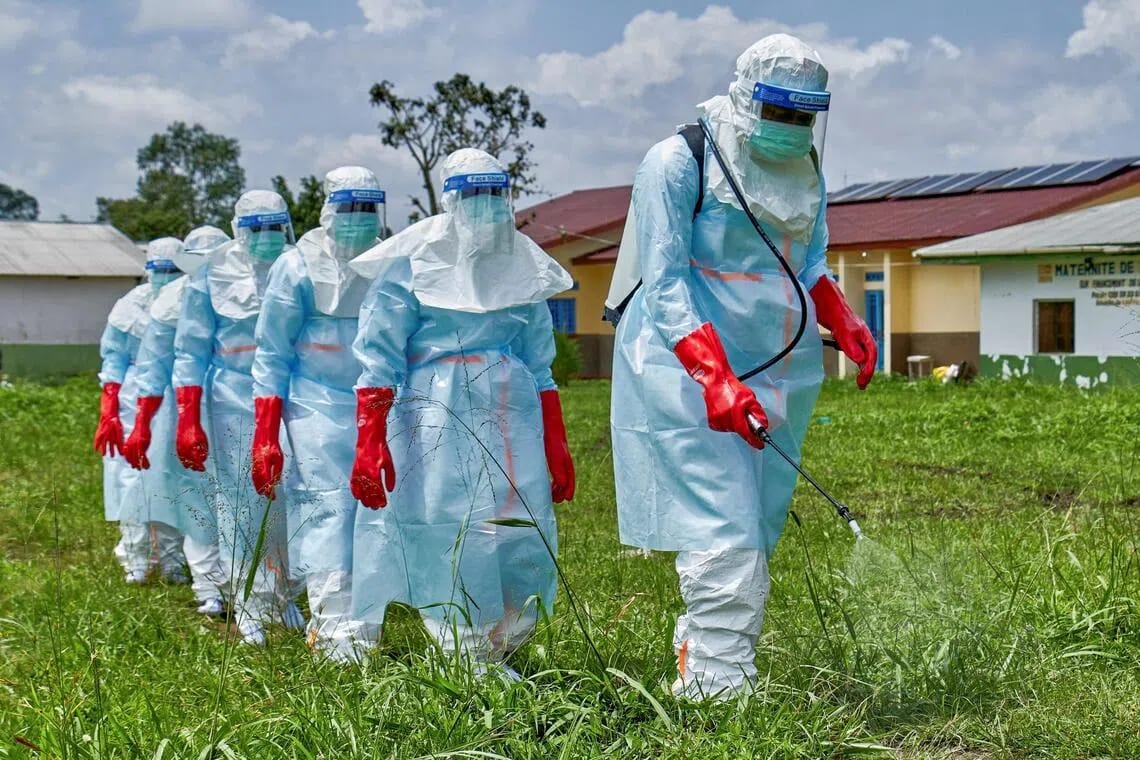
This week, the death toll from the ongoing Ebola outbreak in the eastern Democratic Republic of Congo has risen to 131 as health officials warn the virus is continuing to spread. Investigative reports indicate that flawed diagnostic testing and unsafe traditional burial practices initially allowed the virus to spread undetected for several weeks. International health organizations are rushing medical supplies and deployment teams to the impacted regions to bolster isolation centers, trace contacts, and accelerate vaccination campaigns. The escalating crisis raises severe concerns about local containment capabilities in areas plagued by conflict and displaced populations.
Sierra Leone received its first flight containing nine West African deportees, consisting of seven men and two women, at Freetown International Airport, this week, following an immigration enforcement campaign by the United States. Under a bilateral agreement, Sierra Leone has agreed to accept up to 300 expelled ECOWAS citizens per year from American custody. In return, the country will receive $1.5 million in U.S. financial support to cover operational and humanitarian costs. The deportees, originally from countries like Nigeria, Ghana, Guinea, and Senegal, are being temporarily housed in local hotels and are expected to be safely repatriated to their home nations within 90 days.
Partial results from Cape Verde’s parliamentary election show the opposition African Party for the Independence of Cape Verde (PAICV) unseating the ruling Movement for Democracy (MpD). With 98.2% of polling stations reporting, PAICV secured 46.7% of the vote, translating to 37 of the 72 parliamentary seats, while the ruling MpD trailed closely with 43.6%. Incumbent Prime Minister Ulisses Correia e Silva formally conceded defeat, paving the way for PAICV leader Francisco Carvalho to become the country’s next Prime Minister. This shift requires Carvalho to share power under Cape Verde’s unique hybrid presidential-parliamentary system, marking a peaceful democratic transition.
In Tunisia, hundreds of protesters took to the streets of central Tunis to march against President Kais Saied, decrying a wave of political arrests targeting opposition figures, journalists, and activists. Organized by opposition members and civil society groups, the demonstrators also spoke out against the country’s worsening economic conditions, noting sharp inflation, weak public services, and chronic shortages of food and medicine. Saied has largely ruled by decree since 2022, a consolidation of power that critics claim has effectively dismantled Tunisia’s post-revolution democracy. Police maintained a heavy presence during the marches, which reflected growing public frustration over Authoritarian governance.
Violence broke out on the island of Anjouan in Comoros, after a 46% hike in diesel prices and a 35% hike in gasoline prices triggered widespread anger, leaving one person dead and five others injured. Clashes between security forces and protesters erupted following a strike by the local fishermen’s association and transport workers, which paralyzed infrastructure in the capital, Moroni. In an attempt to quell the protests and ease economic tension, the government announced cuts to official state travel budgets and a 40% reduction in customs duties. Officials hope these measures will stabilize the island nation as protests continue.
Kenyan President William Ruto announced that the government will cut the price of diesel by 10 Kenyan shillings ($0.0772) for the upcoming June–July pricing cycle. The decision follows intense public anger and a two-day public transport strike over a recent 23.5% hike in retail fuel prices, which resulted in four deaths and 30 injuries during clashes. President Ruto noted that the country had secured a guaranteed fuel supply framework to mitigate Middle East conflict disruptions and stated the government has spent 28.1 billion shillings on fuel tax relief to cushion citizens from skyrocketing energy costs.
Nigeria’s National Drug Law Enforcement Agency (NDLEA) dismantled an industrial-scale transnational methamphetamine syndicate, seizing 2.4 tons of meth and chemical materials valued at $363 million. Following a 48-hour coordinated raid on a laboratory hidden in the Abidagba forest of Ogun State and associated properties in Lagos, 10 suspects were arrested. Among those detained were three Mexican “meth cooks” providing technical expertise and the alleged Nigerian mastermind, Anochili Innocent. This massive drug bust represents the single largest methamphetamine seizure in Nigerian history, striking a severe blow to international drug trafficking networks operating within West Africa.
Zambia’s state-controlled mining investment firm, ZCCM Investments Holdings (ZCCM-IH), announced the creation of a new joint venture called Kyalo Goldfields Limited (KGL) to formalize the local gold sector. ZCCM-IH will hold a 51% controlling stake, while Mining Mineral Resources Sprl (MMR) will own the remaining 49%. Operating in the Kikonge area of the North-Western Province—the site of a chaotic gold rush last year—KGL’s main objective is to establish safer, regulated, and mechanized gold production. The partnership plans to expand processing capabilities while ensuring local communities benefit from the region’s vast natural resource wealth.
A London court has intervened to block oil prepayment contracts involving South Sudan due to outstanding debt obligations. The legal halt temporarily restricts the government’s ability to secure immediate cash advances through forward-selling its crude oil production. The ruling introduces severe financial pressure on South Sudan, which heavily relies on oil revenues to sustain its national budget and fund public infrastructure. International creditors are seeking greater transparency and a formal debt settlement before any further crude agreements are approved. This legal bottleneck threatens to worsen the economic instability currently plaguing the East African nation.
This week, the global second-in-command of ISIS, Abu-Bilal al-Minuki, also known as Abubakar Mainok, was eliminated in a precise military operation. The high-stakes strike targeted al-Minuki and several of his top lieutenants at a fortified compound located in the Lake Chad Basin of Northwest Nigeria. The complex operation was executed via a close intelligence partnership between American forces and the Armed Forces of Nigeria. Both President Trump and Nigerian President Bola Tinubu confirmed the mission’s success, hailing it as a massive blow to the extremist group’s operational capabilities and regional dominance.