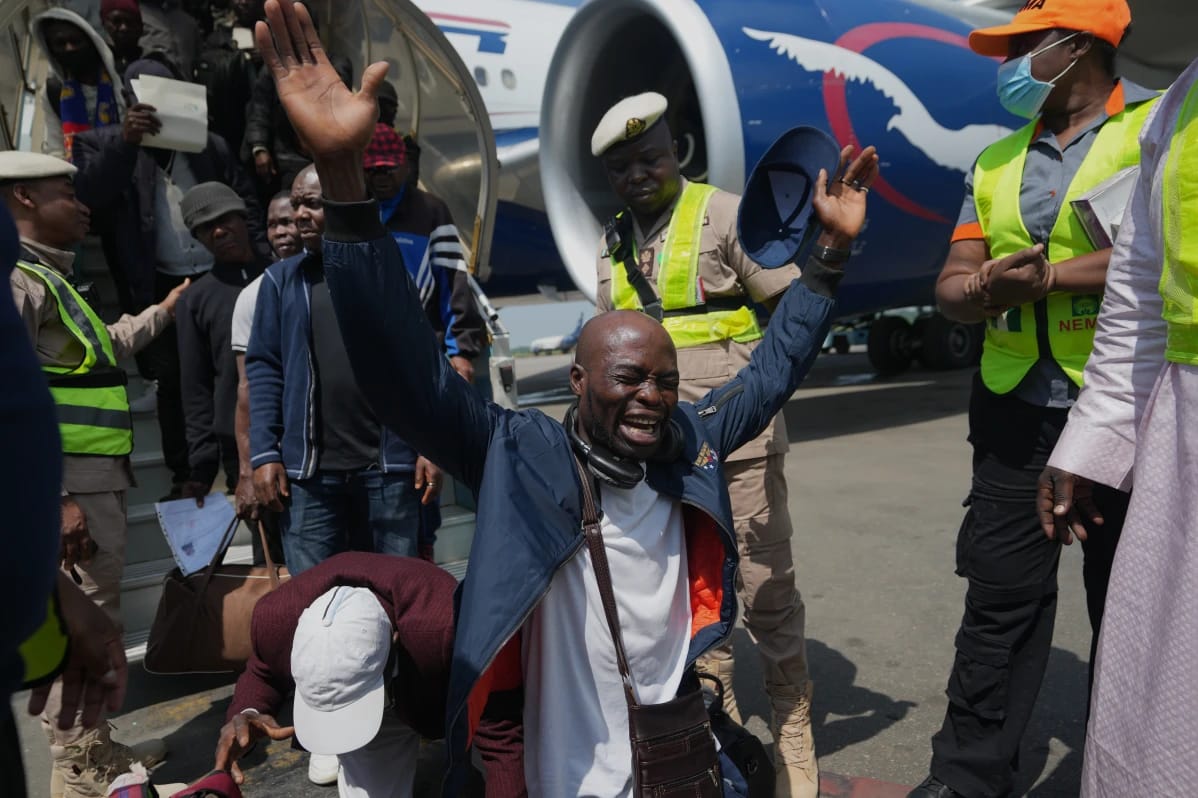
Nigerian authorities have successfully evacuated the first group of its citizens from South Africa and brought them back to their homeland on Thursday as part of the repatriation plan ordered by the government following violent anti-immigration protests. A total of 262 passengers and three officials were on board the flight to Lagos, according to Nigeria’s Ministry of Foreign Affairs. The ministry earlier said over 1,000 Nigerians have registered for voluntary return. Nigeria is the latest African nation to organize such evacuation flights from South Africa. Since April, a series of anti-immigration protests has led to attacks against some foreigners. Ghana, Mozambique, and Malawi have carried out similar evacuations.
The International Monetary Fund has approved a new $250 million extended credit facility for Rwanda, a 38-month program aimed at helping the country sustain growth and protect social and development spending amid tougher economic conditions. While Rwanda’s economy grew 9.4% in 2025, the IMF warned that risks from the Middle East war could weigh on growth, inflation, external balance, and debt, with high oil and fertilizer prices cutting 2026 growth to below 6.8%. The Fund urged Kigali to boost revenue and improve investment management.
Egypt has settled all outstanding arrears owed to its oil and gas investment partners, reducing the balance to zero for the first time in years after the debt had reached nearly $6.1 billion in June 2024. Petroleum Minister Karim Badawi called the repayment a turning point that would help unlock new exploration, drilling, and field development, including capital-intensive Mediterranean deepwater projects. The achievement came through coordinated efforts involving the presidency, cabinet, and Central Bank of Egypt.
Zambia’s government said it had received near-unanimous backing from bondholders for an innovative $1.36 billion debt buyback deal that commits the government to upgrading its power network, with holders of 97.85% of a 2053 bond’s principal having tendered their notes. Using a $600 million African Development Bank loan plus domestic resources, Zambia will spend up to $275 million over 15 years modernising its grid, in what it calls the world’s first “debt-for-development swap” for the energy sector. Nearly half of Zambia’s 22 million citizens still lack electricity access.
Zimbabwe’s state-owned Mutapa Gold Resources plans to double its annual output to 220,000 ounces by 2029 after securing funding for an expansion project, having produced 104,626 ounces in the year to March 31 — a 10% decline due to lower grades. The company secured $75 million from local banks for its Shamva Hill project, which will raise that mine’s output to nearly 80,000 ounces annually from 24,000. Gold export sales hit $1.19 billion in Q1 2026, more than double the same period last year.
The spread of the Ebola virus extended to new areas of northeastern DR Congo this week, including a crowded displacement camp, raising fears the nearly month-long outbreak is entering a more dangerous and larger-scale phase, with cases identified in new health zones almost daily. DRC health authorities have now reported 676 cases and 136 deaths from the rare Bundibugyo Ebola strain, with infections spanning 34 health zones across a 1,000km stretch from Ituri to South Kivu.
Somaliland pushed back against diplomatic pressure from both China and Somalia, asserting its right to “choose its own relationships” as it formally opened a new representative office in Taipei. Speaking at the opening ceremony, Somaliland’s top envoy to Taiwan said efforts by Beijing and Mogadishu to sever the territory’s ties with Taipei had failed, describing the island as a “very important ally.” The two sides—both of which face widespread diplomatic isolation—first established reciprocal representative offices in 2020, and officials say cooperation has expanded steadily since. Somalia swiftly condemned the new office as an “unauthorized” diplomatic move, reiterating that Somaliland remains an inalienable part of its territory. The episode follows a landmark shift in December, when Israel became the first nation to formally recognise Somaliland as an independent, sovereign state — a move Somalia branded a “deliberate attack” on its sovereignty, while China rejected it outright and Taiwan welcomed it.
Niger officially launched a new power plant in a bid to ease the persistent electricity cuts that have plagued the capital, Niamey, since the July 2023 coup. The Niger-Algeria solidarity power plant was inaugurated by Nigerien Prime Minister Ali Mahamane Lamine Zeine alongside his Algerian counterpart Sifi Ghrieb, addressing Niamey’s estimated 200MW demand. Remarkably, the facility was fully financed and built by Algeria in just 70 days, with equipment delivered via an air cargo bridge. Niger is also pursuing longer-term plans for a 2,000MW nuclear plant and a 200MW coal station, as it aims to become a regional energy hub.
Legal Action Worldwide and the African Centre for Justice and Peace Studies filed a landmark criminal complaint with Kenya’s Director of Public Prosecutions in Nairobi on behalf of twelve Sudanese victims. This marked the first time in Kenya’s history that a war crimes complaint has been filed under universal jurisdiction. The victims are asking Kenya to investigate 10 RSF members, some with alleged ties to Kenya, for torture, rape, and sexual slavery committed in and around Khartoum between April 2023 and March 2025.