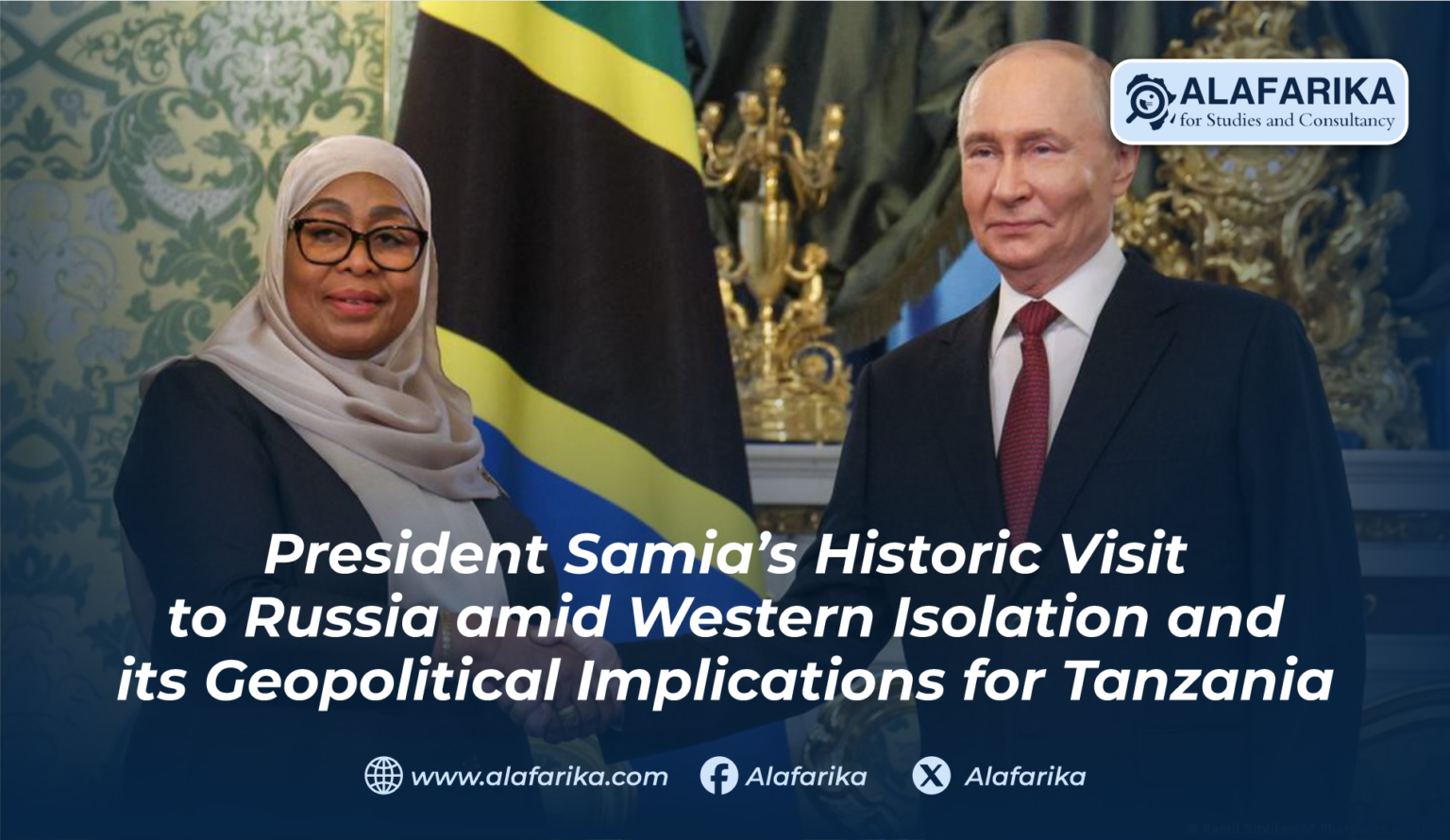
Tanzanian President Samia Suluhu Hassan, during the first week of June 2026, embarked on a historic three-day state visit to Russia at the invitation of President Vladimir Putin. The trip marked her first major official trip abroad since her deeply controversial victory in the October 2025 elections. The visit, which ran from June 3 to 5, took her first to the Kremlin for face-to-face talks with President Vladimir Putin and then to St. Petersburg, where she addressed the 29th St. Petersburg International Economic Forum (SPIEF 2026), which happens to be one of the leading global investment events in Russia.
On the surface, it looked like routine diplomacy; two leaders are meeting, agreements are being signed, and trade figures are being exchanged across a conference table. But very little about this visit was routine. It was only the second time in history that a Tanzanian president had made the journey to Moscow—the first being Mwalimu Julius Nyerere back in October 1969. And it came at a moment when Tanzania’s relationship with its traditional Western partners was under severe strain, making the choice of Russia as her first destination abroad a statement in itself.
This analysis unravels what actually happened in Moscow and St. Petersburg—why did Tanzania choose this exact moment to look up to Moscow? What did the delegation actually achieve, and what are the long-term consequences for Tanzania’s relationship with the West?
Historical Background of Tanzania-Russia Bilateral Relations
President Hassan’s arrival in Moscow marks a massive shift in East African geopolitics, but the roots of this relationship run deep. Russia and Tanzania have a longer shared history, which dates back over six decades. The Soviet Union was among the very first countries to recognize Tanzania after independence, and during the Cold War, Dar es Salaam became a critical transit hub for Soviet-backed liberation movements across Southern Africa. That relationship was built on more than ideology — it was practical, material, and personal for a generation of African leaders who saw Moscow as a genuine counterweight to Western colonial power.
When the Soviet Union collapsed, those ties quietly faded as Tanzania integrated itself into Western trade, financial aid networks, and global banking systems. Now, those old bonds are being dusted off. Hassan’s visit marks only the second time a Tanzanian president has made an official state visit to Moscow. The trip carried heavy symbolic weight because it occurred on the 65th anniversary of their diplomatic ties, as mentioned by Russian president Putin.
President Hassan made a point of acknowledging that history during her bilateral talks. She expressed gratitude for Moscow’s role in African decolonization and took the time to lay a wreath at a Russian war veterans’ cemetery, marking the 81st anniversary of Victory Day. These were deliberate gestures that signal that Tanzania sees this relationship as rooted in something real, not simply formulated out of present-day convenience.
Why the Timing of the Visit Matters
In diplomacy, timing is never accidental. As regards this visit, its timing cannot be separated from the rising political crisis that faces President Hassan’s administration and the escalating diplomatic pressure from the West. Following the disputed October 29, 2025, general election—in which President Hassan was declared the winner with a landslide 97% to 98% of the vote—Tanzania’s political landscape witnessed an immediate fallout. The crisis continued to escalate with civil unrest and protests led by opposition parties.
In response, security authorities under President Hasan’s administration cracked down on protesters with lethal force. Prior to the election, the internet was made unaccessible, social media platforms were blocked, and prominent opposition figures were barred from the election process entirely. The post-election protests resulted in the death of more than 1,000 citizens, according to human rights organizations and Western diplomatic missions.
Earlier in May 2025, two East African activists—Kenyan Boniface Mwangi and Ugandan Agather Atuhaire—who had traveled to Dar es Salaam to observe opposition leader Tundu Lissu’s trial, were detained by Tanzanian security forces, tortured, and then dumped near the border. Also, Martha Karua and Willy Mutunga, both prominent international observers, were detained and deported at Julius Nyerere International Airport.
This domestic political crisis resulted in direct international confrontation in 2026. The United States State Department officially barred Tanzania’s Senior Assistant Commissioner of Police, Faustine Jackson Mafwele, from entering the United States, on May 21, 2026. This was followed in June 2026 by a bipartisan bill proposed by U.S. Senators Jeanne Shaheen and Ted Cruz, which directs the executive branch to undertake a dramatic overhaul of the U.S.-Tanzania relationship. The bill mandates a 90-day review of all security assistance, authorizes asset freezes and visa bans on officials, and halts all funding from U.S. development institutions until political prisoners are freed and electoral reforms are made.
On the other hand, Russia’s president, Putin, had been one of the first world leaders to personally congratulate Hassan on her election victory. He also sent a senior delegation as international observers in the election. By the time she arrived in Moscow in June 2026, the signal was already clear — but the visit made it official. Russia was offering something the West was withdrawing: recognition, legitimacy, and a seat at the table with no conditions attached. Therefore, the Moscow state visit served as a timely diplomatic weapon for the Tanzanian government to demonstrate to the international community that Tanzania is not isolated.
Strategic Objectives of the Visit for Russia and Tanzania
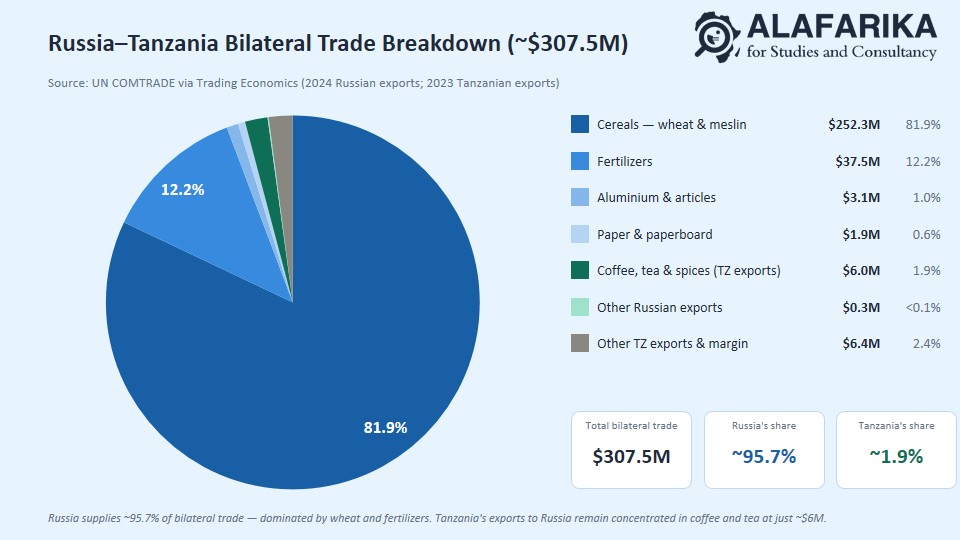
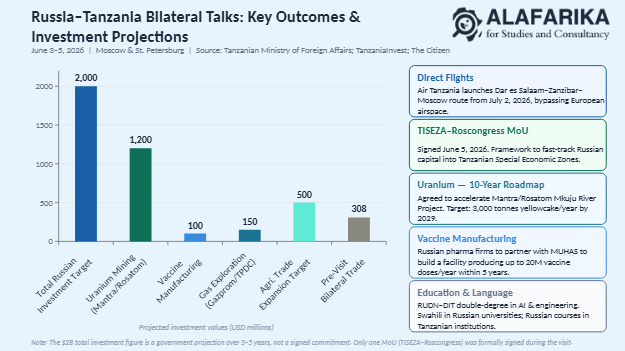
For Tanzania, the core objective of the visit was to diversify the country’s economic partnerships and reduce the leverage that Western donors hold over government policy. Before the visit, annual bilateral trade between both countries stood at roughly $307.5 million. Tanzania’s Director of Economic Diplomacy at the Ministry of Foreign Affairs, John Robert Ulanga, confirmed that the government’s target, through the visit, is to attract over $2 billion (approximately Sh5.2 trillion) in Russian investments and commercial transactions over the next three to five years.
To achieve this, President Hassan brought a large business delegation to St Petersburg, where a Tanzania-Russia Business and Investment Forum ran alongside SPIEF 2026. This commercial engagement is notably designed to put Tanzanian sectors in front of Russian investors and signal that the country is open for business from the East, regardless of what was happening with the West.
Russia’s interests were equally evident, and its officials made little effort to hide them. Presidential advisor Maxim Oreshkin described the deepening of ties with Tanzania in notably clear terms — calling it part of Russia’s “aggressive attacking game” to challenge Western influence in fast-growing developing economies. The appeal of the Tanzanian partnership, from Moscow’s perspective, is straightforward, involving access to strategic mineral resources, a foothold in East Africa’s Indian Ocean coastline, a friendly vote in multilateral forums, and a working example — for other African governments watching — that Russia can be a viable alternative to the West.
Bilateral Negotiations and Outcomes
The visit produced a set of concrete agreements across several strategic sectors, with some of them being more immediately actionable than others. On trade, Russia committed to scaling up exports of fertilisers, agricultural machinery, high-yield seeds, and veterinary medicines to Tanzania, while increasing direct imports of Tanzanian coffee, tobacco, avocados, tea, and nuts. Trade between the two countries had already grown by roughly 25% in 2025 alone, and both sides want to sustain that momentum. Financial authorities from both countries further discussed moving bilateral trade settlements into national currencies – roubles and shillings – a deliberate step to reduce exposure to Western currency systems.
On connectivity, Air Tanzania announced it will launch direct commercial flights linking Dar es Salaam and Zanzibar to Moscow from July 2, 2026 — a practically significant development, given that the route bypasses European airspace, which has become increasingly complicated for Russian travellers since 2022. Russia has already emerged as a growing tourism market for Zanzibar, and a direct route removes restrictions for Russian tourists and investors.
On investment facilitation, the Tanzania Investment and Special Economic Zones Authority (TISEZA) signed a Memorandum of Understanding with Russia’s Roscongress Foundation – a framework designed to simplify entry for Russian capital into Tanzanian special economic zones, reduce bureaucratic processes, and promote Tanzanian industrial areas to Russian manufacturers.
On energy and mining, both governments agreed to a ten-year roadmap to accelerate the long-delayed Mantra uranium mining project. Tanzania is one of Africa’s top five uranium producers, and Russian technical expertise in nuclear extraction is genuinely relevant here. Russian energy giant Gazprom also expressed interest in partnering with the Tanzania Petroleum Development Corporation on gas exploration in southern Tanzania, given that nearly 60 per cent of Tanzania’s electricity grid runs on natural gas.
On health, Russian pharmaceutical companies pledged to collaborate with Muhimbili University of Health and Allied Sciences to construct a domestic vaccine production plant within five years that could produce up to 20 million doses per year. If successful, this endeavor might greatly improve Tanzania’s health security and establish the nation as an East African Community provider of pharmaceuticals.
On education, the Peoples’ Friendship University of Russia and the Dar es Salaam Institute of Technology signed an agreement on a joint double-degree programme in engineering and computer science, focusing on artificial intelligence and data science. An agreement on language cooperation was also signed, establishing Swahili programmes in Russian universities and Russian language courses in Tanzanian institutions.
How the Tanzanian Government Tackled Criticism
The Tanzanian government was well aware that the Moscow trip would invite criticism at home and abroad, and it moved quickly to frame its position. The Minister of State for Planning and Investment Professor Kitila Mkumbo pushed back on the suggestion that engaging Russia was somehow incompatible with maintaining Western relationships. He pointed out that no major Western country has actually severed diplomatic ties with Moscow, as many governments that enforce active sanctions against Russia still maintain active channels of communication and cooperation with it. He argued that Tanzania was doing nothing that Western governments themselves had not done.
Foreign Affairs Minister Mahmoud Thabit Kombo made the same point from a different angle – that engaging Moscow is not a rejection of the West but a recognition that Tanzania needs to operate in a multipolar world where no single partner should have monopoly access to Tanzania’s foreign policy. Thus, President Hassan’s visit can be seen as a calculated effort to position Tanzania as an independent, self-assured nation capable of maintaining active relations with both Russia and the West, rather than being perceived as a wrong geopolitical step taken.
Implications for Tanzania’s Relationship with the West
The immediate pressure points are already visible. If the U.S. Senate bill introduced in June 2026, – which mandates a structural review of the entire U.S.-Tanzania relationship – gets passed, Tanzania faces the real prospect of losing American development financing at precisely the moment it is betting on Russian investment to fill the gap.
The EU, the United Kingdom, and the United States are central players in Tanzania’s development story. Western institutions currently fund significant portions of Tanzania’s health infrastructure, education programmes, and budget support frameworks. The World Bank, the IMF, and USAID also have deep operational footprints inside the country. These relationships cannot be quietly set aside while Dar es Salaam courts Moscow, and they are considerably harder to rebuild once damaged than they are to strain.
The African Union, the East African Community, and the broader community of African states are watching. Tanzania’s stand within these regional institutions might change. Some will applaud its assertion of strategic independence, while others — particularly those with closer ties to Western partners — will draw their own quiet conclusions about where Tanzania’s loyalties now sit and navigate their future relationships accordingly.
However, none of this means the Russia pivot was necessarily the wrong call. The ongoing domestic political crisis, and the international scrutiny it has attracted, will continue to complicate Tanzania’s relationships with Western partners, all of whom remain significant development partners. Pivoting towards Russia does not make those relationships disappear — it just makes them harder to manage should the Russian partnership fail to deliver what was promised in St Petersburg.
Conclusion
President Samia Suluhu Hassan’s visit to Russia was many things at once – a diplomatic lifeline during a period of Western isolation, an economic overture towards a new pool of investment, and a pointed assertion of Tanzania’s right to set its own foreign policy course. By choosing Moscow as the destination for her first overseas trip since the election, she sent a message that was impossible to misread: Tanzania will not be cornered.
Whether the strategy pays off depends on whether the agreements made in St Petersburg and Moscow can survive the long journey from announcement to implementation. The visit has opened doors. Whether Tanzania has the institutional capacity, the political will, and the good fortune to walk through them is a different question — and one that will take years, not months, to answer.