Throughout most of the post-Cold War era, Africa occupied the margins of American grand strategy. Time and again, successive administrations have recognized the continent’s humanitarian needs and episodic security challenges, yet Africa has rarely been framed as a region capable of shaping the global order. Yet across the last twenty-five years of National Security Strategies, Africa’s place has evolved in ways that reveal not only shifting US priorities but also profound structural changes within Africa itself. Population growth, new political alignments, renewed interest in intercontinental trade, and expanding economic footprints gradually but unmistakably placed Africa on Washington’s strategic radar. Some say it was too little too late, but few argued that it was an unworthy effort.
Terrorism in Africa poses the greatest uncertainty. Al Qaeda affiliates al Shabaab and Jama’at Nusrat al-Islam wal-Muslimin (JNIM) are threatening the survival of governments in Somalia and Mali, respectively, and al Shabaab remains the only African group known to have plotted a mass-casualty attack against the U.S. home land. Meanwhile, the Islamic State West Africa Province is probably the largest and most capable Islamic State province worldwide. In the United State, Counter-Terrorism (CT) is a core part the national security mission, and its primary objective is to protect Americans from being harmed by terrorist groups and to deter and undermine the support they receive from enemy actors (Whitehouse, 2026).
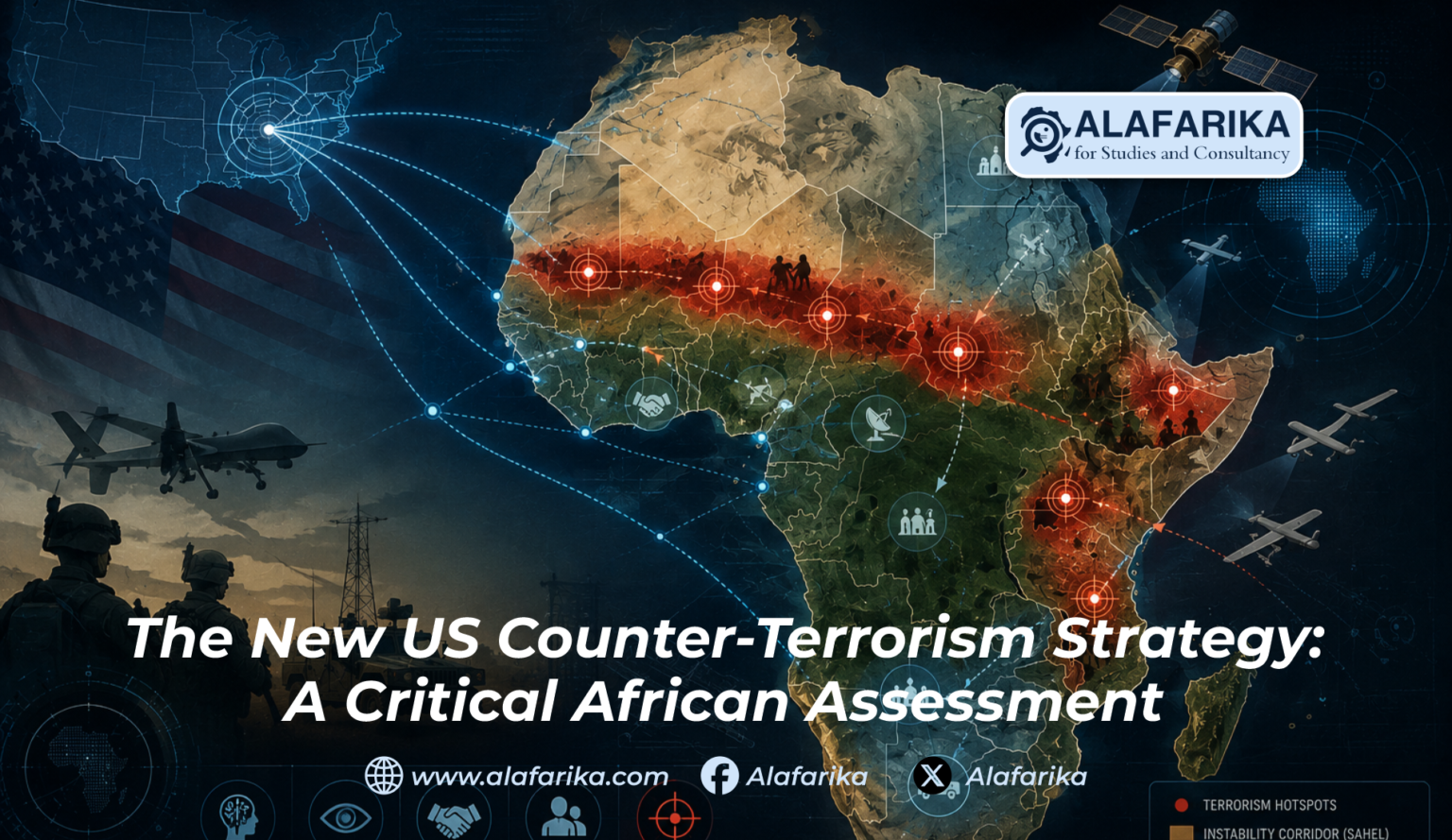
While the 2026 US Counterterrorism Strategy accurately identifies resurgent terrorists threats across Africa, with particular focus on the Sahel region. Also, the Lake Chad Basin continues to face overlapping crises: millions remain displaced, schools are closed, and humanitarian aid is insufficient. Armed groups exploit geographic and administrative gaps to expand operations, while regional security cooperation struggles to keep pace with their adaptability. However, for Africa, the policy has generated considerable debate. While Washington claims that it remains committed to preventing terrorist safe havens across the continent.
What Is New in the 2026 U.S. Counterterrorism Strategy?
The first National Security Strategy (NSS), written during the 1987 administration of President Ronald Reagan, couched Africa’s importance primarily as a vessel for competition with the Soviet Union. However, as the Cold War ended, US policymakers’ approaches toward Africa shifted, focusing on the massive challenges presented by the continent—ethnic conflict, corrupt government, and poverty—which led several documents to decry a growing sense of “Afro-pessimism” among American policymakers. This condition could invariably be addressed with “synergy.” Such buzzwords failed to capture and unpack the complex nature of politics across a continent 14 times larger than Greenland.
In the interim, the US 2026 Counterterrorism Strategy represents a significant development in American security policy, reflecting both lessons learned from past interventions and the current and rapidly shifting geography of global extremist threats. A major theme throughout the strategy is the administration’s focus on narco-trafficking organizations operating in the Western Hemisphere. The document identifies “narco-terrorists and transnational gangs” as one of the nation’s three primary terrorism threats, alongside “legacy Islamist terrorists” and “violent left-wing extremists, including anarchists and anti-fascists.”
The United States has destroyed dozens of boats as part of what Washington has called a counter-narcotics campaign linked to an operation that included the ouster of Venezuelan leader Nicolas Maduro this year.
The strategy highlights the designation of cartels and gangs as Foreign Terrorist Organizations (FTOs) and states that the administration intends to continue military, intelligence, financial, cyber, and law enforcement operations targeting those groups. The document claims that Department of War strikes against cartel-linked maritime drug trafficking operations contributed to a sharp decline in maritime smuggling activity into the United States.
The strategy additionally addresses weapons of mass destruction, calling prevention of terrorist acquisition of nuclear, biological, radiological, or chemical weapons a “no-fail mission.” The document also describes fentanyl and precursor chemicals as a WMD-level threat because of overdose deaths in the United States. The White House says the strategy is intended to reshape U.S. counterterrorism policy heading into the 25th anniversary of the Sept. 11 attacks, emphasizing national sovereignty, border security, and targeted operations against groups viewed as threats to Americans at home and abroad.
Perhaps the most controversial aspect of the strategy is its redefinition of the threat landscape. Analysts at the International Centre for Counter-Terrorism (ICCT) and the Washington Institute for Near East Policy note that the strategy raises violent left-wing extremism while neglecting racially and ethnically motivated violent extremism (REMVE), together with far-right extremism, from its principal threat categories. Concurrently, substantial counterterrorism attention is redirected toward Western Hemisphere cartels and transnational criminal organisations. Critics argue that this signifies a politicization of counterterrorism significances and a diversion of resources away from old jihadist threats.
How the Strategy Relates to Africa
Sub-Saharan Africa, especially the Sahel, has become the global epicenter of terrorism. The Global Terrorism Index reports that the region accounted for over half of all terrorism-related deaths worldwide in recent years. Burkina Faso, Mali, Niger, and neighboring states consistently rank among the most affected countries. Groups such as Jama’at Nusrat al-Islam wal-Muslimin (JNIM, an al-Qaeda affiliate) and Islamic State Sahel Province (ISSP) have expanded operations, controlling territory, encircling key urban centres like areas near Bamako, and pushing toward coastal West African states.
According to the Whitehouse, the surviving remnants of the world’s most dangerous terrorist group of the modern age were forced to relocate to Africa and Central Asia, in turn exploiting the ungoverned spaces there, especially during the years of failed counterterrorism policies under President Biden. As a result, today there are parts of Africa where a resurgent terror threat is the reality. These include in West Africa, the Sahel region, the Lake Chad Basin, Mozambique, Sudan, and of course Somalia, where parts of ISIS have re-established themselves and Al Shabaab maintains its tribal-based Islamist insurgency.
It said further, ‘‘In Africa, we have two clear goals that depart from the nation-building and interventionist policies of the past. The first is to guarantee that none of the terrorist groups can build a base of operations that allows them to plot and execute attacks against the United States and American interests around the world. The second is to protect Christians, who have been slaughtered at the hands of these terrorist groups.’’
Many are also capitalizing on the proliferation of unmanned aerial systems and artificial intelligence to enhance their deadly effectiveness. “These new capabilities unlock new forms of operation, facilitation, and inspiration for international terrorists, requiring novel responses from states, which may also take advantage of emerging technologies,” the report said. “Given the increasing pace of technological change, the future of how terrorists and counter-terrorists will act against each other is increasingly unclear.”
1. Intelligence Over Development Assistance
ISWAP has recently intensified attacks along the Nigeria-Cameroon border, targeting military outposts and humanitarian convoys. These operations are seen as part of a deliberate effort to consolidate territory and demonstrate the group’s continued relevance despite ongoing pressure, including after Trump accused Nigeria of not doing enough to protect Christians in the country’s north from attacks. The Nigerian government has rejected the claim, insisting that Muslims are also being targeted by armed groups. In recent months, dozens of US troops have been deployed to Nigeria to help in the fight against armed groups by providing intelligence sharing and technical support.
The strategy places a greater importance on intelligence cooperation than on development-oriented security assistance. Support is expected to flow primarily through intelligence agencies, special operations partnerships, and technical assistance programmes rather than large-scale governance and development initiatives. Countries such as Nigeria remain significant security partners because of their role in combating insurgent groups effective across the Lake Chad Basin. Nevertheless, the prospect is that African governments will increasingly bear the operational burden of counterterrorism while the United States make available intelligence, surveillance, reconnaissance, and selective strike capabilities.
2. Transactional Security Engagement
A comprehensive feature of the strategy is its transactional approach to foreign policy. Unlike earlier U.S. administrations that related security assistance to governance reforms, democratization, and civil society development, the 2026 framework focus more on immediate security outcomes. While the protection of vulnerable religious communities which includes what it called the persecuted Christian populations in parts of Nigeria, is highlighted more prominently than broader democracy promotion initiatives. This mirrors a change from liberal internationalist assumptions to a more selective and interest-based engagement model.
African Critiques of the Strategy
Despite some of the strategy’s strengths, it also sparks a number of controversies. Critics point to its markedly ideological language, the strong politicization of security policy, and the overly broad application of the concept of terrorism to very different types of threats. At the same time, the document devotes less attention to preventing radicalization, social factors, or the long-term stabilization of crisis regions. Overall, the strategy represents a significant shift in how the United States defines security threats, links the fight against terrorism with organized crime, and utilizes military, intelligence, and technological tools within the framework of global security policy.
Many of the factors driving armed attacks in the Lake Chad Basin are unlikely to be solved by military operations alone. The conditions that give ISWAP and Boko Haram their recruitment base, logistical support, and social legitimacy in some communities can be traced to decades of poverty, displacement, governance gaps, and political exclusion. Data from the UN Office for the Coordination of Humanitarian Affairs (OCHA) shows the region hosts 2.9 million internally displaced people, including 2.3 million in Nigeria. Violence has forced the closure of 1,827 schools across the Lake Chad Basin, while humanitarian actors received just 19 percent of the funding required for 2025.
“ISWAP and Boko Haram’s recent resurgence reflects not simply a military setback, but a deepening governance vacuum across the Lake Chad Basin,” Abiola Sadiq, a security consultant, told Al Jazeera. “While the reported killing of ISIL leader Abu-Bilal al-Minuki may temporarily disrupt command structures, it is also likely to trigger retaliatory violence as rival terrorist factions compete for relevance, legitimacy, and territorial influence,” said Sadiq.
In the weeks following the strike, intelligence reports recorded a surge in small-scale attacks and cross-border raids, indicating that operational fragmentation has not diminished the groups’ capacity to coordinate assaults. Civilians continue to face restricted movement and elevated risks of recruitment, extortion, and displacement. “With Nigeria’s 2027 general elections approaching, these groups are highly likely to intensify their operations, potentially extending attacks beyond their traditional strongholds in the Lake Chad Basin and northeastern Nigeria,” said Sadiq.
From this viewpoint, the strategy focuses more on targeted strikes and intelligence operations address symptoms rather than causes. While such approaches may eliminate individual leaders, they do little to address the structural circumstances that allow extremist movements to reinforce. In conclusion, the dominant question is whether this new approach signifies a sustainable adaptation to modern security realities or a form of strategic cutback that risks generating new vulnerabilities.