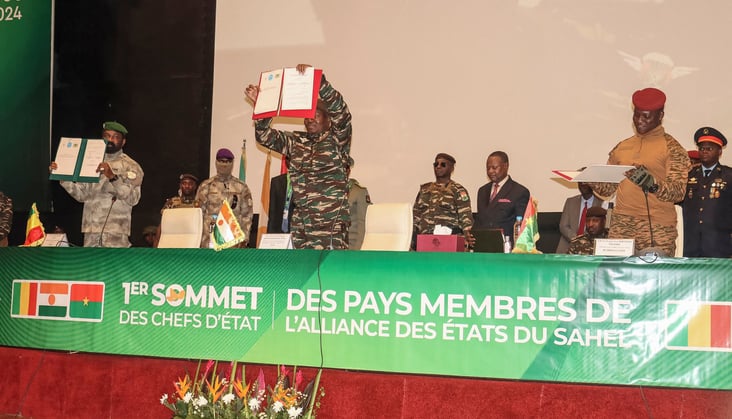
Burkina Faso, Mali, and Niger this week formed the “Confederation of Sahel States” (AES), as their military leaders signed a treaty during a summit in Niamey. The confederation aims for greater integration among its 72 million citizens, following the countries’ exit from the Economic Community of West African States (ECOWAS), which they accuse of being manipulated by France. Relations with ECOWAS soured after a 2023 coup in Niger led to sanctions and threats of intervention, though sanctions were lifted in February. The AES countries, having severed ties with France and seeking cooperation with Russia, have also created a joint military force and discussed collaboration in strategic sectors such as agriculture, water, energy, and transport. Indigenous languages will also receive greater prominence in local media.
ECOWAS expressed disappointment over the lack of progress in reconciling with junta-led Burkina Faso, Mali, and Niger, and announced plans for more vigorous reconciliation efforts. At the summit in Abuja on Monday, ECOWAS commission president Oumar Touray warned of the region’s risk of disintegration and worsening insecurity following the formation of the Alliance of Sahel States (AES) by the three breakaway nations. The AES has severed ties with ECOWAS and Western powers, seeking closer relations with Russia.
Morocco is set to acquire a spy satellite from Israeli Aerospace Industries (IAI) in a $1 billion deal, Moroccan media reported on Wednesday. IAI announced it had entered a $1 billion contract to supply a system to an unnamed third party, which will be delivered over five years. According to Moroccan news sites Le Desk and Le 360, the deal involves the Ofek 13 spy satellite, replacing two satellites from Airbus and Thales. The Israeli mission in Rabat and Morocco’s foreign ministry have not commented on the matter. This follows a 2021 defense pact between Israel and Morocco, focusing on intelligence and military cooperation.
The International Monetary Fund (IMF) this week delayed the approval of an $820 million disbursement to Egypt until July 29 to finalize policy details, according to spokesperson Julie Kozack. Kozack stated that such delays are common under challenging circumstances. Egypt faces difficulties from the Israel-Gaza conflict and increased attacks on Red Sea shipping by Houthi militants, which have significantly reduced Suez Canal revenues. The board’s approval for the third review of Egypt’s $8 billion loan program, initially expected on July 10, was postponed. Kozack emphasized the importance of Egypt maintaining its economic reform efforts, which have shown progress, including reduced inflation, elimination of a foreign exchange backlog, and increased private-sector activity.
Western governments, including the U.S., have criticized a controversial security bill in South Sudan that allows detention without warrants, warning it undermines political and civil freedoms ahead of the December 22 elections. Passed by parliament on July 3, the bill threatens peace talks and raises fears of arbitrary arrests. President Salva Kiir has 30 days to decide on the bill. Nine western envoys stated the bill would significantly hinder political and civic engagement. U.S. State Department spokesperson Mathew Miller in a statement on Wednesday urged the transitional government to ensure a free environment for political expression. The bill is contentious in government-opposition talks, with the U.N. Commission on Human Rights urging amendments to prevent abuse by security agencies.
Rwanda acknowledges the UK’s intention to terminate its asylum-seeker deportation plan, originally initiated to address the UK’s irregular migration crisis, according to a statement from Rwanda’s government spokesperson on Monday. This marks Rwanda’s first official comment on the new UK Labour Party government’s plans to cancel the criticized scheme. British Prime Minister Keir Starmer declared the plan “dead and buried,” calling it a “gimmick” at a recent news conference, though future migration strategies remain unclear. The plan, which has cost the UK hundreds of millions of dollars, aimed to deter dangerous migrant journeys. Rwanda asserts it has fulfilled its financial commitments under the agreement.
A two-week humanitarian truce between the Democratic Republic of Congo’s government and M23 rebels has begun in the eastern region. Announced by the U.S. on Thursday, the truce started at midnight on July 5 and will last until July 19. This truce, supported by the Congolese and Rwandan governments, aims to facilitate the return of displaced persons and ensure humanitarian access to vulnerable populations. The conflict, ongoing since 2021, has seen the M23 rebels seize significant territory in North Kivu province, leading to mass displacement and humanitarian crises. The EU has praised the truce, expressing hope for a lasting ceasefire and political resolution. The DRC’s east has experienced conflict for 30 years, stemming from regional wars in the 1990s.
Senior representatives from Sudan’s army and the paramilitary Rapid Support Forces (RSF) on Thursday arrived in Geneva for U.N.-led discussions on protecting civilians through potential local cease-fires, but one delegation did not attend the initial session. U.N. Secretary-General’s personal envoy, Ramtane Lamamra, invited both sides for separate “proximity talks,” with plans to continue discussions on Friday. The conflict, which erupted in April 2023 between military and paramilitary leaders, has led to over 14,000 deaths, 33,000 injuries, and the displacement of 11 million people. Previous talks in Jeddah failed last year, and the U.N. hopes to advance humanitarian efforts discreetly.
Kenyan President William Ruto has dismissed nearly all of his Cabinet ministers and the attorney general, vowing to form a leaner and more efficient government following widespread protests over high taxes and poor governance. In a televised address on Thursday, Ruto stated that permanent secretaries will temporarily run the ministries and that a broad-based government will be formed after consultations. The dismissals come after three weeks of unrest, where protests led to the deaths of over 30 people and calls for Ruto’s resignation.
The World Health Organization (WHO) on Friday reported that over one million children in the Democratic Republic of Congo (DRC) are at risk of acute malnutrition due to escalating food insecurity caused by prolonged conflict. Recent violence between Congolese forces and the M23 militia has intensified the crisis, displacing more people and overwhelming water and sanitation systems, leading to disease outbreaks like cholera, measles, and mpox. The WHO describes the situation as “catastrophic,” noting that severe flooding and ongoing conflicts have further exacerbated humanitarian needs. With over 25 million affected, the DRC has the highest number of people requiring aid globally but remains underfunded. Aid delivery is hampered by military presence, bureaucratic hurdles, and roadblocks.