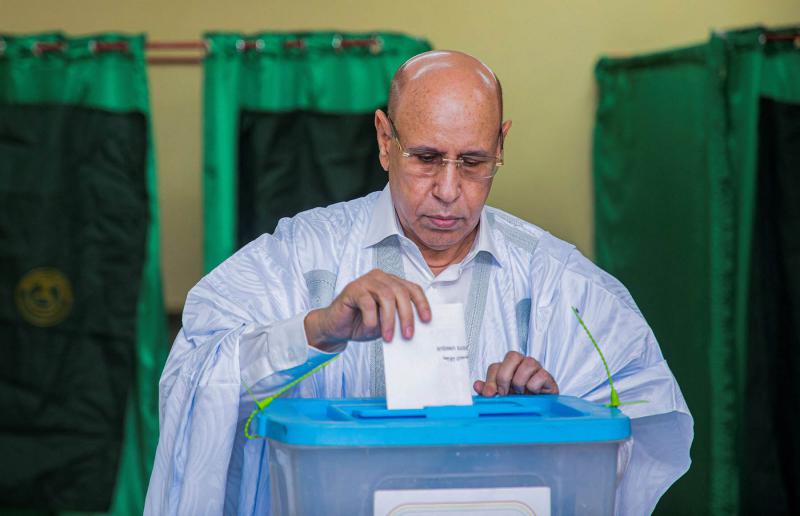
Mauritania’s President Mohamed Ould Ghazouani has been reelected for a second term, securing 56.1% of the vote, as announced by the country’s independent electoral commission. His main rival, anti-slavery activist Biram Dah Abeid, who garnered 22.1%, has rejected the results, alleging fraud and calling for civil disobedience. Voter turnout was 55% of the two million eligible voters. While the vote proceeded peacefully according to observers, opposition candidates accused the electoral commission of collusion with Ghazouani’s regime. Ghazouani, a former army chief, remains popular for his stability, despite accusations of corruption. The final results await the constitutional court’s review.
Somali Prime Minister Hamza Abdi Barre accused Ethiopia of fabricating a narrative to justify territorial claims, asserting that Ethiopia’s true aim is to establish a military base in the Red Sea rather than invest in Somali ports. Speaking at a press conference on Friday, Hamza stressed that Somalia’s stance is clear and non-negotiable, having communicated this firmly to Kenya and Turkey during mediation efforts. He criticized Ethiopia’s “false historical claims” and emphasized that any discussions must prioritize Somalia’s national interests.
The Rapid Support Forces (RSF) captured El Meiram in West Kordofan, Sudan, on Wednesday just days after taking El Fula. Videos show that the Sudanese Armed Forces (SAF) abandoned El Meiram without resistance. Despite SAF claims of repelling RSF attacks, footage from July 4 reveals RSF entering the SAF’s 92nd Infantry Brigade headquarters unopposed. Conflicting reports suggest the SAF’s withdrawal was due to an agreement mediated by community leaders or a severe shortage of supplies. The RSF now controls much of the Sudan-South Sudan border, further isolating the SAF’s 22nd Division in Babanousa and consolidating RSF presence in Darfur and the region. No civilian casualties have been reported.
Sierra Leone on Tuesday enacted a law banning child marriage, signed by President Julius Maada Bio, to protect girls in the country where about one-third are married before adulthood. The law, widely celebrated, criminalizes marrying any girl under 18, with offenders facing up to 15 years in prison, fines of around $4,000, or both. Witnesses to such marriages will also face penalties. President Bio emphasized his belief in the importance of empowering and protecting girls for the future of Sierra Leone. With 800,000 child brides in the country, half married before age 15, this law is a significant step forward.
A new report by the UN refugee and migration agencies and the Mixed Migration Centre this week reveals that migrants and refugees in Africa increasingly risk perilous journeys through the Sahara to reach Europe, facing threats like enslavement, organ removal, and kidnapping. The report highlights that African land routes are twice as deadly as Mediterranean sea routes. Conflict in Mali, Burkina Faso, and Sudan, along with economic strife and climate change impacts, are driving more people northward. Despite the dangers, political anti-immigrant sentiments in Europe persist.
An armed group attacked a wedding ceremony in Djiguibombo village, central Mali, killing at least 21 people. The assailants, who arrived on motorcycles, surrounded the attendees and killed most victims by slitting their throats, according to local residents. No group has claimed responsibility, but the attack resembles those by the al-Qaida-linked JNIM extremist group. Mali has faced escalating violence from extremist groups since 2012, with attacks on remote villages and security forces continuing despite military efforts. The 2015 peace deal with Tuareg rebels has collapsed, exacerbating the security situation following the withdrawal of foreign peacekeepers and French troops.
A militia attack on the “Camp Blanquette” gold mine in northeastern Congo’s Ituri province resulted in the deaths of six Chinese miners and two Congolese soldiers, a local civil society group reported. The assault, which occurred on Wednesday, was carried out by the Cooperative for the Development of the Congo (CODECO), who also set homes ablaze and abducted two miners whose whereabouts are unknown. CODECO, mainly comprised of ethnic Lendu farmers, is engaged in a violent conflict with the Zaire Militia, a dissident faction. This attack underscores the escalating violence in eastern Congo, where government forces and over 120 armed groups vie for control over the region’s rich resources. The United Nations has indicated that some of CODECO’s attacks may qualify as war crimes and crimes against humanity.
Egypt’s new Cabinet, led by Prime Minister Mustafa Madbouly, was sworn in on Wednesday amid economic challenges and regional conflicts. Key changes include new ministers for defense, finance, tourism, and electricity. Mohamed Maait, finance minister since 2018, was replaced by deputy Ahmed Kouchouk, a former World Bank economist instrumental in implementing IMF-backed reforms. Sherif Fathy took over as Tourism and Antiquities Minister, and Mahmoud Esmat now oversees the electricity ministry. Badr Abdelatty, an experienced diplomat, replaced Sameh Shoukry as Foreign and Migration Minister. General Abdel-Majeed Sakr succeeded General Mohamed Zaki as Defense Minister. President Abdel Fattah el-Sissi, re-elected for a third term, tasked Madbouly with forming the new government. The Cabinet, featuring four women and several technocrats, aims to address Egypt’s economic woes, including soaring inflation, currency devaluation, and power cuts, while navigating regional instability.
The U.S. military is set to complete its withdrawal from Niger’s Air Base 101 in Niamey on Sunday, with a ceremony marking the departure of the last U.S. aircraft. The withdrawal follows Niger’s junta ordering nearly 1,000 U.S. military personnel to leave, after a coup in the country. Niger had been a key U.S. ally in combating insurgents in the Sahel region. The U.S. is now searching for alternative strategies in West Africa, facing challenges due to dimming intelligence on extremist groups. Air Force Major General Kenneth Ekman, coordinating the exit, confirmed the base will be handed over to Niger’s control. Concurrently, Russia has deployed military forces to the base for training activities, with assurances from Niger that U.S. and Russian forces will remain separate. Ekman noted that the Russian presence is under 100 personnel, who are expected to leave once training concludes
Kenyan President William Ruto announced a 177 billion shilling budget cut to address the deficit following the withdrawal of a contentious finance bill, which was scrapped after protests turned violent, resulting in 39 deaths. Young Kenyans led the demonstrations against high taxes. To bridge the funding gap, Ruto proposed a combination of budget cuts and borrowing 169 billion shillings, increasing the fiscal deficit from 3.3% to 4.6%. Despite rising public debt of 10 trillion shillings (70% of GDP), the borrowed funds will support hiring secondary school teachers and medical interns, and funding a milk stabilization and fertilizer program for farmers. Ruto also announced the closure of the offices of the First Lady and the Deputy President’s spouse, a 50% reduction in government advisors, and suspended all non-essential travel by state and public officers.