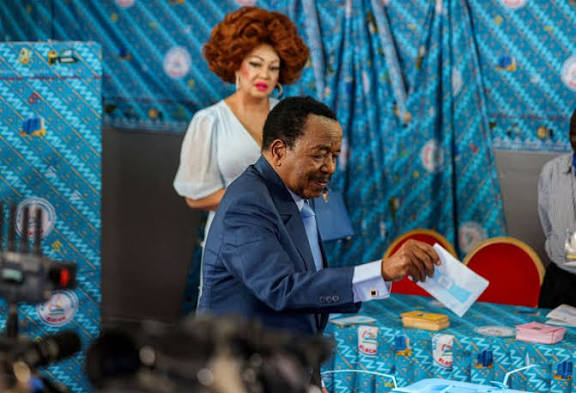
This week, Cameroon’s President Paul Biya secured an eighth term in office following the official declaration of results by Cameroon’s Constitutional Council. The 92-year-old incumbent was announced the winner of the October 12 presidential election with 53.66 percent of the vote, defeating his main challenger, former ally Issa Tchiroma Bakary, who polled 35.19 percent. This victory extends Biya’s four-decade rule but has immediately triggered fresh unrest and tension across the country. Opposition supporters and civil society groups alleged serious irregularities, seeking the cancellation of the polls. Reports of protests and clashes with security forces emerged in cities like Douala even before the final results were announced.
Ivory Coast held its presidential election this week, with votes being counted in favor of 83-year-old incumbent President Alassane Ouattara, who seeks a fourth term in office. The poll proceeded despite significant opposition contention, as several key contenders, including former President Laurent Gbagbo and businessman Tidjane Thiam, were barred from the race by the electoral commission. Though the Independent Electoral Commission announced an initial turnout of 50%, reporters on the ground noted a lower turnout in many polling stations in the main city of Abidjan. International observer missions, including one led by ECOWAS and the African Union, stated the election took place in a “calm and peaceful atmosphere.”
Widespread protests and violence erupted in Tanzania following the general election on Wednesday, over what the opposition has strongly condemned as the “stifling” of the democratic process. The unrest began immediately on election day, fueled by the exclusion of key opposition figures from the presidential ballot, a move that opponents claim favors the incumbent President Samia Suluhu Hassan and her ruling party (CCM). In response to the growing chaos, the government imposed a nighttime curfew and implemented an internet shutdown.
Madagascar’s new military head of state, Colonel Michael Randrianirina, established a civilian government by naming a new civilian cabinet, following his appointment of businessman Herintsalama Rajaonarivelo as prime minister. The formation of the cabinet is a direct response to international alarm regarding the power grab that saw former President Andry Rajoelina flee the country after weeks of massive youth-led protests over shortages and failed governance. The move is seen as an attempt to lend legitimacy to the transition and calm both domestic and international concerns.
The paramilitary Rapid Support Forces (RSF) captured the army headquarters in El Fasher, Sudan. The RSF launched a multi-pronged assault that culminated this week with the storming of the Sudanese Armed Forces (SAF) Sixth Infantry Division Command headquarters. This was quickly followed by the capture of the El Fasher Airport, marking the complete withdrawal of the SAF from the city. RSF leader Mohamed Hamdan Dagalo has already established a parallel government, the “Government of Peace and Unity,” to administer RSF-controlled territory, significantly strengthening the group’s leverage in any future peace talks and signaling a crucial turning point in the conflict.
The Ghanaian government announced a new policy that mandates the use of local mother-tongue languages as compulsory in all primary schools, with immediate effect. Education Minister Haruna Iddrisu made the announcement on October 24, stressing that local languages must now serve as the primary medium of instruction in basic schools. The policy represents a significant shift from decades of English-language dominance and is aimed at dramatically improving academic outcomes and preserving national cultural identity. The government’s goal is to correct access and performance inequalities that have been exacerbated by the linguistic barrier in public schools, tasking the Ghana Education Service (GES) with ensuring nationwide implementation of the directive.
Mali’s government took the drastic measure of closing all schools and universities nationwide until November 9 due to a deepening and critical fuel crisis. The severe fuel shortages have made commuting virtually impossible for staff and students, forcing the government to suspend all academic activities and potentially forcing the rescheduling of major exams. The crisis is largely a consequence of the ongoing security situation, specifically repeated attacks by the al-Qaeda-affiliated jihadist group JNIM, which has been blockading imports by frequently targeting tanker trucks traveling from neighboring Senegal and Côte d’Ivoire. The attacks have crippled the supply chain, leading to the closure of many service stations in Bamako and regional cities.
Burkina Faso’s Transitional Legislative Assembly has unanimously approved a bill that formally dissolves the Independent National Electoral Commission (CENI). The new law, passed on Tuesday, immediately transfers all powers and responsibilities for organizing elections to the Ministry of Territorial Administration. This move is seen as a reform intended to “strengthen institutional coherence with the Transition Charter” and to rationalize state structures. The dissolution follows a recommendation from the National Dialogue and is part of the military junta’s broader electoral reforms.
In a major economic and financial boost for two of Africa’s largest economies, Nigeria and South Africa have been officially removed from the Financial Action Task Force’s (FATF) global “grey list,” which tracks jurisdictions under increased monitoring for deficiencies in combating money laundering and terrorist financing. The decision was announced by the FATF at its October 2025 Plenary in Paris. Both nations were lauded for making “significant progress” in implementing comprehensive action plans to strengthen their anti-money laundering and countering the financing of terrorism frameworks. The exit is seen as a crucial “vote of confidence” that is expected to reduce international scrutiny, lower the cost of transactions, and attract increased foreign investment to both countries.
Djibouti’s parliament voted unanimously this week to remove the constitutional age limit for presidential candidates, a decisive move that allows incumbent President Ismail Omar Guelleh to potentially seek a sixth term in the 2026 elections. The age restriction, which stood at 75 years, was eliminated by all 65 lawmakers present in the National Assembly in a vote held this week. President Guelleh, who is currently 77 years old and has been in charge of the Horn of Africa nation for more than two decades, is expected to approve the decision, which will be followed by a second parliamentary vote on November 2 or a national referendum.