Border disputes, according to experts, have been a reality on the continent for millennia. Precolonial Africa was hardly a setting of harmony and bliss between African peoples. Most kingdoms paid attention to territorial control and did adapt some precise boundaries. But border disputes are not the preserve of Africa, as the recent conflict between Ukraine and Russia attests. Indeed, Mauritania’s economic and cultural ties with Mali run deep, but the threat of war in the neighboring nation has everyone on edge. For centuries and especially since the last drought cycles (1970–90), nomadic Mauritanian herders have moved across the border towards the Malian regions of Kayes, Koulikoro, and Ségou to find pasture for their livestock. The Malian border is the primary destination for Mauritanian livestock owners in the Hodh El Gharbi region. Populations from these border areas of Mali and Mauritania have maintained strong political, religious, economic, and social links, as well as centuries-old blood ties and marital alliances. The border areas are used for trade and animal husbandry, with feeding areas on the Malian side traditionally being open to all transhumant herders—including Mauritanians—who only had to receive the village chief’s blessing to use them. Thus, people, goods, and animals were placed under the protection of the village throughout the transhumance season. Before the Malian crisis, contacts with Malian authorities were limited to the irregular transit of water and forest rangers patrolling the area.
Subsequently, Al-Qaida in the Islamic Maghreb (AQIM), Ansar Dine, the Movement of Unity and Jihad in West Africa (MUJAO), Al-Mourabitoune, the Islamic State in the Greater Sahara (ISGS), and other violent extremist organizations (VEOs) had already transformed the region into an inviting space for terrorists and traffickers. Equally, the fall of Libya in 2011 has unleashed unforeseen consequences, such as protracted conflict in the Sahel states, particularly Mali, Niger, Nigeria, and Burkina Faso. Following an inflow of weapons, ammunition, and armed fighters from Libya into Mali, a dormant Tuareg rebellion was strengthened, experts stated. Just like other sub-Saharan African countries, the border between Mauritania and Mali is barely visible, but the communities on either side remain tightly knit through their shared family ties, trading relationships, and religious traditions. Experts say one of the most pressing issues in the border areas of the Mali and Mauritania regions is the potential for violent conflicts arising from disputes over land management, access to water, and wood harvesting rights in grazing areas. Competition for these resources has ignited tensions between various communities, threatening to disrupt the peace in the region.
A long-term instability in the Sahel
In the Sahel region, droughts, floods, and changing transhumance corridors are reshaping the dynamics between communities. As these natural disasters become more frequent and intense, traditional agro-pastoral practices are under threat. Pastoral communities, once attuned to the rhythms of the land, now grapple with uncertain migration patterns and dwindling resources. Competition for these resources has ignited tensions between various communities, threatening to disrupt the peace in the region. Apparently, the 2,262 km boundary between Mali and Mauritania mostly follows straight lines and watercourses, connecting the tripoint with Senegal in the west with the tripoint with Algeria in the east. The border was established by the French during the colonial era. Mali and Mauritania signed a border agreement in 1963, and it has not changed since. There are no disputes over the border, but it has yet to be demarcated, and there are several discrepancies concerning how the border is described in the relevant agreements and how it is portrayed on maps. These discrepancies are largely due to vague border documents, particularly from the colonial period. Meanwhile, in accordance with the provisions of the epizootic agreement signed on July 20, 1968, and amended on February 2, 1986, between the Republic of Mali and the Islamic Republic of Mauritania, consider the importance of the movement of livestock herds between the two countries, consider the factors motivating this transhumance and the various other movements of livestock in the border zone between the two countries, which are mainly to seek pastures and watering points, and consider the ecological, health, socio-economic, and legal problems that can result from the large movements of livestock.
Nevertheless, in April 2010, an elderly aid worker named Michel Germaneau, 78, was held hostage by Al-Qaeda in the Islamic Maghreb (AQIM). In order to free the French hostage, in July 2010, a Mauritanian force backed by French troops raided the al-Qaeda-affiliated group site inside the Malian territories but did not find him. Germaneau was later killed to avenge a deadly but failed rescue raid. However, this operation took place without the consent of the Malian government. Then, the Mauritanian opposition criticized the cross-border raid in Mali. They said it “endangers the country.” While the Mali government considered it to be an “unannounced declaration of war,“.
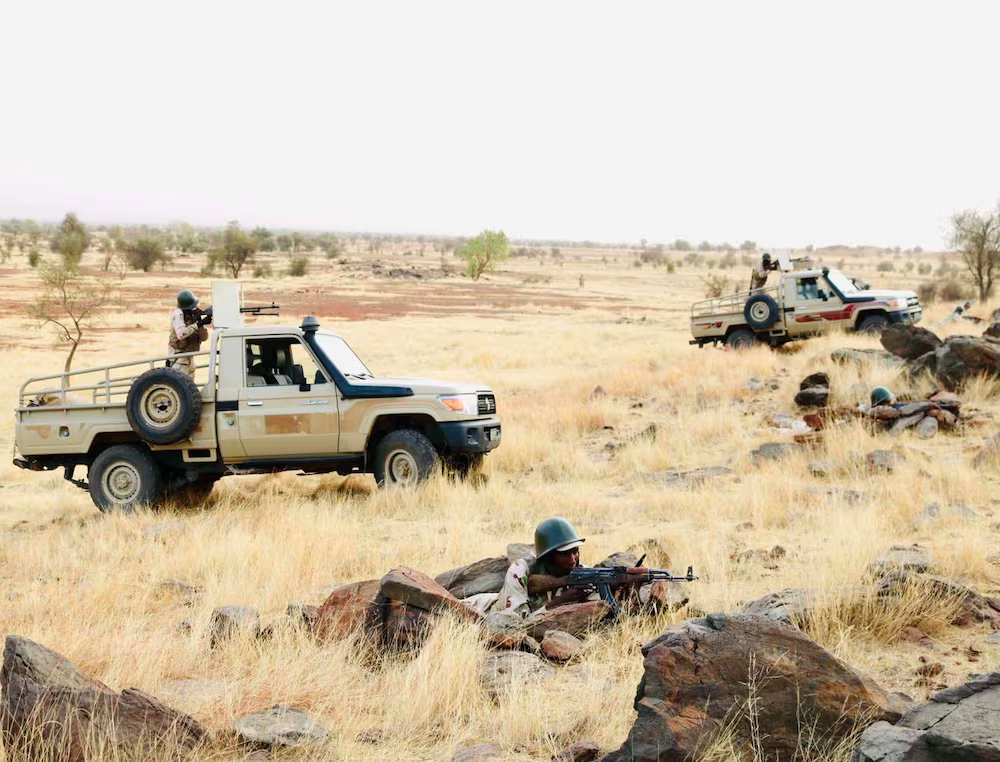
Mauritania is a member of the G5 Sahel, a military alliance formed to tackle militant groups, which also includes Niger, Burkina Faso, Mali, and Chad as of 2021. Mali has been ruled by a junta since a 2020 coup overthrew civilian president Ibrahim Boubacar Keita. According to the report, it has been plagued by spiraling jihadist violence that has swept the Sahel region, as well as by the resumption of hostilities in the north by armed separatist groups. The junta pushed out France’s anti-jihadist force in 2022 and the UN peacekeeping mission MINUSMA in 2023 and turned politically and militarily towards Russia. Meanwhile, Mauritania, considered by the UN to be one of the least developed countries in the world, has also battled waves of jihadist violence, but after a security crackdown, it has not seen an attack since 2011. In 2022, there was the disappearance of several Mauritanian livestock breeders in Malian territory, which caused tensions between the two neighboring Sahel countries. In reaction to the event, authorities in Mali restricted access to the border area with Mauritania.
Before the arrival of the Russians, the situation was already “catastrophic.” After a decade of failures to quell the violence—and amid accusations of human rights violations against Malian military leaders and France—some Malians have welcomed the support from Russia. Yet, some Malian refugees in Mauritania say they fled because the security situation had deteriorated since Wagner’s arrival. In April 2024, Mauritania accused Mali and Russia’s Wagner mercenary group of pursing armed men across the border into Mauritanian territory. While extrajudicial executions and human rights violations have resulted in the rejection of the defense forces, non-state armed groups have become more accepted by populations with whom they share cultural codes and to whom they provide basic services that the state no longer provides.
Resolving the Protracted Conflict
The fragility of the states, bad governance, unemployment, ethnic conflicts, climate change, foreign exploitation of resources, and external military involvement have resulted in increased poverty, hopelessness, and illegal migration. The multiplication of security initiatives by outside powers has exacerbated rather than resolved the issues. While the lack of effective development initiatives, the persistence of gerontocratic leaderships, and dependency on foreign powers have complicated the political and socioeconomic conditions, resulting in military coups, A purely security approach is clearly insufficient. The observer says exclusion and distrust of government are not the only causes of conflict, which can also be fuelled by climate change and food insecurity, among other factors. Moreover, the dire repercussions of the security crisis, coupled with these challenges, underscore an urgent need for humanitarian assistance and the pressing need to improve the quality and efficiency of security expenditures, as well as combat terrorism financing. However, those efforts may fall short if the problem of exclusion is not addressed at the same time.
Furthermore, while extrajudicial executions and human rights violations have resulted in the rejection of the defense forces, non-state armed groups have become more accepted by populations with whom they share cultural codes and with whom the fight against extremism requires the implementation of targeted development strategies. The needs of communities are different across nomadic groups, sedentary groups, and among men and women. These populations also suffer the consequences of their ‘peripheral’ geographical isolation (fewer public services and less security) and are extremely exposed to external shocks like drought. This situation increases their vulnerability and exposure not only to illegal trafficking but also to recruitment by armed groups. However, close observations of the affected communities show that, far from rejecting the state, communities are calling for a better state, namely a more inclusive state that provides public services.
Lastly, fostering relationships between people and a government that ensure justice and equitable public service delivery is crucial to establishing conditions for sustainable peace and social cohesion. Also, investing in adaptation measures and building greater resilience to the effects of climate change is another key priority for these border areas. Experts also suggest that strengthening social cohesion, empowering more women and young people in conflict, and managing natural resources will also help to resolve the protracted conflict.