TOC
In recent years, Africa’s political landscape has witnessed a surge in military coups and unconstitutional changes in power, challenging the credibility of democratic institutions in Africa. These coups are mostly driven by common factors such as deteriorating security, poor governance, corruption, term limit evasions, electoral fraud, and resentment of foreign influence.
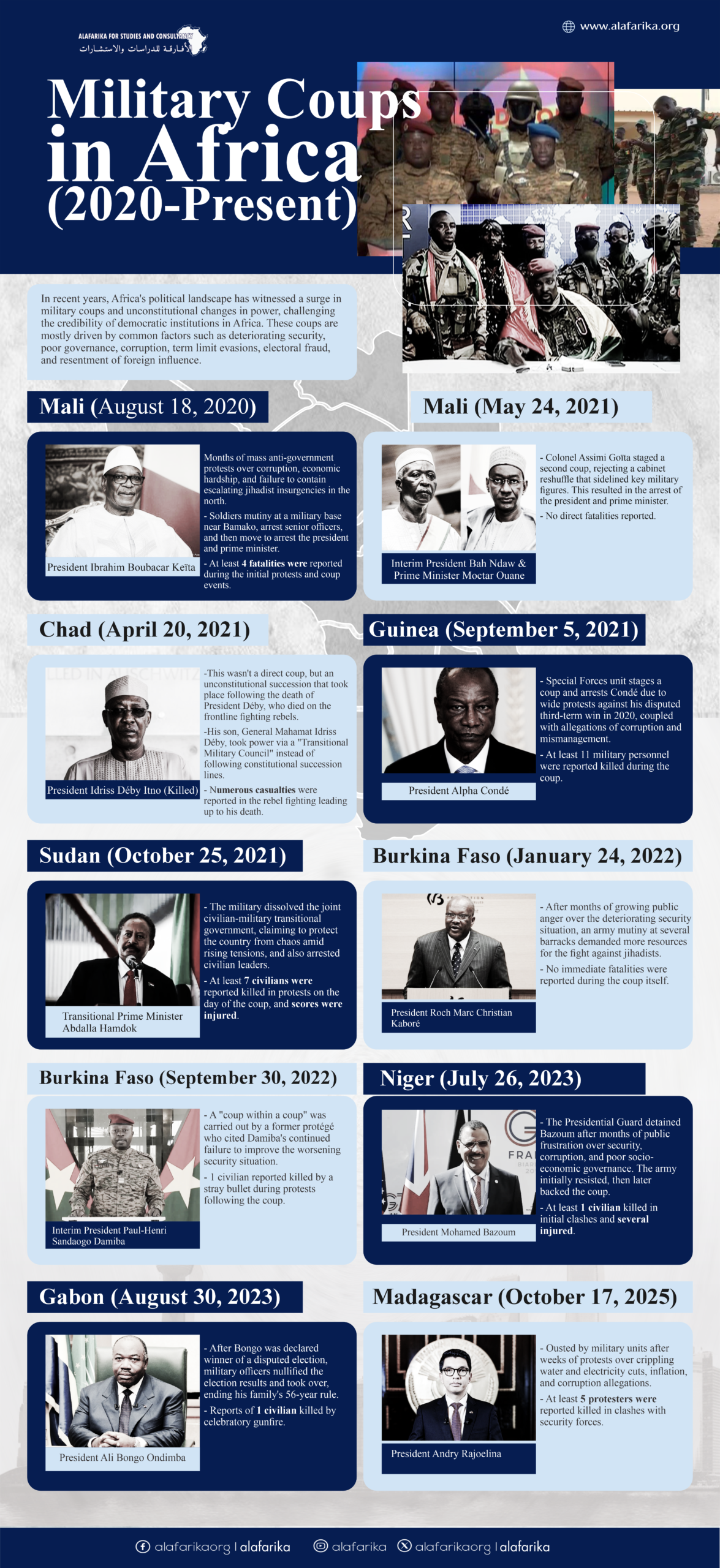
Mali (First Coup, August 18, 2020)
President Ibrahim Boubacar Keïta
- Months of mass anti-government protests over corruption, economic hardship, and failure to contain escalating jihadist insurgencies in the north.
- Soldiers mutiny at a military base near Bamako, arrest senior officers, and then move to arrest the president and prime minister.
- – At least 4 fatalities were reported during the initial protests and coup events.
Mali (Second Coup, May 24, 2021)
Interim President Bah Ndaw & Prime Minister Moctar Ouane
- Colonel Assimi Goïta staged a second coup, rejecting a cabinet reshuffle that sidelined key military figures. This resulted in the arrest of the president and prime minister.
- No direct fatalities were reported.
Chad (April 20, 2021)
President Idriss Déby Itno (Killed)
- This wasn’t a direct coup but an unconstitutional succession that took place following the death of President Déby, who died on the front line fighting rebels.
- His son, General Mahamat Idriss Déby, took power via a “Transitional Military Council” instead of following constitutional succession lines.
- Numerous casualties were reported in the rebel fighting leading up to his death.
Guinea (September 5, 2021)
President Alpha Condé
- A Special Forces unit stages a coup and arrests Condé due to wide protests against his disputed third-term win in 2020, coupled with allegations of corruption and mismanagement.
- At least 11 military personnel were reported killed during the coup.
Sudan (October 25, 2021)
Transitional Prime Minister Abdalla Hamdok
- The military dissolved the joint civilian-military transitional government, claiming to protect the country from chaos amid rising tensions, and also arrested civilian leaders.
- At least 7 civilians were reported killed in protests on the day of the coup, and scores were injured.
Burkina Faso (First Coup, January 24, 2022)
President Roch Marc Christian Kaboré
- After months of growing public anger over the deteriorating security situation, an army mutiny at several barracks demanded more resources for the fight against jihadists.
- No immediate fatalities were reported during the coup itself.
Burkina Faso (Second Coup, September 30, 2022)
Interim President Paul-Henri Sandaogo Damiba
- A “coup within a coup” was carried out by a former protégé who cited Damiba’s continued failure to improve the worsening security situation.
- 1 civilian was reported killed by a stray bullet during protests following the coup.
Niger (July 26, 2023)
President Mohamed Bazoum
- The Presidential Guard detained Bazoum after months of public frustration over security, corruption, and poor socio-economic governance. The army initially resisted, then later backed the coup.
- At least 1 civilian was killed in initial clashes, and several were injured.
Gabon (August 30, 2023)
President Ali Bongo Ondimba
- After Bongo was declared the winner of a disputed election, military officers nullified the election results and took over, ending his family’s 56-year rule.
- Reports of 1 civilian killed by celebratory gunfire.
Madagascar (October 17, 2025)
President Andry Rajoelina
- Ousted by military units after weeks of protests over crippling water and electricity cuts, inflation, and corruption allegations.
- At least 5 protesters were reported killed in clashes with security forces.