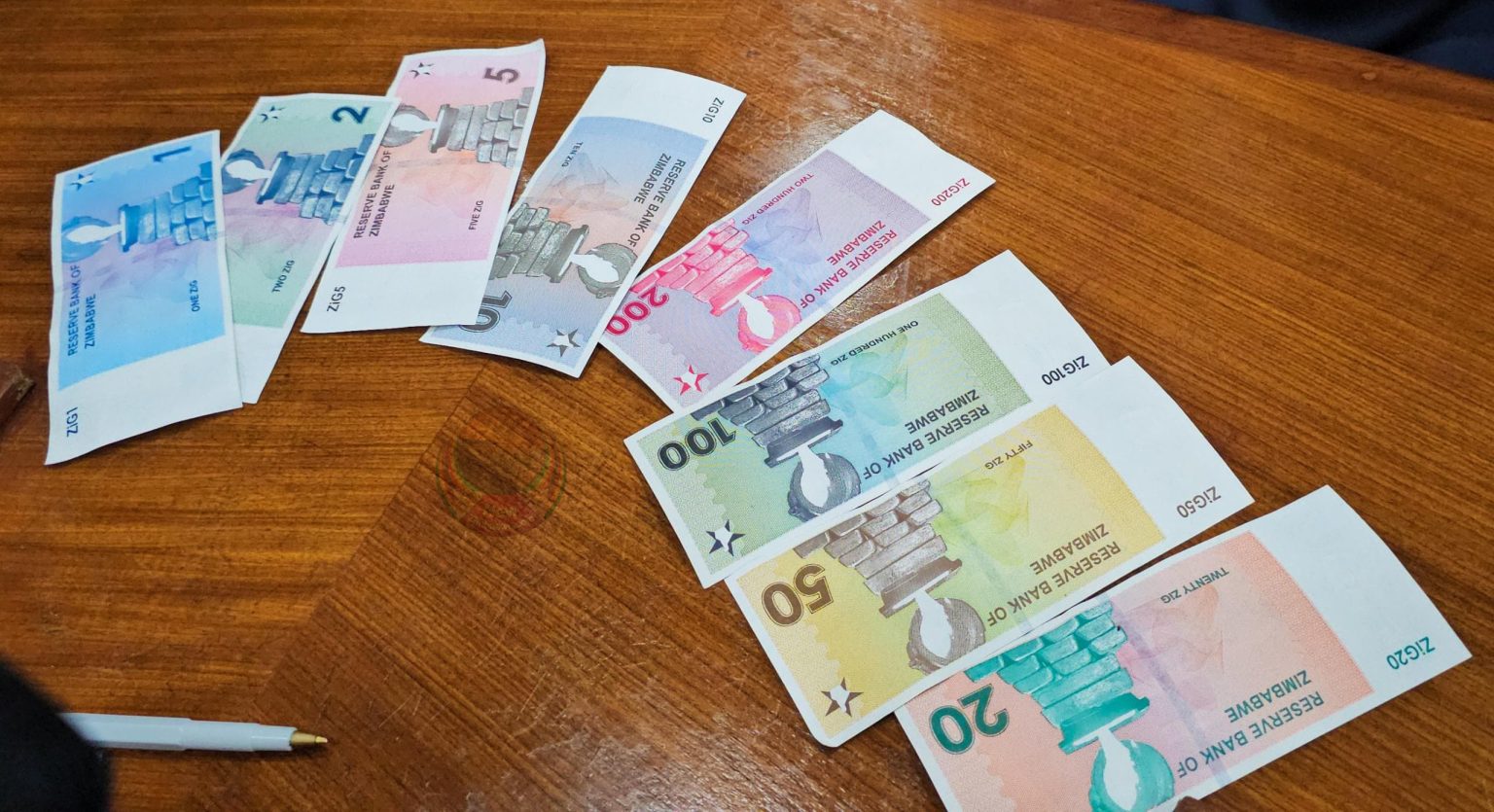
Zimbabwe made a significant move to stabilize its economy on Friday by replacing its failing local currency with a new one backed by gold and foreign currencies. This decision comes as the country battles soaring inflation rates, with the Zimbabwean dollar losing over 70% of its value since the beginning of the year. The new currency, named Zimbabwe Gold (ZiG), will circulate alongside foreign currencies, with its exchange rate initially determined by market factors. The central bank has also announced a drastic reduction in the main interest rate, from 130% to 20%. Banks are required to convert their Zimbabwean dollar balances into ZiG immediately, while citizens have 21 days to exchange old notes and coins for the new currency. These measures mark the outcome of discussions between the central bank and finance ministry aimed at addressing currency challenges. As part of the announcement, the central bank revealed reserve assets of $100 million in cash and 2.52 tonnes of gold valued at $185 million.
The World Food Programme (WFP) announced the negotiation of two convoys delivering food aid into Sudan’s Darfur region on Friday, a critical response to the looming famine exacerbated by a year-long war and restricted access to aid. Sudan’s conflict between the army and paramilitary forces has left over eight million displaced, causing widespread hunger due to destroyed infrastructure and markets. FEWS Net warns of imminent catastrophic hunger in Khartoum and West Darfur, areas heavily affected by conflict. One convoy, carrying 1,300 tonnes of supplies, arrived via the Adre border crossing with Chad, previously blocked by the Sudanese army. The second convoy used the Tina border crossing into North Darfur. However, WFP remains uncertain about future access routes. With over 18 million people facing acute hunger and only 5% of Sudan’s aid response funded, the situation is dire. Eddie Rowe, WFP Sudan Country Director, expressed concerns about unprecedented levels of starvation and malnutrition in the upcoming lean season, exacerbated by a depleted cereal harvest and soaring prices.
Somalia announced the expulsion of Ethiopia’s ambassador, closure of two consulates, and recall of its own ambassador from Addis Ababa on Thursday amidst a dispute over Ethiopia’s proposed naval base in Somaliland. Somalia cited Ethiopia’s actions infringing upon its sovereignty. Despite Somalia’s orders, officials from Somaliland and Puntland asserted autonomy, refusing to abide by the closures. The rift stems from Ethiopia’s agreement to lease coastline in Somaliland for a naval base, prompting Somalia’s opposition. Concerns arise over the fate of 3,000 Ethiopian soldiers in Somalia as part of an AU peacekeeping mission fighting al Shabaab. Somali President Mohamud previously deemed the port deal illegal but stated no intention to expel Ethiopian troops. Tensions with Puntland escalated as it declared self-governance, sparking further constitutional disputes.
Ethiopia and the World Bank on Friday finalized loan agreements worth $1.72 billion aimed at bolstering electricity and water supply and facilitating food transportation to markets, announced the finance ministry. The agreements include $523 million to expand Ethiopia’s electricity network and enhance renewable energy production. Another $500 million is designated for projects enhancing access to food markets, particularly through rural road network improvements. Ethiopia, grappling with foreign currency shortages and compounded by the impacts of COVID-19, a conflict in Tigray, and natural disasters like droughts and locust invasions, stands to benefit from this support. The remaining funds will be directed towards improving water supply and backing youth employment programs in urban areas.
China has extended an invitation to Uganda’s energy minister to discuss the country’s $5 billion crude oil pipeline in Beijing as announced by the Uganda presidency on Friday. The pipeline is crucial for Uganda to commence crude production from oilfields discovered in 2006. Western banks had declined funding due to environmental concerns raised by activists. Chinese President Xi Jinping expressed support for the 1,445-km pipeline via a special envoy to President Yoweri Museveni. Chinese financial institutions are open to discussions, inviting Uganda’s energy minister for further talks. The East African Crude Oil Pipeline (EACOP) will span from Uganda’s west to Tanzania’s Tanga port. Despite ongoing discussions with China’s export credit agency SINOSURE, previous deadlines for agreement had passed without resolution. Construction has commenced, including the transportation of materials and operations of a thermal insulation plant for pipeline insulation. President Museveni affirmed the project’s potential for regional socio-economic development.
Nosiviwe Mapisa-Nqakula, South Africa’s National Assembly speaker and former defense minister, announced her resignation on Wednesday amid an ongoing corruption investigation. Last month, her home was raided by investigators as part of the inquiry, though details of the allegations remain undisclosed. Mapisa-Nqakula emphasized her resignation does not imply guilt. Effective immediately, she steps down from both her role as speaker and her parliamentary position. Allegations suggest she received substantial bribes from a former military contractor during her tenure as defense minister from 2012 to 2021. Despite losing a court bid to block potential arrest and taking special leave, she hasn’t faced formal charges yet, and police haven’t made announcements regarding her arrest.
Over 100 inmates have died in the Democratic Republic of Congo’s severely overcrowded and underfunded prisons this year due to contagious diseases like tuberculosis and insufficient food, a U.N. human rights official reported. The U.N.’s Joint Humans Rights Office on Wednesday confirmed 104 deaths in detention since the start of 2024, with most occurring in eastern provinces like North Kivu and Tanganyika, as well as in the western province of Kwilu. Families living far from prisons struggle to provide food for detained relatives. Congo’s prisons suffer from extreme overcrowding and inadequate funding, with instances of cells meant for 50 people housing over 200. Efforts are underway to improve conditions and release inmates, especially those in prolonged pre-trial detention due to judicial delays.
Bassirou Diomaye Faye, Senegal’s once-jailed opposition candidate, was sworn in on Tuesday as the country’s youngest president at 44, pledging stability and economic progress. Faye’s landslide victory in the first round of voting reflected a strong desire for change. His inauguration was attended by over a dozen heads of state and regional representatives, signaling international support for Senegal’s democratic transition. Faye’s also announced the appointment of Ousmane Sonko, a popular firebrand politician and key supporter, as prime minister .
The International Monetary Fund (IMF) concluded discussions in Ethiopia on Tuesday without reaching an agreement on IMF support, leaving the country without a commitment it made with official international creditors. While progress was made, no deal was reached, with further talks scheduled in Washington later this month. The Paris Club, comprising developed creditor nations excluding China, warned last year that suspending Ethiopia’s debt payments until 2025 would be contingent on securing an IMF loan by March 31, though it’s unclear if this deadline will be enforced. Ethiopia’s last IMF program expired in late 2022, and in December, it defaulted on a $1 billion Eurobond payment, becoming the third African nation to default in recent years. Ethiopia’s external debt stands at $28.2 billion as of March, with Chinese lenders having committed over $14 billion in loans between 2006 and 2022, according to Boston University data.
The IMF on Monday linked an $8 billion loan to Egypt with economic reforms, including allowing the Egyptian pound’s value to be market-determined and ensuring foreign exchange availability. Egypt received immediate access to $820 million and will get similar amounts biannually upon meeting set conditions, with the final payment due in 2026. The IMF’s approval follows a previous $3 billion facility and Egypt’s currency devaluation, which was briefly reversed but now fluctuates freely. The Gaza crisis impacted Egypt’s economy by affecting tourism and Suez Canal revenues. The IMF seeks further reforms, such as equal opportunities for private and state firms and reduced state economic involvement. Future discussions may include an additional IMF loan for climate change policies. Egypt faces high inflation, expected to average 25.5% in the upcoming fiscal year, and has raised fuel prices to reduce subsidies. The IMF further advises replacing broad fuel subsidies with targeted support for needy households.