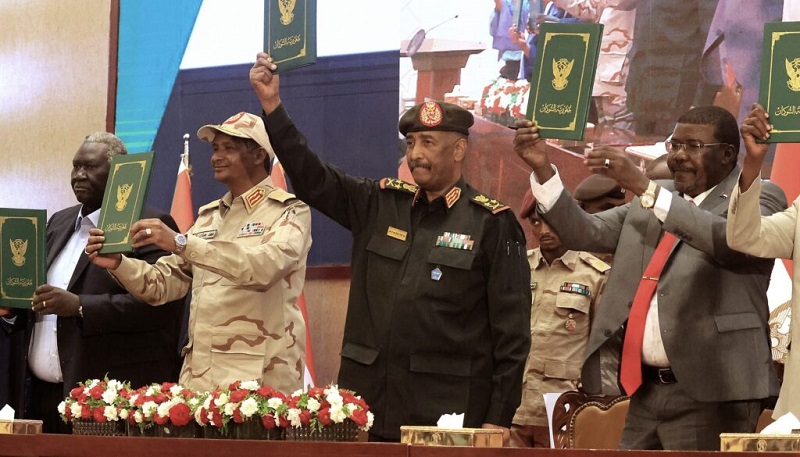
The US Treasury Department sanctioned three Sudanese companies, including Alkhaleej Bank and Al-Fakher Advanced Works, linked to the paramilitary Rapid Support Forces (RSF), and Zadna International, associated with the Sudanese army, for allegedly financing the devastating war in Sudan. These companies are accused of engaging in activities like money laundering and fundraising through gold exports, undermining peace and stability in Sudan. The conflict, which has led to over 12,000 deaths and displaced nearly eight million people, persists despite international efforts. General Abdel Fattah Al-Burhan, commander of the Sudanese army, has called for a full-scale offensive against the RSF, rejecting dialogue. Both the army and the RSF deny allegations of war crimes amid mounting humanitarian concerns.
U.S. Secretary of State Antony Blinken met with Kenyan Prime Cabinet Secretary and Cabinet Secretary for Foreign and Diaspora Affairs Musalia Mudavadi at the State Department on Thursday to underscore the enduring strategic alliance between the two nations. Blinken expressed appreciation for Kenya’s role as a crucial democratic ally and anticipated collaborative efforts on bilateral, regional, and global issues. He praised Kenya’s endeavors in promoting peace and security in the region and emphasized the importance of strengthening economic ties. Mudavadi conveyed greetings from Kenyan President William Ruto and echoed Blinken’s sentiments, emphasizing the need to enhance the partnership between the United States and Kenya.
The United Nations Security Council convened to discuss the International Court of Justice’s (ICJ) provisional ruling on genocide allegations against Israel amidst the ongoing deadly conflict in Gaza. Algeria requested the meeting to address the ICJ’s Jan. 26 ruling regarding measures to prevent potential genocide in Gaza. Algeria’s ambassador stressed Israel’s obligation to comply with the court’s directives as the occupying power. South Africa presented allegations before the ICJ, accusing Israel of violating the Genocide Convention regarding actions in Gaza and inflammatory rhetoric from Israeli leaders. The court’s order alerts states to the risk of genocide against Palestinians in Gaza, urging immediate action to prevent such atrocities and avoid complicity in violations of the Genocide Convention, including the cessation of support for Israel’s military actions.
Niger, Mali, and Burkina Faso, all led by military regimes, jointly declared their immediate withdrawal from the Economic Community of West African States (ECOWAS), a regional economic bloc. This decision deals a blow to ECOWAS’s efforts for regional integration, particularly after the bloc suspended the three nations due to recent coups. The move further challenges ECOWAS’s authority, which has been striving to restore democratic governance in the West African region. ECOWAS, in response, stated it has not received formal notification of the withdrawal. Despite ECOWAS’s rejection of military-led governments, the coup leaders have not provided a clear timetable for returning to constitutional rule, citing security concerns linked to insurgencies. The military leaders criticize ECOWAS for allegedly neglecting their fight against terrorism and insecurity. Observers note a growing rift between the junta-led states and ECOWAS, with indications of strengthened ties among the junta-led countries.
Senior leaders from Sudan’s army and the paramilitary Rapid Support Forces (RSF) held three meetings in Bahrain on Wednesday, marking the first direct contact between the warring factions in nine months of conflict. Attendees included influential deputies from both sides and officials from Egypt and the United Arab Emirates, key supporters of the army, and the RSF. The unannounced talks, also involving the United States and Saudi Arabia, come after failed attempts by various actors to broker a ceasefire and political resolution to the war, which erupted over power disputes within Sudan’s transition towards civilian rule. The conflict has ravaged parts of Sudan, claiming over 13,000 lives, triggering warnings of famine, and causing internal displacement. Although the Manama meetings didn’t yield breakthroughs, they signaled increased pressure from allies to address Sudan’s descent into chaos. The involvement of Egypt, Saudi Arabia, and the UAE represents a significant shift in peace efforts. The RSF’s recent military advances and the army’s recruitment efforts further underscore the urgency of negotiations to prevent further fragmentation and suffering in Sudan.
South Africa’s ruling African National Congress (ANC) on Monday suspended the membership of former president Jacob Zuma after he announced his intention to vote for another party in the upcoming general election. Zuma’s nine-year presidency was marred by corruption scandals and economic stagnation. His decision to support the uMkhonto we Sizwe (MK) party reflects deep divisions within the ANC, which has governed South Africa since the end of apartheid. Analysts suggest that the ANC could face its toughest electoral challenge since 1994, with the possibility of losing its parliamentary majority. The ANC views the formation of the MK party as a deliberate attempt to undermine its support base. Zuma’s suspension aims to protect the ANC’s integrity and reputation. Zuma, who has clashed with the ANC leadership since his resignation in 2018, remains influential, particularly in KwaZulu-Natal. His imprisonment in 2021 sparked widespread protests and violence across the country.
Algeria on Thursday drafted a U.N. Security Council resolution that calls for an immediate humanitarian ceasefire between Israel and Hamas, the Palestinian militant group that controls the Gaza Strip. The resolution also rejects the forced displacement of Palestinians and demands compliance with international law. Algeria presented the draft after the International Court of Justice ordered Israel to prevent genocide but did not call for a ceasefire. The U.S., a veto power in the council, opposes the resolution, saying it would favor Hamas. The U.S. and Israel prefer pauses in fighting to protect civilians and hostages. The Security Council had previously passed a resolution to increase humanitarian aid to Gaza, but without a ceasefire. The U.N. General Assembly had also voted for a ceasefire, but the U.S. had vetoed it in the council.
Namibia’s President Hage Geingob, 82, passed away on Sunday in a hospital after battling cancer, according to the presidency. Geingob has led Namibia since 2015 and has previously survived prostate cancer. Vice President Nangolo Mbumba assumes leadership until elections later this year. Geingob, born in 1941, played a pivotal role in Namibia’s politics before and after its independence from South Africa in 1990, serving as its first prime minister until 2002.
President Macky Sall of Senegal postponed the country’s presidential election, initially scheduled for February 25, on Saturday, citing electoral concerns that could lead to disputes. The decision, announced in a televised address, has drawn criticism from opposition and civil society groups, with some labeling it an “institutional coup.” Sall’s move follows the exclusion of prominent contenders from the electoral list by the constitutional council in January, sparking discontent about the election process. While Sall did not specify a new date for the vote, he emphasized the importance of ensuring a free, fair, and transparent election through a parliamentary inquiry and national dialogue. Despite concerns, Dakar remained calm following the announcement, with no immediate signs of protests.
A massive gas explosion in Nairobi, Kenya, claimed at least three lives and injured nearly 300 people. The blast occurred when a truck carrying gas cylinders exploded in the Embakasi district late Thursday night, causing extensive damage to buildings, businesses, and vehicles. Authorities launched an investigation, and Kenya’s deputy president pledged accountability for those responsible. Initial reports suggested the explosion happened at a gas plant, but later clarification indicated it occurred in a parking yard. The incident highlighted safety concerns, as the gas plant was operating illegally despite rejected construction permits due to safety standards and the high population density in the area. Government officials emphasized the need for the company owners to compensate victims and take responsibility for the tragedy. Kenyan leaders have vowed a robust government response to ensure accountability and prevent similar incidents in the future.