Reports emerged that shortly after Ali Bongo Ondimba, often known as Ali Bongo, was declared the winner of a closely contested election in the Central African nation of Gabon, a military takeover rocked the country, toppling the president whose family had ruled for more than 50 years. The incident occurred when the election authority in the country said Bongo had been re-elected president after the country’s election last month.
Gabon is on the list of oil-rich African nations, but since taking power over 14 years ago, the now-ousted president Ali Bongo has been accused of electoral fraud and corruption despite the country’s richness in oil and mineral resources. The jubilation of the people in the nation’s capital immediately after the coup appeared to be a clear message; some citizens were seen rejoicing and hugging soldiers on the street after the coup.
However, a lot is still unknown because Bongo is apparently under house arrest; his son, Noureddin Bongo Valentin, was also arrested alongside six others for “high treason”, according to reports. Also, all borders have been closed, and the government is ostensibly shut down.
A video that was circulated online shows Bongo placed in a room that looks like a library as he says, “I didn’t know what was happening… My son is somewhere; my wife is in another place,” he said. Also, in the shared video, he called on “friends of Gabon to “make noise” for his restoration.”
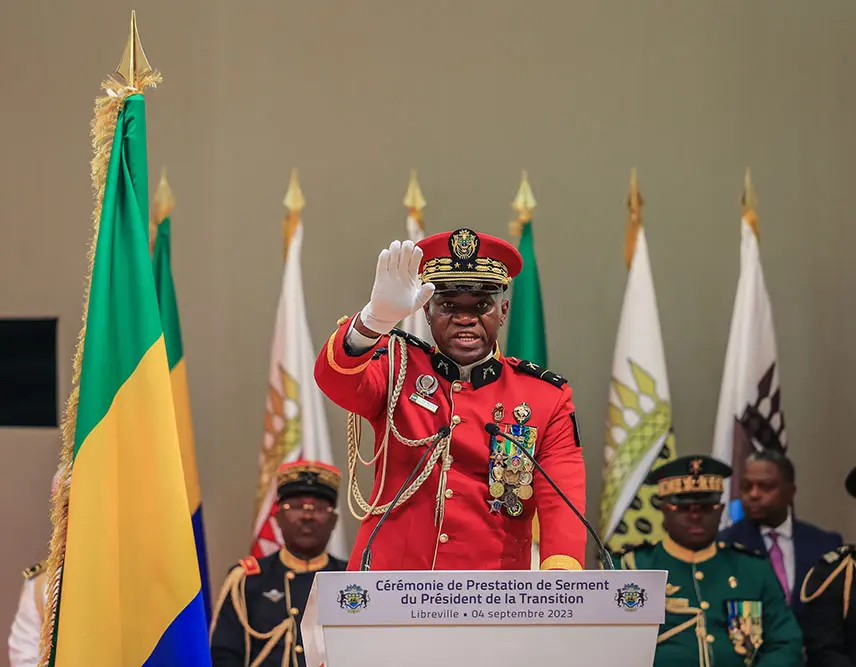
In another development, the junta named General Brice Oligui Nguema as a transitional leader. It is interesting to know that Gen. Brice Oligui was once the bodyguard of Bongo’s late father, the previous ruler of Gabon. However, the junta has proclaimed that there is no cause for alarm as “Bongo is enjoying all his rights as a normal Gabonese citizen.”
The nexus of the coup with Bongo’s family
Apparently, apart from alleged corruption and fraud, Gabonese citizens appeared agog at the need to end Bongo’s dynasty. The Bongo dynasty assumed political power seven years after Gabon’s independence from France in 1967. The father of Ali Bongo is Omar Bongo, and he served as president for over 42 years before passing away in 2009 from a cardiac arrest while receiving treatment in Spain for intestinal cancer.
Research shows that during his time, he imposed a one-party system for many years and only permitted multi-party control in 1991, yet his party still held power. He dominated the country with an iron fist.
According to the website of the Gabonese embassy in the United States, Ali Bongo started his political career in 1981 and held positions as foreign minister, congressman, and defence minister before taking office as president in 2009.
Despite the family’s footprints in the country’s political landscape, their track records do not speak well of their reputation. According to Reuters, a French financial police probe in 2007 revealed that the Bongo family had 39 properties in France, 70 bank accounts, and nine high-end vehicles worth a total of 1.5 million euros.
In 2016, after Bongo was declared the election winner, his main rival said the country’s constitutional court’s decision to uphold the disputed outcome was biased. 2019 saw yet another failed coup attempt against Bongo. Moreover, each of Ali Bongo’s three electoral triumphs has been hotly contested, occasionally igniting violent nationwide demonstrations. The opposition criticised the recently held election as being rigged, but Bongo’s administration before the coup denied any wrongdoing.
It has become part of some African countries’ culture to hide under the guise of democracy to be power mongers. However, the system of “president-for-life” doesn’t resonate with democracy. What will happen to Bongo’s family after the restoration of the constitutional order or amidst this current saga remains a yearning question.
Regional and international reactions
African countries as well as the West have denounced the Gabon coup. The 55-member African Union, which denounced the coup, has barred Gabon from all of the organisation’s operations “until the restoration of constitutional order.”
Also, the Economic Community of Central African States (ECCAS) condemned the coup and advocated for dialogue to return the country to civilian rule. A meeting is expected with the heads of state of member nations to examine “the path to follow” regarding Gabon.
United Nations Secretary-General Antonio Guterres, through his spokesperson, expressed concern over “reports of serious infringements of fundamental freedoms” and urged all parties to respect the rule of law and human rights.
The US embassy in Gabon had advised its citizens in the country to stay put and limit “unnecessary movements around town. Through the embassy website, it reads: “Americans in Gabon should keep a low profile… Avoid demonstrations, make contingency plans to leave, and have evacuation plans that do not rely on US government assistance.
The European Union’s top delegate shared concerns about the recently conducted election pertaining to the electoral process, but the bloc “rejects” the coup in its entirety. Other European countries, like the United Kingdom, Germany, and Spain, made the same statements.
Can coup leaders run closely related democratic governments?
Coup leaders frequently used corruption, poor administration, and poverty as justifications for overthrowing democratically elected governments in Africa. While coups may resonate with many Africans’ ideologies, the mismanagement of funds is getting worse.
Some other questions surfacing are: how long will coups be resurfacing in Africa? Can coup leaders, via militarization, run closely related democratic governments with the spirit of the people at the center? People are often fed up with some policies of democracy, and that’s why it is not mostly surprising when jubilation usurps the air upon coups.
Like Niger, a celebration filled Gabon too, per the videos circulated online, including footage of soldiers carrying Gen. Oligui on their shoulders and shouting “president. Residents in the capital, Libreville, were seen dancing on the streets. Also, it was reported that some members of the Gabonese diaspora celebrated with students from Gabon while gathering outside the country’s embassy in Dakar, Senegal.
“I assure you that what the Gabonese people wanted was just for the Bongo PDG system to leave power… Because, as we said, 60 years is too much.”
Bad leadership and mismanagement of funds have fueled more recent coups in Africa. Since the 1950s, there have been around 100 documented coups in Africa. Analysts claim that this rise in military coups is frequently brought on by a decline in democratic dividends. Using Guineans and Malians as a case study, Afrobarometer revealed that, in theory, they prefer democracy to other systems of government. However, “public confidence in democratic institutions is low.”
But there are several compelling reasons why military rule is not conducive to the establishment and sustenance of genuine democracy in African nations. People often welcome coups, but along the way, military regimes tend to suppress civil liberties, curtail freedom of speech, and limit political dissent. These actions undermine the fundamental principles of democracy, which are built on respect for individual rights and freedoms.
Military coups also come with soiled hands. This is because they can operate without the checks and balances that democratic institutions provide, although democracy is not without criticism, too. Apart from this, military takeovers can lead to international isolation and sanctions, further hindering a nation’s development and global engagement, which is already occurring in Gabon as the international community has shown its discontentment.
In a wave of development, Rwanda and Cameroon sacked and reshuffled the heads of the military in their countries. President Paul Kagame of Rwanda approved the retirement of several generals, including a senior presidential advisor on security matters, while in Cameroon, too, President Paul Biya, who has been in power since 1975, allegedly “to help prevent his country from being on the coup list”, reshuffled the military with new appointments.
It is safe to conclude that it is high time for African governments to actively engage in political dialogue, encourage multi-party systems, and ensure fair and transparent elections to curb the menace of recurring coups. This is because inclusivity and participation in the political process can help address grievances and reduce the appeal of coup attempts.