African countries’ relations with the oil-rich Gulf States have historically been based on religious solidarity and humanitarian aid. In the past, gulf monarchies such as Saudi Arabia, and the United Arab Emirates primarily engaged with African countries mainly through development assistance, construction of schools and mosques, and scholarships. African countries weren’t perceived as equal partners, but were rather seen as recipients of charity and support. Although, this helped in addressing immediate needs of the African society, but did very little to transform into broader economic ties beyond humanitarian frameworks.
Since the early 2000s, this paradigm began to shift as both sides recognized new opportunities. The Gulf States began to see Africa as a hub for strategic collaboration in trade, investment, and regional influence, not just as an aid destination. In the last decade, the African continent, characterized by its young populations, resource wealth, and growing consumer markets, have attracted wide investments from Gulf cooperation councils and sovereign wealth funds, into a range of sectors – ports, logistics, agriculture, energy and mining.
Today, African – Gulf relations are built upon mutual economic interests, and geopolitical cooperation. Gulf countries now perceive African countries as key hotspots in global supply chains, export markets, food and energy security strategies. The emergence of formal trade agreements, defense cooperation, and high-level forums portrays a more balanced engagement that goes beyond traditional and long-term strategic partnerships.
How Gulf Countries are Expanding their Footprint in Africa
In recent years, the African continent emerged as a strategic priority for the Gulf Cooperation Council (GCC) states. The UAE, Saudi Arabia, and Qatar have all taken the bull by its horn through massive investments capital to expand their political, economic, and security presence on the African continent, known for its rapidly growing markets and critical natural resources, which are vital for these Gulf States in sustaining their economic diversification agendas.
Similarly, the Africa Continental Free Trade Area (AfCFTA), officially launched in 2021, portrayed Africa as the next global investment hub for global partners. It is designed to create a single market projected to reach $6.7 trillion business spending and 1.7 billion people by 2030.
Gulf countries have collectively made over $100 billion worth of investment in the last decade. Between 2022 and 2023, their investment worth surged to $113 billion aproximately. The UAE tops the list of Gulf States Investments in African, becoming the fourth largest foreign direct investor in the continent. They have also organized high-level summits with African leaders, in order to show their readiness for cooperation with African governments. Some of these summits include the Saudi-Africa Summit, 2023, and the New Africa Summit, 2024.
Table 1: GCC Investment Profile in Africa (2012–2025)
| Country | Total FDI (USD Billion) | Share of GCC Investment (%) | Primary Geographic Focus |
| United Arab Emirates | 64.3 | 54.9% |
Egypt, Morocco, Nigeria, Horn of Africa
|
| Saudi Arabia | 28.7 | 25.6% | Egypt, Kenya, West Africa, South Africa |
| Qatar | 9.2 | 7.2% | Rwanda, DRC, Egypt, South Africa |
|
Kuwait |
6.0 |
5.0% |
Development projects across sub-Saharan Africa |
| Bahrain | 5.0 |
4.2%
|
Northern and Western Africa |
| Oman |
1.0+
|
<1.0% | East Africa (Zanzibar, Tanzania) |
Source: Africa Businessinsider
What are the main drivers of the Gulf States’ investments in Africa?
Gulf countries have been expanding their footprint in Africa for a mix of strategic, economic, political, and security reasons.
- Economic Diversification: The most foundational driver is the GCC’s urgent need to reduce dependence on oil revenues. The 2014 global crash in oil price seems to be the turning point for Gulf States. This pushed them to look beyond their borders for new opportunities—and Africa, with its vast resources and fast-growing markets, quickly became one of the most attractive destinations for Gulf money, offering an ideal opportunity for new areas of trade and investment due to its enormous untapped resources, growing markets and population, and sizeable youth population.
- Food Security: Gulf Countries relies heavily on the importation of food commodities. Reports proved that they spent $73 billion approximately on food imports in 2022, equivalent to 85% of their foods. They invested massively in local agricultural sectors, including fisheries, in Sudan, Ethiopia, Tanzania, majorly. Through these countries, Gulf States aims to lock in reliable, long-term supplies of wheat, rice, livestock, and animal feed for their own populations.
- Political and Diplomatic Influence: The Interests of Gulf States grew beyond just trade and investment, and transgressed into playing active roles in African politics. Qatar, for example, is active to be a peacemaker. It played significant roles in brokering negotiations between Ethiopia and Sudan in 2010 after a border dispute. Also, it secured a peace deal between Rwanda and the Democratic Republic of Congo in 2025, to put an end to the M-23 crisis.
- Infrastructure Financing: According to reports, Africa is in need of about $150 billion annually in order to meet its required infrastructural demands. Gulf States have actively invested into various infrastructural projects across Africa. It is also worth noting that most of these investments goes into port development, aimed at securing Gulf States trade networks. Today, UAE’s DP World and Abu Dhabi now manages six major ports across Angola, Somalia, Tanzania, Mozambique, and Senegal, including two inland dry ports in Rwanda and South Africa.
- Security and Counterterrorism: Both the Gulf region and African continent are dealing with severe terror threats due to continous spread of violent groups. This is why Gulf States sees the necessity to partner with African governments on counterterrorism and regional security. Among the joint measures taken to achieve this is the creation of a security alliance known as the Council of Arab and African Coastal States of the Red Sea and Gulf of Aden. The alliance was created by Saudi Arabia, and saw the membership of Egypt, Jordan, Sudan, Eritrea, and Somalia. In 2022, this group conducted joint naval exercises focused on keeping sea lanes safe.
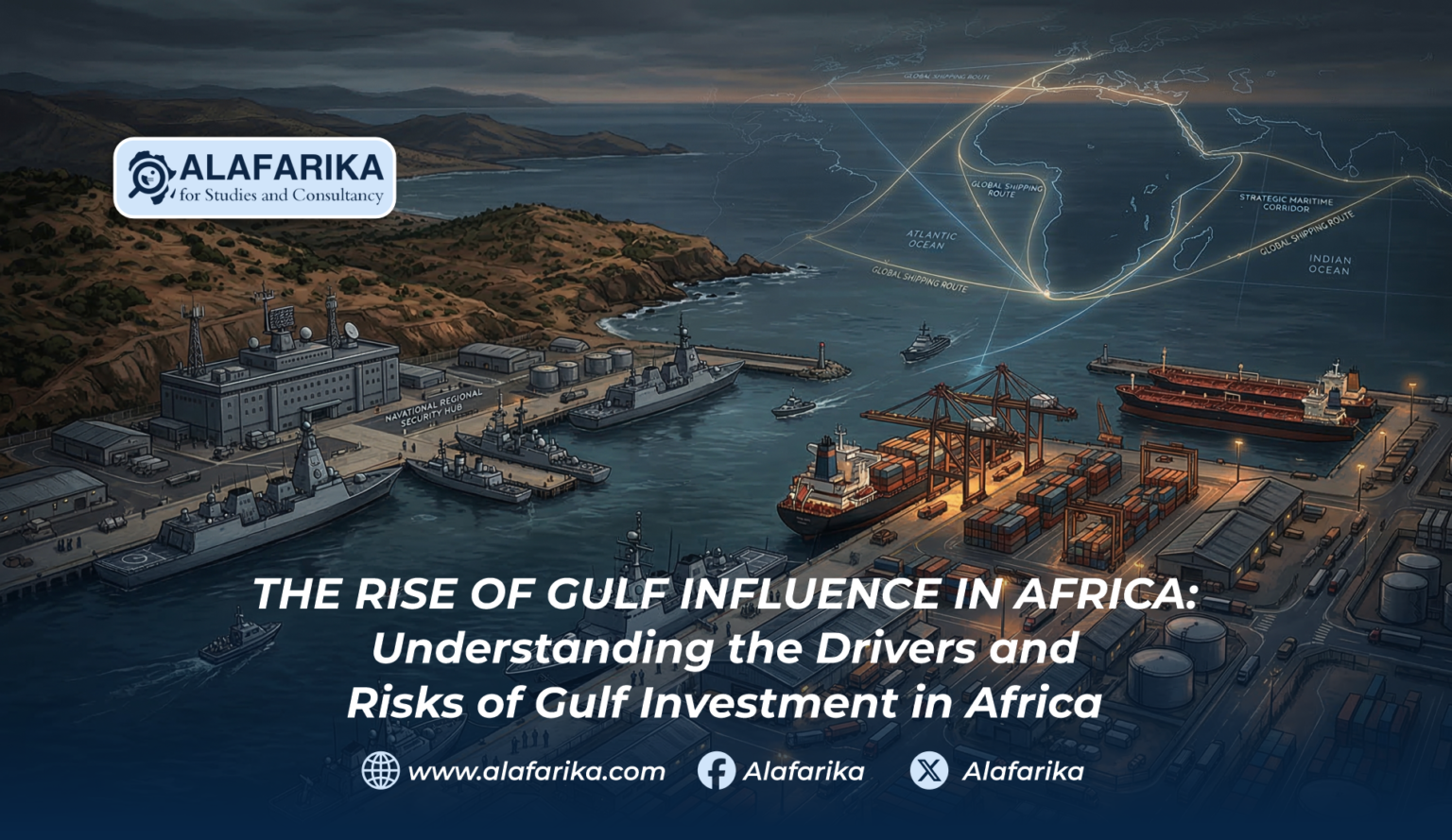
- Maritime Control: The desire to oversee maritime activities between the gulf and the African continent is another major key driver behind Gulf States shift towards Africa. The UAE is currently operating major ports like Mukalla, Aden, Berbera, Assab, and Moqa, located in the Red Sea coast. These ports are specifically being operated for military purposes to safeguard maritime routes.
Table 2: Key Maritime Infrastructure Projects of GCC States in Africa (2025 Updated)
| Project Location | Operator | Investment/Scale | Strategic Significance |
| Berbera, Somaliland | DP World | $442M invested; 1,050m quay | Gateway to Ethiopia; bypasses Djibouti bottlenecks. |
| Dakar (Ndayane), Senegal | DP World | $1.13 Billion | Largest private investment in Senegal; 1.2M TEU capacity. |
| Banana, DRC | DP World | $1 Billion+ | First deep-sea port for DRC; access to Atlantic markets. |
| Luanda, Angola | AD Ports | $150M+ | Integrating Southern African mining with global routes. |
| Maputo, Mozambique | DP World | $165M upgrade | Resilience for Southern African trade corridors |
Sources: Emirates News Agency, DP World in Africa – John Burger (pdf).
- Critical Minerals and the Energy Transition: Critical Minerals and the Energy Transition: Most Gulf States have longed showed interests into Energy transition. The UAE and Saudi Arabia have taken significant step towards investing in Africa’s mining sector. In 2024, the UAE signed a deal with Kenya to work together on mining and technology. That same year, an Emirati company acquired a 51% stake in Zambia’s Mopani Copper Mines, one of the largest copper producers on the continent. Also, Saudi Arabia announced, in the same year, a $15 billion commitment to secure critical minerals globally, focusing on Namibia, Guinea, and the DRC. On clean energy, Emirati firms unveiled six green hydrogen projects across Sub-Saharan Africa in 2023, the biggest being a $34 billion facility in Mauritania with a planned capacity of 10 gigawatts. The UAE is also helping co-finance the $25 billion Morocco-Nigeria offshore gas pipeline — a 6,800 km project that will carry gas across 15 West African countries and on to Europe. In Egypt, a $2.3 billion wind farm is currently being developed by Saudi Arabia’s ACWA Power. The 2 gigawatts wind farm is expected to be completed in 2026.
Table 3: GCC States’ Strategic Energy Projects in West and East Africa
| Country | Project Type | GCC Partner | Investment Value |
| Nigeria | Gas Aggregation | Qatar (Jeniks) | $15–$20 Billion |
| Angola | Solar PV | UAE (Masdar) | 150 MW project |
| Ghana | Solar/Wind | UAE/Qatar | $650 Million committed |
| Kenya | Geothermal | UAE (Masdar/AMEA) | $1.8 Billion combined |
| Togo | Green Ammonia | UAE/Arise IIP | Part of $2.8B Capex |
Sources: Africa Businessinsider, ecofinagency
- Technology and Digital Connectivity: Gulf States are also pumping large capital into Africa’s digital future. The UAE has launched a $1 billion initiative to develop artificial intelligence across the continent, with a focus on practical areas like education, healthcare, and climate change. Also, Qatar has been backing renewable energy projects in Kenya and has invested in African fintech — most notably Airtel Mobile Commerce, the mobile money platform of Airtel Africa. It is a clear signal that Gulf states are not just interested in Africa’s roads and ports anymore — they want a share of Africa’s fast-growing digital economy too.
Table 4: GCC States’ Strategic Energy Projects in West and East Africa
| Country | Project Type | GCC Partner | Investment Value |
| Nigeria | Gas Aggregation | Qatar (Jeniks) | $15–$20 Billion |
| Angola | Solar PV | UAE (Masdar) | 150 MW project |
| Ghana | Solar/Wind | UAE/Qatar | $650 Million committed |
| Kenya | Geothermal | UAE (Masdar/AMEA) | $1.8 Billion combined |
| Togo | Green Ammonia | UAE/Arise IIP | Part of $2.8B Capex |
Sources: Africa Businessinsider, ecofinagency
How African Countries View Gulf States Engagement
For many African countries, the Gulf States’ growing interest in the continent has been a welcome development. African leaders see real value in Gulf partnerships—mainly because Gulf investment comes without the heavy conditions that usually come along with Western aid. Countries like Tunisia and Morocco, which have long depended on Western funding, have started turning more to Gulf investors simply because Western aid packages often come with demands for economic reforms that are difficult to push through at home.
Looking through a geopolitical lens, many African governments see their growing ties with Gulf States as a statement of independence, to assert that the continent no longer has to pick a side or rely on a single foreign partner. Kenya is a good example of this balancing act. The country maintains strong security ties with the US and the UK, while at the same time working closely with Gulf States on counterterrorism. Egypt does much the same; it receives American military support, buys Russian weapons, uses Chinese defence systems, and still manages to deepen its economic and diplomatic ties with Gulf countries.
What Risks do Gulf States Investments Pose to the African Continent?
Gulf involvement is a double-edged sword, whose one hand paves way for massive investment opportunities, while the other hand signifies potential risks of economic dependency and external political interference that could increase existing tensions or even create new ones.
Critics have noted that most Gulf investment deals lack transparency. This raises doubts as regards whether their partnership with African governments truly benefit both sides equally. A critical concern is that Gulf investments tends to flow into sectors that serve Gulf interests—ports, farmland, and minerals—rather than into areas that create jobs or build local industries for Africans. Also, there have been reported cases of workers being mistreated and local communities being displaced from their land, with very little accountability from either side.
Beyond economics, it is worth noting that Gulf engagement has started to drag African countries into political disputes that are not their own, posing political and stability risk to the continent. The clearest example is Somalia, where Saudi Arabia and the UAE are quietly backing opposite sides of the country’s internal power struggle, pulling the nation deeper into a regional conflict involving Eritrea, Sudan, Qatar, Turkey, Ethiopia, and Kenya. Sudan tells an even darker story—where the UAE’s alleged financial and military support for the RSF militia did not bring stability but instead fueled an already devastating civil war, worsening one of the world’s worst humanitarian crises rather than helping to resolve it.
From another point of view, the current economic crisis in the Middle East, which stems from the prolonged ongoing USA/Israel-Iran war, could force Gulf States to reassess their investment commitments in Africa. This would be a significant setback for African nations already contending with shrinking Western aid and China’s diminishing appetite for large-scale infrastructure financing.
Conclusion
Gulf-Africa relations, which began decades ago as charity and religious solidarity, have transformed into a strategic partnership built on shared interests, mutual needs, and growing ambition on both sides. The relationship is proof that African countries are beginning to forge strategic partnerships to meet their economic needs, and the Gulf has become one of the most important partners to them.
Apparently, African governments have clearly recognized the need for a more structured and institutionalized framework to govern the Gulf-Africa relationship going forward. In a significant step in that direction, 27 African countries and the six Gulf States are set to convene in Abidjan in December 2026 under the Gulf-Africa Strategic Partnership Initiative—a landmark gathering now slated for December 2026. This is an encouraging development and a move in the right direction.