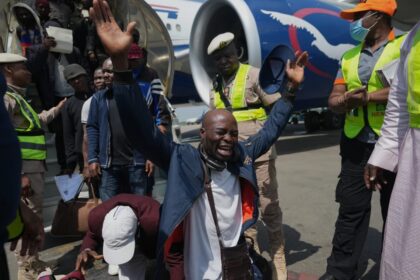
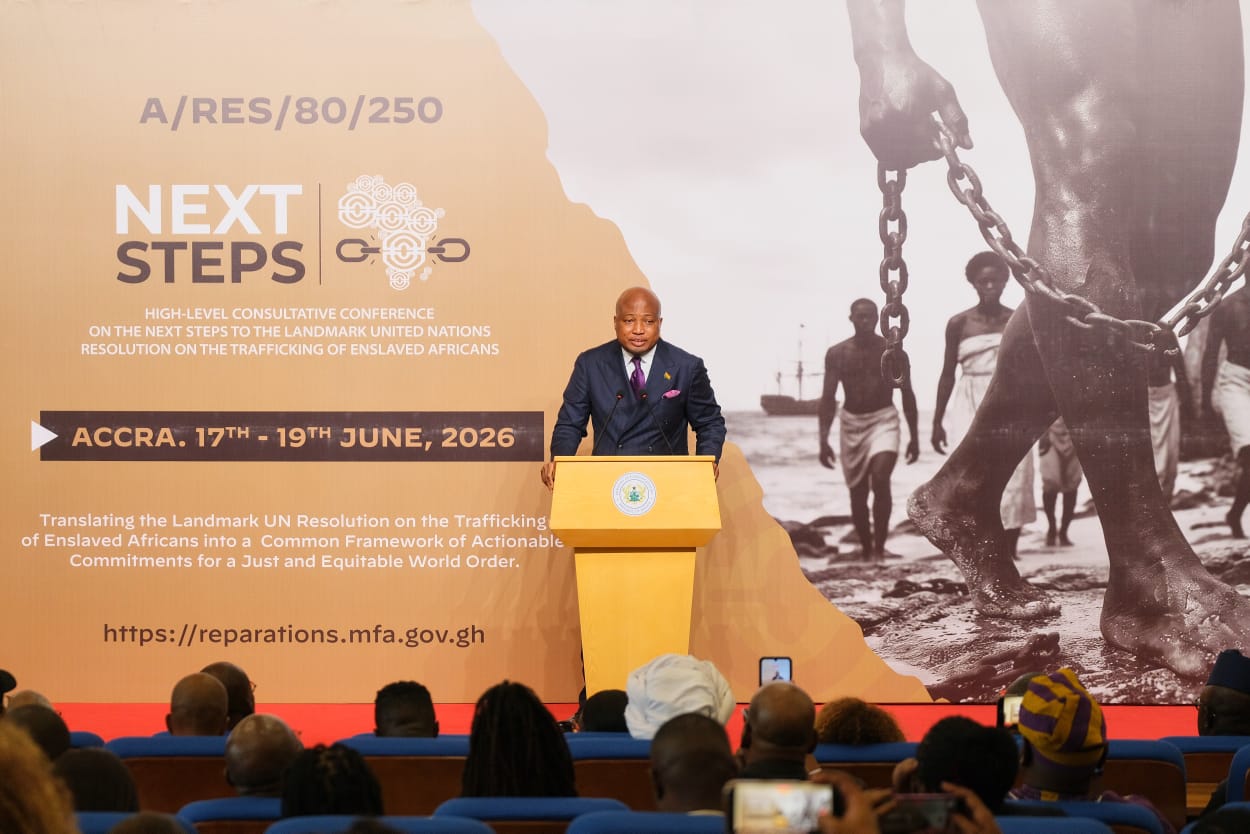
Ghana hosted a landmark global conference this week aimed at converting growing political momentum into concrete, practical commitments for slavery reparations. Attended by prominent leaders from across Africa and the Caribbean, the summit builds on a historic United Nations resolution that formally designated the transatlantic slave trade as the “most serious crime against humanity.” Ghanaian Foreign Minister Samuel Ablakwa emphasized that the global movement has gathered unprecedented momentum since the UN resolution passed last March. The conference focused on structuring a unified international framework to demand legal and financial justice for historical atrocities.
Kenya is close to finalizing a critical minerals agreement with the United States, President William Ruto announced during the G7 summit near Lake Geneva. The deal, covering rare earths and strategic minerals, ensures Kenya will process its resources locally. Ruto stated, “We have agreed that Kenya will process the minerals,” following discussions with G7 leaders, including US President Donald Trump. Representing his nation as a partner country at the summit, Ruto called for a comprehensive reset of relations between Africa and the West, emphasizing local value addition over raw material exportation. The agreement is currently underway and expected to conclude soon.
Zimbabwe’s parliament has overwhelmingly approved a controversial bill that adds two years to President Emmerson Mnangagwa’s current tenure, effectively keeping him in power until 2030. Introduced by the Justice Minister earlier this June, the legislative amendment secured a sweeping 218 votes, comfortably clearing the minimum 187-vote threshold required for constitutional adjustments. The Senate is expected to pass the bill without significant resistance. By delaying the next scheduled presidential elections from 2028 to 2030, the measure successfully secures a prolonged mandate for the current administration.
Panic spread through Niger’s capital early Thursday morning as powerful explosions and intense gunfire erupted around the Niamey International Airport. Security forces mobilized instantly to cordon off the area, establishing a strict security perimeter to control access. Field reports indicate the initial blasts detonated around 6:00 AM local time, followed by sporadic clashes and heavy weapon fire that echoed across the district for nearly two hours. The Nigerien government has maintained strict silence regarding the scale of casualties or physical damage.
The executive cabinet of Equatorial Guinea has collectively resigned after failing to achieve its mandated government performance metrics. Vice President Teodoro Nguema Obiang Mangue revealed on X that the ministers stepped down because the administration had achieved barely ten percent of its stated national objectives. Mangue, who is also the son of the president, stated that public office must remain strictly tied to visible outcomes. He emphasized that the state allocated vast human and financial resources to serve citizens, making the government’s low delivery rate entirely unacceptable.
The Democratic Republic of the Congo’s Senate has approved a major constitutional reform bill, positioning President Félix Tshisekedi to potentially seek a third term in office. Supported unanimously by all 89 senators present, the legislation creates a clear path toward a national referendum on a brand-new constitution. If signed into law by Tshisekedi, the text will reset his official term counter, bypassing current limits. The parliamentary vote triggered immediate political friction, sparking large-scale opposition protests across Kinshasa against what critics call a power grab.
The government of Guinea-Bissau has officially launched its new national carrier, “Air Bissau,” following the signing of a Memorandum of Understanding (MoU) with United Nigeria Airlines. The signing ceremony took place in the capital, Bissau, attended by Transport Minister Dr. Florentino Mendes Pereira and the Nigerian airline’s chairman, Prof. Obiora Okonkwo. Under the 18-month agreement, United Nigeria Airlines will provide full operational support, including aircraft, technical expertise, and executive management. The government has granted the joint venture official national carrier status, allowing it to leverage bilateral air service agreements to connect Guinea-Bissau with key regional and international destinations.
Angola’s state-owned oil giant, Sonangol, has secured a $2.65 billion financing agreement with a syndicate of international banks. While specific terms of the deal remain confidential, banking sources revealed that the capital will fund Sonangol’s immediate operating expenses and broader capital investments. The lending consortium includes South Africa’s Standard Bank and Absa, France’s Société Générale, and First Abu Dhabi Bank. As Angola’s largest corporate entity, Sonangol oversees the country’s entire energy value chain. To support its infrastructural goals, the company is concurrently negotiating a separate $4.8 billion loan with Chinese financial institutions to partially fund a new oil refinery at the Atlantic port of Lobito.
Somaliland President Abdirahman Mohamed Abdullahi has arrived in Jerusalem for a landmark state visit aimed at strengthening ties with Israel, marking the first time a Somaliland head of state has visited the country. The visit was confirmed during an official reception hosted by Israeli President Isaac Herzog. The diplomatic milestone follows Israel’s decision to recognize Somaliland as an independent, sovereign nation. In response, Somaliland announced plans to establish an official embassy in Jerusalem. Reflecting on his nation’s 35-year campaign for international recognition since breaking away from Somalia in 1991, President Abdullahi noted, “Israel was the first to answer.”
Cameroonian opposition leader Issa Tchiroma Bakary has filed two criminal complaints in France against the country’s 93-year-old President, Paul Biya, and over twenty senior government officials. The legal action, submitted to the Paris Judicial Tribunal, accuses the administration of torture and forced disappearances following a heavily disputed presidential election. Tchiroma is invoking “universal jurisdiction,” a legal doctrine allowing French courts to prosecute severe human rights violations if the accused individuals are physically present on French soil. The filing coincides with President Biya’s current stay in France. Neither the Cameroonian government nor its embassy in Paris has issued an official response to the lawsuit.