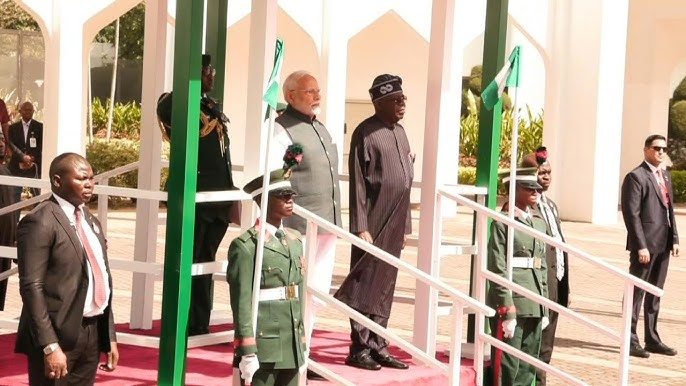
The recent visit of Indian Prime Minister Narendra Modi to Nigeria on November 16, 2024, has renewed interest in Nigeria-India relations. This was the first state visit by an Indian prime minister to Nigeria in 17 years, according to media reports that highlight the growing importance of the relationship between the two nations.
The Indian community in Nigeria has a long history, with many Indians arriving in the country as traders and businessmen. Over time, they have become an integral part of Nigerian society, contributing to the country’s economic growth and development. They have also played a significant role in promoting cultural exchange between the two nations.
PM Modi’s visit to Abuja
The historical ties between India and Nigeria form part of a strong foundation for the bilateral relationship. Apart from this, the two nations have a shared history of colonialism and have both been members of the Non-Aligned Movement.
India’s PM visit was also motivated by New Delhi’s intentions to strengthen ties with Abuja. This is in line with India’s larger strategic objectives in Africa, where China and Russia already left a lasting impression. India’s increased interest could also be seen in the context of the role Africa plays in the Indian Ocean region and the important resources the continent possesses, such as minerals that India needs for industries like electric vehicles.
During the visit, both countries pledged to strengthen ties in key areas, including economic development, defense, healthcare, and food security, among others. This commitment to strengthening ties is an indicator of the growing importance of the India-Nigeria strategic partnership. The two leaders, Modi and Tinubu, engaged in a tête-à-tête, followed by an expanded bilateral and political talk, where they discussed various areas of cooperation.
The visit saw the signing of three Memoranda of Understanding (MoUs) on the Culture Exchange Programme, Cooperation in Customs Matters, and Survey Cooperation. Furthermore, the two leaders agreed to finalize and sign several other agreements at the next opportune time, including a mutual legal assistance treaty, an extradition treaty, a transfer of sentenced persons, agriculture and allied sectors, a double taxation avoidance agreement, and a bilateral investment treaty, among others. These agreements are expected to enhance and broaden the bilateral areas of cooperation between India and Nigeria and strengthen their strategic partnership in various sectors.
Also, the bilateral discussion between the two leaders resulted in a significant agreement to enhance collaboration in counterterrorism, maritime security, and intelligence sharing. With the growing threats in the Gulf of Guinea and the Indian Ocean, the two nations agreed to coordinated actions to safeguard maritime trade routes and combat piracy. They also pledged to continue regular naval exercises and joint anti-piracy operations in the Gulf of Guinea to safeguard critical maritime routes. This strengthened cooperation between India and Nigeria is expected to have a positive impact on regional security and economic development.
It is pertinent, however, to analyze the talks held between the two leaders regarding key areas of the agreements.
Economic and Defense Cooperation
During the talks, the two leaders highlighted the vibrant economic relationship between India and Nigeria, with “India positioned as Nigeria’s largest trading partner and a significant contributor to its economy.” This is because, according to data, India is a major trading partner for Nigeria, with bilateral trade reaching $7.89 billion in 2023-24.
Nigeria is the 2nd largest trading partner of India in the African region, with a bilateral trade worth $11.8 billion in 202022–23. Geria commended the over 200 Indian companies currently operating in Nigeria, with investments totaling around $27 billion across various sectors.
The economic cooperation between India and Nigeria has been growing rapidly in recent years. India has become a significant investor in Nigeria, with investments in sectors such as oil and gas, pharmaceuticals, and infrastructure. Nigerian companies have also been investing in India, particularly in the areas of agriculture and food processing.
The economic relationship between India and Nigeria has the potential to grow even further in the coming years. There are several areas where the two nations can cooperate, including trade, investment, and infrastructure development. The Indian government has been actively promoting trade and investment with Nigeria, and several Indian companies have already established a presence in the country.
On the same note, another key area discussed is countering terrorism. The two countries show commitment to continue regular naval exercises and joint anti-piracy operations in the Gulf of Guinea to protect critical maritime routes.
The joint statement in part stated: “The leaders reiterated their unequivocal condemnation of terrorism in all its forms and manifestations, including the cross-border movement of terrorists and terror financing networks and safe havens.
“They called for zero tolerance to terrorism and expeditious finalization and adoption of the Comprehensive Convention on International Terrorism in the UN Framework.
“As well as the implementation of the UNGA and the UNSC resolutions on countering terrorism and violent extremism.
“It was agreed to enhance cooperation in the area of counter-terrorism.”
The defense cooperation between the two nations has historical roots, with India playing a crucial role in establishing the Nigerian Defense Academy and Naval War College. Thus, India and Nigeria have a strong defense relationship, with India providing training and support to Nigerian forces.
The Indian Navy has been actively engaged in the Gulf of Guinea, providing training and support to Nigerian naval forces. The Indian Navy Ship (INS) Sumedha made a port call in Lagos, Nigeria, in October 2023, to enhance maritime security and combat piracy. The visit highlighted the growing defense cooperation between India and Nigeria.
This cooperation as regards counter-terrorism is crucial in combating the growing threat of terrorism in the region. Although both nations are committed to sharing intelligence, best practices, and capacity-building initiatives to strengthen their counter-terrorism efforts, the Indian and Nigerian navies must enhance their cooperation to ensure the safety of maritime trade routes, particularly in the Gulf of Guinea.
Energy and Agricultural Cooperation
Energy and agricultural cooperation between India and Nigeria are other key areas discussed by the two leaders, and the sectors are set to receive a significant boost following the talks. The two leaders recognized the immense potential for collaboration in the fields of renewable energy, agriculture, and food security. India’s expertise in renewable energy, particularly in solar power, is expected to support Nigeria’s efforts to diversify its energy mix and reduce dependence on fossil fuels.
The energy cooperation between India and Nigeria has been growing rapidly in recent years. Indian companies have been actively investing in Nigeria’s oil and gas sector, and several Indian companies have already established a presence in the country.
Specifically, Nigeria’s oil and gas resources offer significant opportunities for energy cooperation with India. Nigeria is a crude oil powerhouse, generating approximately 90% of its revenue from petroleum and related products. India, on the other hand, is the third-largest importer of oil globally, with a significant portion of its imports coming from the Middle East.
What is left for the Nigerian government is to keep actively promoting energy cooperation with India, as agreements have been signed between the two nations. This will enable the cooperation to keep waxing stronger in the coming years.
As for the agricultural sector, agriculture is a critical sector in Nigeria’s economy, employing roughly 70% of the population and contributing 25.18% to GDP in 2023. Despite having over 70 million hectares of arable land, only about 44% is currently cultivated. There is significant scope for cooperation in agriculture, with Indian companies already engaged in edible oil plantations and interested in grain farming.
Research shows that Indian companies have been actively investing in Nigeria’s agricultural sector too, and it is only sacrosanct for the two countries to prioritize mutual trust, respect, and understanding based on their partnership.
Conclusion
India’s PM visiting Nigeria at this period of intense geopolitical competition signals New Delhi’s geostrategic plan, especially in the context of the rivalry with China and struggle to access the Gulf of Guinea. Also, India’s commitment to supporting Nigeria’s development priorities through concessional lines of credit and technical expertise can be utilized by Abuja to address its development challenges, particularly in areas such as energy and agriculture.
India’s growing activity in Nigeria has many potentials, especially with regards to exposing African companies to new advances in technology and modern labor skills. Other African governments could potentially use the opportunity of an increased Indian corporate presence in Africa as sources of appropriate technology, skills, and advice for economic development.
Though the success of this partnership will depend on the commitment of both nations to implement the agreements reached, a strong cooperation between Nigeria and India will have far-reaching benefits, including enhanced trade and investment, improved security, and accelerated development.