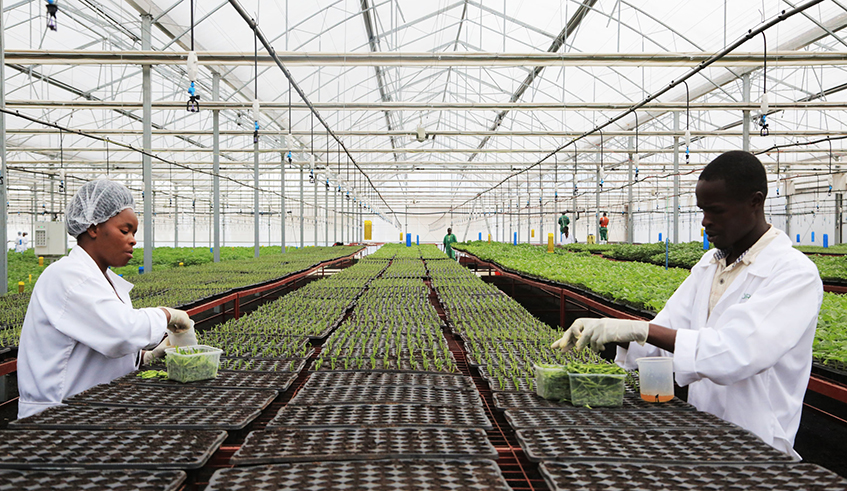
Rwanda is a country on the rise, having survived a genocide that threatened the very foundation of the country—including its future. The nation has roused itself from the ground, moving upward and forward every single day, improving, rebuilding, growing, expanding, sharing love and happiness, and contributing to making a society that has today become an envy of other nations.
The agricultural sector of Rwanda contributes immensely to the country’s economy, employing a huge chunk of the country’s population. In fact, the agricultural sector employs roughly 70% of Rwanda’s population of approximately 14 million people. Three-quarters of Rwanda’s agricultural production comes from small-holder farmers. The main crops the country produces are: coffee, tea, flowers, cassava, pyrethrum, beans, Irish potatoes, wheat, rice, sugarcane, and bananas, among others (Rwanda Development Board, 2024). In 2022, the agricultural sector contributed 24.9% to the country’s gross domestic product (GDP), while the industry sector and the service sector contributed 21.24% and 46.49%, respectively (Statista, 2024).
The agriculture sector of Rwanda, however, is hard hit by climatic conditions such as drought, inhibiting plant growth, high winds causing wreckage to farmlands, erratic rainfall frustrating plant growth, and seasonal temperature variations. The country also depends mainly on rainfed agriculture, exposing it to the whims and caprices of nature. This has adversely affected the agriculture sector, incurring significant economic costs. Nonetheless, the government of Rwanda is keen on boosting the agriculture sector by investing in infrastructure, markets, institutions, and innovations. Creating an enabling environment for investment by the private sector and other stakeholders (International Fund for Agricultural Development [IFAD] 2024).
The Agritech Revolution in Rwanda
The agriculture sector is very important to the economy of Rwanda, and to make it a global standard, it has to be efficiently and sustainably managed. Thus, there is a need for innovations in agriculture. In light of this, Rwanda has veered into agricultural technology. Agritech is the application of technology in agriculture, horticulture, and aquaculture, with the aim of improving efficiency, agricultural produce, and profitability. It is producing more with fewer resources. The adoption of Agritech in Rwanda’s agriculture has significantly improved yields, created more jobs, brought about innovation, and boosted the economy.
Agritech in Rwanda is also revolutionizing the way agriculture is carried out in the landlocked country. The use of technology in farms has brought about a lot of improvements in the sector as well as in the lives of the farmers in the country. The government is also investing heavily in Agritech, boosting the sector. Agritech startups in Rwanda have received a lot of support from the government and other stakeholders, helping them stand their ground. One of the government’s support for agritech startups is the Hanga Agritech Innovation Challenge Fund. A $2 million funding initiative, birthed by a collaborative effort between the Ministry of Agriculture and Animal Resources and the World Bank, is designed to address the challenges of food shortages due to poor yields, promote sustainable agricultural practices, and propel technological innovations in Rwanda. The Hanga Agritech Innovation Fund focuses on financial and technical support for agritech startups in the country. This shows the nation’s dedication to supporting and cultivating a flourishing agritech ecosystem (The Farmer’s Journal Africa, 2023).
The Rwandan government is committed to fostering technological advancement in agriculture in the country. The Hanga Agritech Innovation Fund is just one of many of the government’s supports for Agritech in the country. On another front, the European Investment Bank (EIB) and the Bank of Kigali have come together to provide €100 million in financial support for agroecological projects in Rwanda. This is another milestone for agriculture in Rwanda, especially in the face of a changing climate, drought, unusual rainfall patterns, and extreme weather events. A sustainable agricultural practice is a necessity. The €100 million financial support is an initiative aimed at transforming the agriculture of rural Rwanda, making credit more accessible to agritech startups and agribusinesses. The initiative has also seen the empowerment of over 2,000 farmers in agroecology training programs (Empower Africa, 2024).
Though Agritech is thriving in Rwanda, it still relies heavily on rudimentary, traditional methods that are dependent on land and water usage. In some cases, these resources may not be readily available or stretched too thin, thus the need for a more advanced, sustainable option.
Vertical Farming: A Promising Future?
Vertical farming is an agritech solution that involves the growing of crops in vertically stacked layers. Unlike conventional agriculture, where seeds are planted on the soil over a large expanse of land, vertical farming involves stacking up the plants in layers. Vertical farming is usually done in a controlled environment, such as a greenhouse. These techniques of agriculture do not require soil for plant growth; they are hydroponics, aquaponics, and aeroponics.
Hydroponics involves the growing of plants using a water-based nutrient solution without using soil. Aquaponics, on the other hand, is a combination of aquaculture and hydroponics. In this method, waste from aquatic creatures like fish is converted and used as a source of plant nutrients. The water is filtered and reused in the fish tank, drastically cutting down on waste and improving yields. Aeroponics, like hydroponics, do not require soil to grow plants; rather, the roots are suspended in the air and fed with a nutrient-rich mist (National Agriculture Library, 2024).
These techniques of agriculture are collectively referred to as vertical farming. They are advances in agritech, and they provide solutions to the problems of conventional methods of agriculture, such as land dependency and water usage. Vertical farming requires less land, and the yields are enormous.
The government of Rwanda’s long-term goal is the movement of Rwandan agriculture from a subsistence sector to a more knowledge-intensive, market-oriented one that is sustainable and adds high value to products (MasterCard Foundation, 2024). In light of this, the adoption of vertical farming in Rwanda is rapidly changing the face of agriculture in the country. Vertical farms have trumped the challenges of conventional farming methods. Investment and its widespread use are what are needed to propagate their impact in the country.
Vertical farming is capital-intensive and consumes a high amount of energy, thus the need for high initial investments. What is needed is to set it up; the rate and amount of yields are enormous, and its return on investment (ROI) is high. There have been a number of successful agritech solutions in Rwanda, and these agritech startups are funded by various organizations. They offer hydoponics starter kits, seeds, education, and training for farmers. These B2B agritech startups in Rwanda are NjordFrey, AquaSafi, STES Group, FarmPal, and Shambapro, among others. The advanced solutions they provide are a plus for the agricultural sector of Rwanda (Tracxn, 2024).
Vertical farming holds a promising future for agriculture in Rwanda as well as in other African countries. The combination of agritech and vertical farming would create a more sustainable and productive agricultural sector, which would be of immense benefit for innovation in Rwanda. There is, however, a need for investment in research and development, farmer education and implementation, and infrastructural development.
ـــــــــــــــــــ
References
Empower Africa. (2024). “Rwanda Gets €100 Million European Investment Bank For Sustainable Agriculture.” Retrieved from https://shorturl.at/SBj2q
International Fund for Agricultural Development [IFAD] (2024). “Rwand”. Retrieved from https://shorturl.at/qquNJ
MasterCard Foundation. (2024). “Hydroponic farming in Rwanda.” Retrieved from https://shorturl.at/l2Mub
National Agriculture Library (2024). “Hydroponics”. Retrieved from https://shorturl.at/SJftt
Rwanda Development Board (2024). “Investment Opportunities: Agriculture.” Retrieved from https://rdb.rw/
Statista. (2024). Rwanda: Share of economic sectors in the gross domestic product (GDP) from 2012 to 2022 Retrieved from https://shorturl.at/sHQh0
The Farmer’s Journal Africa (2023). “Rwanda Seeds Growth with $2M Agritech Support Facility.” Retrieved from https://tinyurl.com/mrxxf2z4
Tracxn. (2024). “B2B AgriTech startups in Rwanda.” Retrieved from https://tinyurl.com/3ejbwapd