- The Concept of Economic Diversification in Developing Countries
- Historical Evolution of Oil Economies in Major African Oil-Producing Countries
- The Global Energy Transition and What it threatens for African Oil-Dependent Nations
- Africa’s Renewable Energy Potential as a Diversification Asset
- Why the Need for Economic Diversification in Post-Oil Africa?
- Policy Recommendations for Achieving Economic Diversification in Africa
- Conclusion
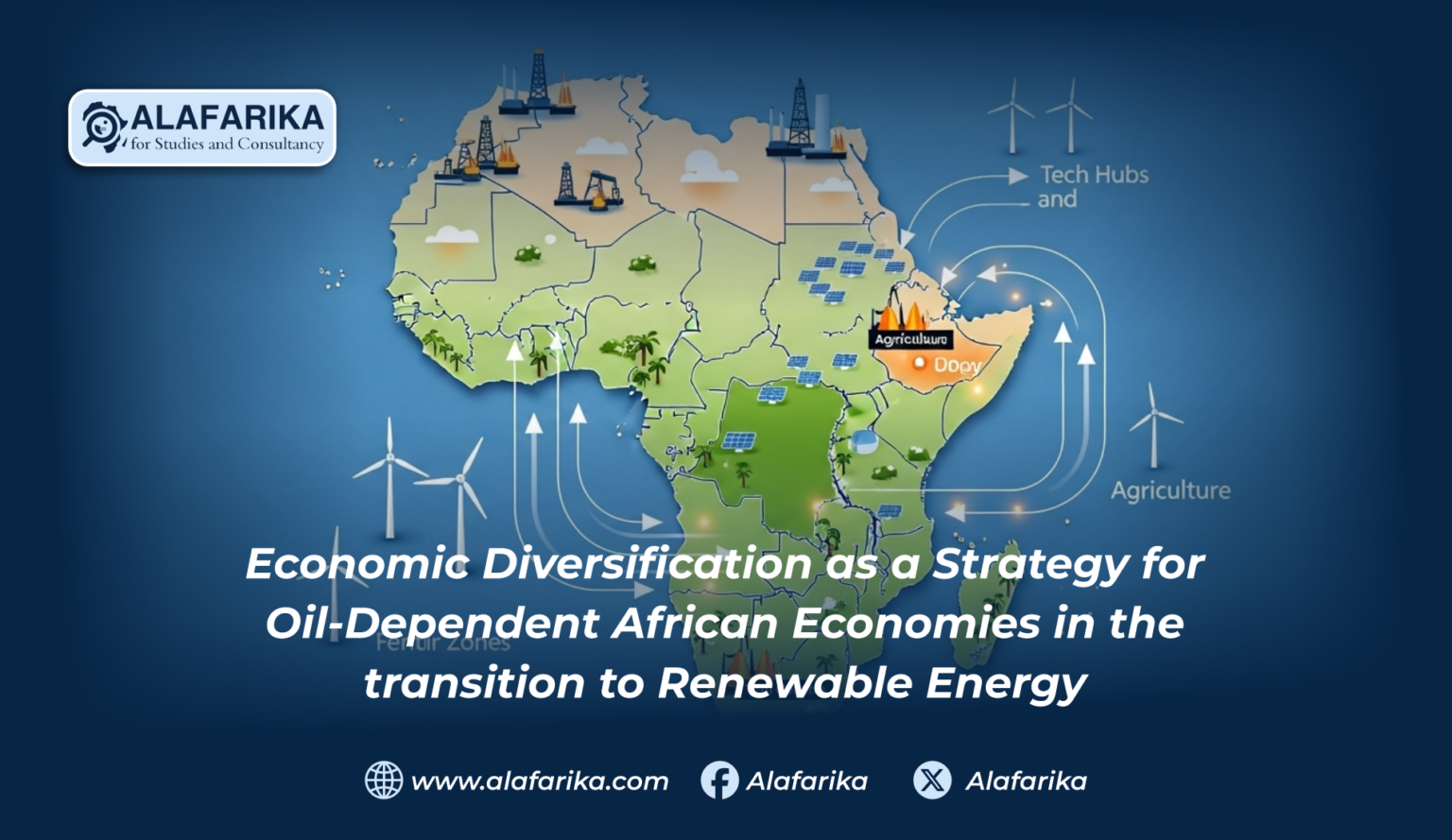
For a long time, oil and other goods have been the main sources of export income and financial stability for many African countries. But changing oil prices around the world, the growing importance of sustainability, and the world’s move toward renewable energy all make it urgent to diversify the economy. As the fossil fuel era comes to an end, African economies are figuring out how to make the switch by coming up with plans to promote strong, broad-based, and long-lasting economic growth.
To solve these problems, a lot of money is needed to be invested into renewable energy technologies. Solar, hydro, wind, and geothermal power are all examples of renewable energy sources that could give millions of people in Africa clean and long-lasting energy. Because of these problems, switching from non-renewables to renewables has become a crucial economic goal.
Due to their carbon neutrality and inexhaustibility, wind, solar, wave, and waste are considered renewable sources of energy that can replace most conventional fossil fuels. Numerous studies have indicated that the use of renewable energy technologies in place of or near price replaces conventional fossil fuels, which can stimulate economic activity by generating jobs.
The Concept of Economic Diversification in Developing Countries
Economic diversification refers to changes in the magnitude, type, composition, and quality of a nation’s economic sectors. As per Nobel laureate Simon Kuznets, a country’s ability to offer more diverse economic goods to its people is considered essentially a pillar of development. It is not only about the various products but also about a structural transformation that involves the shift of production factors such as labor and capital to more productive activities. This process called diversification emphasizes multiple product categories. This change is crucial for boosting productivity, increasing earnings, and strengthening market resilience.
Using the Herfindahl-Hirschman Index (HHI), economists often use other indices to measure progress, which measures concentration across different sectors. When the HHI is low, it indicates a more balanced distribution of economic activity, which is indicative of achieving good diversification.
Diversifying is not only a way to help developing countries grow, but it also guarantees a backup in case of sudden economic challenges. A recent report from UNCTAD found that more than 80% of the world’s least developed countries get more than 60% of their export income from raw materials. This highlights how much many countries depend on primary commodities. They are vulnerable to the volatile global prices that come with their commodity dependence, which is known as the resource curse and where wealth from raw materials does not translate to sustainable development.
There are obvious advantages in avoiding this model. According to research from the IMF, economic diversification is strongly correlated with higher incomes per capita and faster economic growth in developing countries. More diverse economies help manage market instability, generate more stable employment opportunities, and facilitate more scalability and sustainable growth. The UNCTAD Trade and Development Report 2024 talks about how the world is slowing down, climate change is happening, and geopolitical tensions are rising. It says that economic diversification is needed to make economies more resilient.
Taking the path of diversification is not easy. In developing countries, structural problems are often worsened by inadequate infrastructure, insufficient credit, a shortage of skilled workers, and complicated rules. Landlocked developing countries (LLDCs) have a harder time with their economies because they depend on nearby transit countries and have to pay a lot to move goods. Getting enough money is challenging because very few developing countries have investment-grade ratings. This makes it harder for them to get long-term loans at low rates.
Historical Evolution of Oil Economies in Major African Oil-Producing Countries
Nigeria’s economy was strong and stable before the discovery of oil. The North and Southwest were famous for their huge groundnut pyramids and cocoa farms, which made the country a top leading food exporter in the world. The discovery of oil in significant amounts at Oloibiri in 1956 brought about a change. The country then witnessed a rapid and devastating transition from heavy food production to massive oil production, and the situation became known as petro-centric economic development. Nigeria’s oil output reached over two million barrels per day by the late 1960s, and it soon accounted for more than 90% of its foreign income. Agriculture, once the national pride left, was abandoned.
A study from 2019 found that oil revenue made up 65% of government revenue and 85% of all exports. This solidified its position as the main source of income. This windfall caused a lot of corruption among political officials and also resulted in a centralized control of the nation’s wealth, leading to a huge system of patronage that made inequality worse, kept people in poverty, and set the stage for the security problems.
In Angola, the first commercial discovery in the Cabinda province happened in 1955, but it wasn’t until 1966 that a big offshore reserve was found, which caused a disaster. Oil was the primary export by 1973, surpassing coffee as the mainstay of their export.
A brutal 27-year civil war erupted after the country gained independence from Portugal in 1975, marking an unprecedented tragedy. Despite the conflict, Angola’s oil wealth was instrumental in motivating and financing the MPLA and UNITA. The conflict involved international oil companies, such as Gulf Oil, which paid taxes and royalties to the MPLA government, which was backed by the Soviet Union. The war ended in 2002, and between 2002 and 2014 there was a brief quadruple bonanza marked by more production, higher oil prices, rebuilding efforts, and Chinese investment.
Even though the country sold over $500 billion worth of oil during this time, it was plagued by corruption and capital flight. Sonangol, a powerful state oil company, played a big role in getting the money out of the country. This was due to these factors. The “paradox of plenty” in Angola is exemplified by the failure of the broader population to benefit from resource wealth, despite its immense wealth.
As regards Libya, the past oil prices in Libya have been both catastrophic and impressive. The nation uncovered its initial significant oil production in 1959 and, by 1969, was surpassing Saudi Arabia’s output of over 3 million barrels per day. Muammar Gaddafi’s coup attempts in 1969 resulted in the establishment of a radical new leader.
Following that year, Gaddafi started nationalizing the oil industry by establishing his own National Oil Corporation (NOC) and taking a 51% stake in all foreign oil companies in 1973. This gave him immense power and oil revenue, which made up as much of Libya’s exports as it could handle at times—it became the lifeblood of his dictatorship and was used as the instrument of international influence. The industry and economy were severely impacted by the international sanctions imposed by his regime for sponsoring terrorism, which had been in place for decades.
Following the end of sanctions in 2003, there was some brief recovery until 2011, when a similar situation occurred. After the Arab Spring revolt, Gaddafi was overthrown, and the country was brought back into chaos. Due to the civil war, the country was left with broken oil pipelines and a reduced amount of production. Libya’s OPEC membership no longer matter, as it became the epitome of intense competition for control over its oil wealth.
The Global Energy Transition and What it threatens for African Oil-Dependent Nations
The global energy landscape is currently witnessing its most significant change to the world’s energy situation since the Industrial Revolution. This is evident in the structural decline in the global demand for fossil fuels. For African countries that export oil, this is an emerging financial crisis.
They risk a structural loss in their main source of revenue, as the demand for oil diminishes, while major importers shift towards the adoption of domestic renewable energy. This tendency is particularly noticeable in African countries like Nigeria, which depends on oil for more than 80% of its foreign exchange revenues; Angola, where petroleum accounts for around 95% of export revenue; and Libya, whose whole state budget is essentially dependent on oil production levels.
Also, as energy security concerns drive big economies toward self-sufficiency through renewables, African oil exports tend to lose strategic relevance. The influence that African oil exporters formerly wielded in international negotiations—using oil supply as a political tool—is steadily disappearing. This means that African oil economies must consider not just economic reform, but also a fundamental repositioning in the global system.
Africa’s Renewable Energy Potential as a Diversification Asset
The African continent is rich in renewable energy potential, with over 60% of the world’s top solar resources, huge wind corridors, major geothermal resources in the East African Rift, and enormous hydropower capacity, particularly in the Congo Basin. Despite its richness, Africa contributes less than 3% of global renewable energy investment, highlighting the critical need for strategic economic diversification. By resolving this inequality, Africa can ease its recurrent energy crisis and build a strong industrial and employment foundation that goes beyond what oil earnings can sustain.
The continent’s good prospects for green hydrogen generation stem from abundant solar and wind resources and low land prices. Countries such as Namibia, Morocco, and South Africa have attracted large investments in green hydrogen, while Nigeria and Angola have the energy infrastructure to establish green hydrogen export markets, provided they have adequate regulatory frameworks.
Furthermore, improving solar manufacturing and deployment creates immediate potential for employment growth and industrialization. Oil-dependent countries may support domestic businesses by building local solar panel manufacturing skills rather than depending on imports, as Egypt and Morocco have proved with their local content rules.
Critical minerals, which are essential to the renewable energy shift, provide another opportunity for economic growth. The transformation requires huge quantities of minerals for technologies such as electric vehicles and solar panels, while Africa has its deposits in abundance. The Democratic Republic of the Congo is a major supplier of cobalt, while Zimbabwe and the DRC are important lithium producers. Establishing supply chains for these key minerals, rather than merely exporting raw commodities, might give more significant economic advantages to African countries.
Table 1: Africa’s top 10 Renewable Energy Champions
| Rank | Country | Renewables Share (% of Electricity) | Notable Highlights |
| 1 | Central African Republic | 100% | 100% hydro-based grid |
| 2 | DR Congo | 100% | Powered by Inga Dam and small hydro |
| 3 | Ethiopia | 100% | Massive hydro (GERD); expanding wind |
| 4 | Lesotho | 100% | Small grid fully powered by hydro |
| 5 | Namibia | 98% | A mix of hydro and rapidly growing solar |
| 6 | Uganda | 97% | Strong hydro base; GET FiT program |
| 7 | Eswatini | 96% | High hydro penetration. |
| 8 | Malawi | 96% | Hydro-based grid with some solar |
| 9 | Sierra Leone | 95% | Bumbuna hydro dominates supply |
| 10 | Mozambique | 84% | Cahora Bassa Dam + solar expansion |
Source: Business Insider
Why the Need for Economic Diversification in Post-Oil Africa?
Economic cycles in Africa’s oil-dependent economies, including Nigeria, Angola, and Libya, have historically been associated with the resource curse: high commodity prices, corruption (which affects all sectors of the economy), weak institutions, and limited growth in non-oil sectors.
Concerns have arisen regarding the influence of oil prices on renewable energy from a macroeconomic perspective, particularly due to commodity price declines and the COVID-19 outbreak. In countries that are heavily dependent on oil exports, a decrease in global oil prices can result in significant losses for their economies, leading to reduced government revenue and budget deficits while also reducing investment in renewable energy. The growth of renewable energy industries may be influenced by the government’s insufficient funding for such initiatives. For example, the COVID-19 epidemic has caused a significant decrease in global oil demand, which has also contributed to soaring oil prices. The downturn has had a significant impact on several African nations, whose financial resources are limited to cushioning.
The impact of oil prices on the development, promotion, and competitiveness of renewable energy is a subject that investors and governments are interested in exploring and how it can be utilized to promote economic growth. Increased oil prices may make renewable energy a more competitive and attractive alternative energy source, potentially opening up the possibility for governments to shift more quickly towards it. The potential economic benefits of African countries, particularly in the form of sustainable development, may be enhanced by addressing the challenges posed by fluctuating oil prices through massive investments in renewable energy.
Policy Recommendations for Achieving Economic Diversification in Africa
To achieve significant diversification in Africa, governments must adopt strategic policy interventions, including investments in human capital, the development of financial markets, and creating conditions that foster growth in private sector sectors across all kinds of industries.
Fiscal regulations must be reformed with the goal of breaking the connection between oil earnings and government spending by creating well-capitalized and well-managed sovereign wealth funds. To grow industries beyond oil, aggressive industrial strategies are required in addition to fiscal reform. Agriculture, industry (particularly for commodities related to energy transition), digital infrastructure, and services should be the main areas of investment. Market access can be greatly enhanced by aligning with the African Continental Free Trade Area (AfCFTA).
By setting renewable energy objectives, investment-attracting regulatory frameworks, and policies for green hydrogen and minerals, oil-dependent African nations may now position themselves as active players and beneficiaries of the energy shift rather than just victims Also, it is worth noting that successful diversification demands increased investment in education and skills. Governance reforms to reduce corruption and improve property rights are crucial, as they are foundational to economic policy effectiveness.
Conclusion
The COVID-19 pandemic and other economic shocks have undoubtedly exposed the vulnerabilities inherent in oil dependence exposure. When oil prices fall, government revenues vanish, budgets decrease significantly, and investments in essential areas such as education, infrastructure, or renewable energy are diminished.
With the increasing emphasis on energy transition and decarbonization, this cyclical fragility is no longer sustainable. Yet, the move towards an after-oil scenario is not just a defensive measure; it’s also incredibly valuable. Energy security, job creation, industrial development, and inclusive growth are all possible with significant investments in renewable energy technologies.
The rise in global oil prices, which is often seen as a benefit for oil exporters, can also help to make renewable energy more competitive, providing governments with an opportunity to shift towards cleaner and stronger energy systems.
Economic diversification in Africa after oil is not a theoretical goal but rather attainable through existential means. It is the distinction between ongoing periods of boom and bust, corruption and conflict, poverty and fragility, and a future of sustainable prosperity that is resilient. From the experiences of Nigeria, Angola, and Libya, it is clear: The fossil fuel age is finite now; accelerated efforts towards diversification today guarantee the prosperity of African economies tomorrow.