- Introduction
- The Call towards the Adoption of African Indigenous Languages in Education
- Major Bilingual Education Policies Adopted Across Africa
- Challenges in Adopting Indigenous African Languages in Education
- Are colonial languages still foreign to Africa?
- Building the Framework for a Multilingual Africa
- Conclusion
Introduction
Language is not merely a tool for communication; it is the operating system of any society. The role it plays is multifaceted, acting simultaneously as a bridge, a barrier, a container of culture, an architecture of thought, and a weapon of economic mobility. It acts as a fundamental infrastructure of civilization. Looking from the educational lens, language is the primary medium through which the operating system of any society is installed into the next generation.
Africa is a rich and diverse continent linguistically, being a home to over 2000 distinct languages spoken by its people; roughly one third of the world’s total linguistic wealth. Despite this richness, the formal structures of education across the continent remain largely built upon the legacy of colonial rule which shaped the continent in the 18th and 19th centuries. In most African classrooms, English, French, Portuguese, and Spanish languages, continue to be the medium of formal instruction. These languages also serve as the primary tool for media, governance, and social life in Africa.
Across the 54 nations of Africa, the question of which language children learn in is not limited to mere administrative procedures only, rather it is also a civilizational decision that shapes the African identity, economic and social development, and national sovereignty. From the reality today, it is widely perceived as a striking paradox that the African continent, which possesses an unparalleled linguistic diversity educates the majority of its children in foreign or colonial languages.
This analysis examines the concurring debate around language of instruction in African education, tracing the momentum behind the call for the adoption of Indigenous – language education, and assessing the structural and political challenges that makes such a shift very difficult to achieve. It also debates the current reality of the colonial languages in the African environment; does these languages, in their current states, still remain foreign to Africa, or have they evolved to become part of the African life?
The Call towards the Adoption of African Indigenous Languages in Education
In educational psychology, the pedagogical resolution of teaching children in their mother tongue is among the most widely supported findings. Numerous researches have proved that children learn to read, reason, and solve academic problems more effectively when instruction is given in a language they speak fluently at home.
A recent Global Education Monitoring (GEM) report indicates that colonial history in Africa hampered educational development due to the fact that most children are taught in foreign languages, slowing down the early acquisition of reading and writing proficiency. The report also attributed the decline in the development of children’s social- emotional skills and their sense of self – worth inclusive, to the dominance which colonial languages have in the African educational system.
In response to these challenges, there has been a resurgence of interest in mother-tongue-based multilingual education (MTB-MLE). Organizations like UNESCO, the Association for the Development of Education in Africa (ADEA), and the African Academy of Languages (ACALAN), are leading the quest to integrate African languages into formal education systems.
UNESCO began with its landmark 1953 monograph “The Use of Vernacular Languages in Education”, which argued that children perform better academically when their first years of schooling occur in their home language. Another UNESCO report in 2006, titled “Optimizing Learning and Education in Africa” highlighted that the usage of local languages in the early grades of primary school in countries like Burkina Faso, Mali and Mozambique yielded positive and better results compared to the usage of foreign languages. In its 2025 report titled “Languages Matter: Global guidance on multilingual education, released on International Mother Language Day (February 21), a call was made to urgently multilingualism in education systems.
The African Academy of Languages (ACALAN) is an organ of the African Union, established in 2001 and headquartered in Bamako, Mali. It was specifically created to support and promote the usage of African languages in education, science, and governance. This body has worked so far on standardizing orthographies for the Swahili, Hausa, Fulfude, Wolof, and Lingala languages, to enhance their usage across multiple countries.
The roles of this body also includes mapping out a linguistic atlas for Africa to understand dialectical differences and interrelations, training qualified linguists and educators through PANMAPAL project (Pan-African Master’s and PhD Programme) to achieve the intellectualization of African languages, and enabling African languages to become true working medium of instruction and administration through the Pan-African School for Translation and Interpretation (PASTI).
Correspondingly, the Association for the Development of Education in Africa (ADEA), established in 1988, has long advocated for language policy reforms, and produced for African governments, frameworks that supports the integration of Indigenous languages into the national curriculum. The body, through its Working Group on Books and Learning Materials, has succeeded in helping African publishers to develop textbooks in local languages, thus addressing the issue of quality reading material.
In March 2026, ADEA hosted the third episode of its Africa Policymaker Forum (APF) webinar series, in partnership with the Learning Generation Initiative (LGI) of the Education Development Center (EDC). The session brought together senior education policymakers from across the continent, to examine language of instruction as a critical driver of foundational learning, strengthen peer learning and reinforce evidence-based policymaking, drawing on country experiences from some African countries that have achieved milestones in the integration of local languages into education systems.
Major Bilingual Education Policies Adopted Across Africa
As of 2024, 31 African countries have adopted bilingual or multilingual education policies, which is an important response to the local and global calls for the integration of indigenous languages in educational programmes, according to the Global Education Monitoring Report. Though these policies weren’t implemented at full scale, 23 countries shifted to the second language before grade 5, while 80% of the policies indicate that local languages should later be kept as subjects.
In Tanzania, the Swahili language has served as the medium of instruction in primary schools for decades. Ethiopia adopted the most ambiguous multilingual education system in Africa, as over 25 local languages have been adopted so far as mediums of instruction. In Mozambique, the adoption of bilingual policy increased learning rates by 15%, according to a UNESCO report.
In South Africa, schools are allowed to use local languages as mediums of instruction in classrooms, as outlined in the Basic Education Laws Amendment Act 2024. The country has also recognized the usage of twelve official indigenous languages, including the South African Sign Language (SASL), a specially curated language for deaf ones.
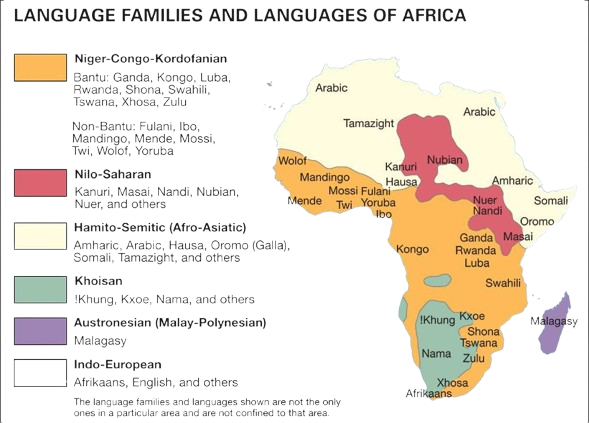
Image source: Britannica
Senegal has also adopted a bilingual education model known as MOHEBS, mandating children to gain foundational skills in both French and Wolof languages. The model is currently available in 13 out of Senegal’s 16 education regions and has integrated six national languages into the curriculum alongside French, with two more local languages to be added in 2026.
Ghana implemented a bilingual policy known as the National Literacy Acceleration Programme (NALAP) in 2010, mandating the use of local languages alongside the official English language. It further made compulsory the use of mother-tongue instruction in all Ghanian primary and secondary academic institutions in October 2025.
Nigeria once adopted a similar policy, mandating mother-tongue instruction from levels 1–3 across all primary schools, but the policy was reversed in late 2025, and the English language—the country’s official language—was reaffirmed as the medium of instruction for all levels. However, Nigeria promoted the integration of local languages into educational programs by adopting an inclusive language policy that entails the teaching and learning of at least one of the country’s three major indigenous languages (Hausa, Igbo, or Yoruba) in the primary and secondary levels.
Challenges in Adopting Indigenous African Languages in Education
The roles that languages play in Africa extend to the safeguarding of the continent’s rich cultural identity. Its diverse linguistic wealth comprises African traditions, beliefs, and heritage. The importance of adopting indigenous languages as mediums of instruction in education programs cannot be overemphasised. It is a tool for enhancing quick understanding and better engagement between teachers and students and also serves as a factor that guarantees access to education for local populations. However, the reality in Africa proves that there are some challenges that hinder the successful integration of African languages into education programs. These challenges include:
1- Structural and Resource Deficits: The structural realities of African schooling pose significant challenges towards the smooth and successful implementation of indigenous-language education. This is because most African nations already suffer from deficits in physical infrastructure, well-trained teachers, and learning materials. In a situation whereby these necessities must be provided in numerous indigenous languages, there is a high tendency of failure.
From a critical perspective on the reality of African schooling, providing learning materials, such as textbooks, in languages like Wolof, Hausa, or Zulu involves more than just translation. Rather, it requires enormous capacity demands, which include the availability of professional lexicographers for the coining of terms for modern concepts; the presence of balanced orthographies; the utmost willingness of publishers to invest in the publication of limited-profit materials for small language communities; and teacher-training bodies for the production of skilled literates in those languages to function as educators. All of these require massive funding and curriculum infrastructure, which most African schooling systems cannot afford to provide.
2- Socio-economic Reality: In Africa, it is strongly believed that educating children primarily in indigenous languages narrows their access to the formal economy. Thus, colonial languages—English, French, and Portuguese—function as the languages of formal socioeconomic life. Governance, civil service employment, university admission, international trade, professional certification, and digital commerce all operate in these languages. This factor tends to be the most powerful force behind the continuous dominance of colonial languages as mediums of instruction in African educational systems.
Studies across sub-Saharan Africa have proved that expertise in colonial languages guarantees higher wages and widens employment opportunities. As long as they dominate labor markets, it will be almost impossible for African parents—who see education as their children’s primary route of poverty—to resist language of instruction policies that they perceive as reducing their children’s economic potential. This situation raises significant concerns as regards the call towards the adoption of indigenous languages as mediums of instruction in African classes.
3- Political Risks: For many African countries, the adoption of any single indigenous language as a primary medium of instruction for education carries heavy political implications for African governments. The reality in Africa shows that barely any country has a single indigenous language. For this reason, governments prefer to adopt colonial languages, which are politically neutral within many ethnic groups, rather than adopting a certain indigenous language, which carries political risks.
Nigeria, for example, refuses to adopt Hausa, Yoruba, or Igbo as a national indigenous medium of instruction in the education system, simply because choosing any one among the three popular indigenous languages would be seen by the other two groups as an automatic power grab. At the same time, it would be very challenging for the government, administratively and financially, if it adopts the three at the same time.
Are colonial languages still foreign to Africa?
To the majority, colonial languages—English, French, and Portuguese—are classified as foreign languages. For this reason, some analysts believe that the usage of these languages as mediums of instruction in African classrooms poses challenges for the preservation of indigenous African languages, thus calling for the adoption of local languages in educational systems. However, from an analytical point of view, it can be argued that these colonial languages are no longer “foreign” in the African context, as widely assumed.
Based on the sociolinguistic reality in African environments, it can be concluded that these languages remain indispensable as primary official languages of education in Africa. While these languages truly originate from Europe, their current versions have witnessed a domesticated evolution and became rebranded to fit the African tongue, soul, and social structure. The version of English spoken in Lagos, the French spoken in Abidjan, or the Portuguese spoken in Luanda is different from the versions spoken in London, Paris, or Lisbon.
At the moment, African economies have already been integrated into a global system that operates in these languages—which are perceived to be foreign to Africa—and this situation will not change regardless of language policy decisions taken by African governments. In addition, higher education—such as science, technology, engineering, and medicine—is mostly conducted in English or French globally. If these languages get abandoned, African students will no longer have the opportunity to access the world’s knowledge production systems. Although these languages are foreign-rooted, their political neutrality in a multiethnic continent like Africa plays a genuine unity and peacekeeping role that cannot be undermined. Dismantling their “official language” framework in favor of indigenous language instruction will likely cause disunion, unrest, and social turmoil.
Moreover, these languages have witnessed the coining of their new versions by African tongues, such as Nigerian Pidgin—the localized English version; Ivorian Nouchi, an indigenized language that blends French with Dioula and other local languages; and the Kriolu language of Cape Verde, a blend of Portuguese, Mandinka, and Wolof languages. Some other varieties include the Kenyan Sheng, a blend of English, Kikuyu, and Luo languages; and the Cameroonian Franglais, a blend of French, English, Duala, and Ewondo languages. This further proves that what remains from these colonial languages—English, French, and Portuguese—are no longer the original versions but indigenized African tongues.
Building the Framework for a Multilingual Africa
The path towards the adoption of a balanced medium of instruction in Africa’s educational system doesn’t necessarily warrant choosing between indigenous and colonial tongues. The African reality demands a hybridized future that embraces the adoption of a strategic multilingual framework as regards education. Such a framework is required to ensure that colonial monolingualism isn’t just replaced by African monolingualism but strategically merged for building a balanced education system that is truly responsive to the realities of African environments.
The challenge for the educational future in Africa is not to expel colonial languages as foreign invaders but to acknowledge their status as Indigenized Assets. The goal should be to create a curriculum where the Indigenous language provides the deep cognitive foundation, while the Indigenized colonial tongue provides the wide-reaching social and academic empowerment. In order to achieve this, African governments and policymakers are advised to identify the most widely spoken indigenous or regional local languages and develop them to become co-official languages, alongside the official colonial languages; thus, adopting them as mediums of instruction in African classrooms alongside the colonial languages will be achievable.
Table 1: Most Widely Spoken Indigenous Languages in Africa
| Language | Primary Region(s) | Estimated Total Speakers | Note |
| Swahili (Kiswahili) | East & Central Africa | 150 – 200 Million | Lingua franca of the East African Community. |
| Arabic | North Africa, Horn of Africa | 150 Million (in Africa) | Indigenous to North Africa for over a millennium. |
| Hausa | West Africa (Nigeria, Niger) | 75 – 80 Million | Key trade language in the Sahel. |
| Yoruba | West Africa (Nigeria, Benin, Togo) | 45 – 50 Million | Large diaspora presence. |
| Oromo | Horn of Africa (Ethiopia, Kenya) | 40 Million | Largest language in Ethiopia. |
| Igbo | West Africa (Nigeria) | 35 – 40 Million | Native to SE Nigeria |
| Amharic | Horn of Africa (Ethiopia) | 35 Million | Working language of Ethiopia. |
| Fula (Fulfulde/Pulaar) | West & Central Africa | 30 – 35 Million | Spoken by the Fulani people across more than 20 nations. |
| Berber (Tamazight) | North Africa | 25 – 30 Million | Indigenous to Morocco, Algeria, Libya, and Tunisia |
| Zulu | Southern Africa | 27 – 28 Million | A major language in South Africa; part of the Nguni group |
| Wolof | Senegal, Gambia | 16 – 18 Million | The primary vehicular language of Senegal. |
| Shona | Southern Africa (Zimbabwe, Mozambique) | 15 Million | Spoken by the vast majority of Zimbabweans. |
Source: UNESCO, Ethnologue (SIL International), Cambridge University Press.
In East Africa, governments can adopt Swahili as an official language alongside English throughout primary education, with a transition to English-dominant instruction from the secondary level onward. While in West Africa’s Francophone region, it is recommended for policymakers to adopt the most widely spoken languages, like Hausa (in Niger), Wolof (in Senegal), and Bambara/Dioula (in Mali, Burkina Faso, and Cote d’Ivoire), as languages of early childhood and primary education alongside French. In Southern Africa, the Shona and Ndebele languages can become partner languages with English in Zimbabwe. While the expansion of Zulu, Xhosa, and Sotho languages in South Africa beyond the current two-year period can be adopted. In Central Africa, there is a need for massive investments to develop the popular Lingala and Kikongo languages as regional education languages.
Above all, drafting well-intentioned policy documents isn’t just enough; implementation matters most. Government and policymakers have to adopt a phased and evidence-based implementation and invest in teacher training and the provision of multilingual educational materials. Also, there has to be a long-term institutional commitment and political will to avert policy failures, such that no new government will reverse or neglect the ongoing implementation of language policies and initiatives.
Conclusion
The debate about integrating indigenous languages into education in Africa is, at its core, an argument that African students have the right to see their own dignity and heritage reflected in the academic institutions that shape their future. However, disregarding the importance and necessity of the colonial languages in education today poses significant risks for the educational future of African students.
Africa’s educational future cannot be secured by choosing between indigenous languages and inherited colonial ones but by adopting a strategic framework that respects cultural dignity, acknowledges socio-economic realities, and understands that no single language has the capacity and potential to carry the full weight of Africa’s aspirations.
For this reason, adopting a multilingual educational system is recommended, rooted in Africa’s most widely spoken indigenous languages and sustained by the global access that colonial languages provide. This literally gives Africans the opportunity to not just choose between their identity and their future but to hold, honor, and develop them together.