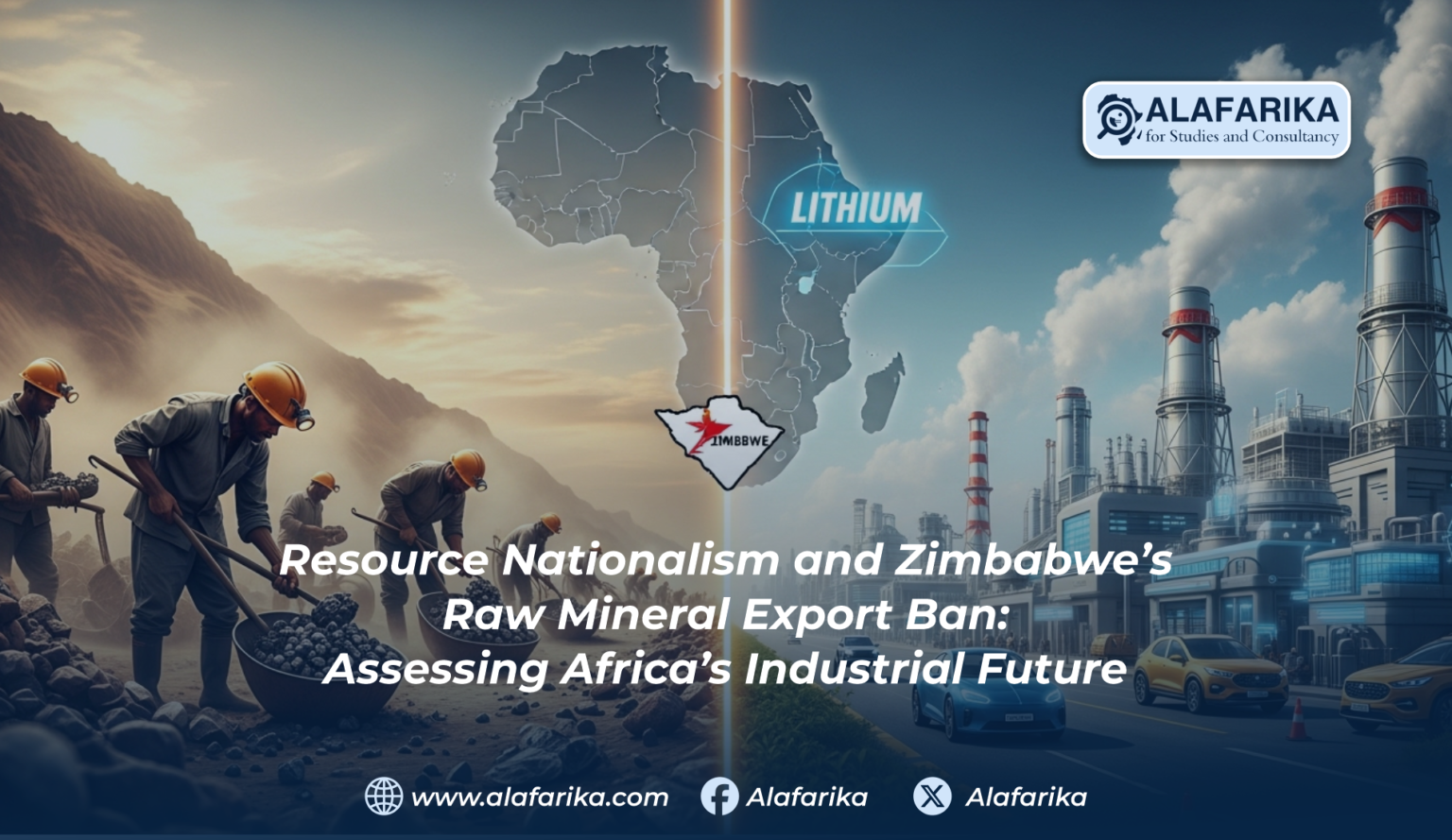
African governments in recent times have increasingly begun to reconsider how their natural resources are extracted and traded in the global economy. For many years, African countries have sold huge quantities of raw minerals to the global market while buying back finished industrial products at far higher prices. This arrangement has kept many resource-rich economies exposed to the unpredictable swings of global commodity markets. In the same vein, the most profitable stages of production, which is refining minerals and turning them into finished products, are most often carried out outside Africa. But as global demand for critical minerals continues to grow, particularly those used in cleaner energy technologies, a lot of policymakers across the continent are starting to question whether this long-standing arrangement truly serves Africa’s long-term interests.
Zimbabwe is akin to being a key example in this debate. The country has vast deposits of lithium, a mineral widely used in the batteries that power electric vehicles, renewable energy storage systems, and a range of modern electronic devices. Acknowledging the growing value of this resource, the Zimbabwean government in 2022 placed restrictions on the export of unprocessed lithium ore. The move was intended to curb the steady outflow of raw minerals and encourage investment in domestic processing industries so that more value can be created within Zimbabwe before the resources leave the country. According to the International Energy Agency policy database on Zimbabwe’s lithium export controls, the restriction formed part of a broader effort to stimulate local mineral beneficiation and strengthen industrial development within the country.
For Zimbabwean authorities, the decision reflects a growing awareness that simply exporting raw minerals does little to transform a national economy. Mining can generate government income through taxes and royalties, but the largest economic gains usually come after the minerals leave the ground. The real value is created in what happens next—when the minerals are refined, manufactured into products, and used in new technologies. These kinds of activities create skilled employment, strengthen local industrial expertise, and allow new technologies to spread through the broader economy. By restricting the export of raw lithium, Zimbabwe hopes to draw investors willing to establish processing facilities within the country and help it move into more advanced and profitable segments of the global battery supply chain.
Resource Nationalism and Strategic Minerals
Analysts opined that Zimbabwe’s decision can also be seen from the lens of a wider policy approach often referred to as resource nationalism. In other words, it connotes steps taken by governments to exercise stronger control over their natural resources so that a larger portion of the economic benefits remains within their own countries. Across many African countries, the idea of resource nationalism has gained fresh attention as governments grapple with a difficult reality: the continent is rich in minerals, yet industrial growth has remained limited. Despite having large deposits of valuable resources, much of Africa still exports them in raw form while the real industrial and technological gains happen elsewhere.
Research have shown that Zimbabwe’s policy attracted even more attention this year when the government expanded its restrictions on mineral exports as part of a wider strategy to tighten oversight of the mining sector and ginger local processing. International media reports also indicated that authorities had banned the export of raw minerals and lithium concentrates. The step was aimed at reducing losses linked to uncontrolled exports and encouraging investors to process the minerals inside the country rather than sending them abroad for refining. This development was reported by Reuters’ report on Zimbabwe’s suspension of raw mineral and lithium concentrate exports.
Table 1: Zimbabwe Lithium Sector Overview
| Indicator | Description |
| Export policy | Ban on export of unprocessed lithium ore |
| Policy expansion | Suspension of raw mineral and lithium concentrate exports |
| Strategic importance | Lithium used in EV batteries and energy storage systems |
| Development objective | Promote domestic mineral processing and industrialisation |
** Source: IEA reports and policy database & Reuters reports.
The Industrialisation Argument
Many who support export restrictions often stand their ground that they can play a key role in driving industrial growth. This may be due to the fact that, when countries export raw materials without processing them domestically, they capture only a small portion of the value chain. The refining and manufacturing stages in which significantly higher economic value is generated typically happen in countries with established industrial capacity.
Thus, Zimbabwe’s lithium policy therefore reflects a strategic move to shift this dynamic. According to some economists, encouraging investors to establish processing plants within a country, policymakers can create jobs, expand industrial capacity, and increase export revenues from higher-value products such as lithium concentrates or battery-grade chemicals in the case of Zimbabwe.
But be it as it may be, industrial transformation hardly occurs through policy restrictions alone. This is because a strong processing industry requires basic conditions like reliable electricity, transport infrastructure, skilled labour, and stable regulatory frameworks. Without the aforementioned, export restrictions may discourage investment rather than attract it.
Comparative Policies Across Africa
Just as African governments are (now) seeking to capture more value from their natural resources, Zimbabwe’s strategy is reflecting a broader trend.
According to media reports, Namibia, for instance, had also announced in 2023 that it would restrict the export of certain unprocessed critical minerals parts of which included lithium and rare earth elements. This was also to promote domestic beneficiation and encourage investment in local processing industries. The development was reported by The Brief Namibia report on the ban of unprocessed lithium and critical mineral exports.
Table 2: Selected African Policies on Mineral Value Addition
| Country | Policy | Target Minerals |
| Zimbabwe | Ban on export of raw lithium ore | Lithium |
| Zimbabwe | Suspension of raw mineral exports | Lithium and other minerals |
| Namibia | Ban on export of unprocessed minerals | Lithium, cobalt, rare earth minerals |
** Source: IEA, Reuters, The Brief.com
Africa and the Global Energy Transition
As countries around the world push for cleaner energy, attention is gradually turning to the minerals that make those technologies possible—and many of them are found in Africa. Usage of electric cars, solar panels, wind turbines, and large battery systems have all proven to be dependent on materials such as lithium, cobalt, copper, and graphite to function.
Meanwhile, several African countries are believed to be holding substantial deposits of these resources, which means the continent has become a proof to the global shift toward renewable energy.
A report by the International Energy Agency on critical minerals and clean energy transitions notes that meeting global climate goals will require a major increase in the supply of these materials in the coming decades. In simple terms, the push for cleaner energy will drive an unprecedented demand for the very minerals that several African countries possess in large quantities.
Conclusion
Zimbabwe’s decision to ban the export of raw lithium ore is therefore more than just a policy adjustment in the mining sector. More broadly, the decision also shows a change in how some African governments are beginning to look at their natural resources and the role those resources should play in economic development.
The thinking behind the policy is fairly simple. For decades, many countries have exported minerals in their raw form, while the real processing and manufacturing—and the higher profits that come with them—take place elsewhere. Zimbabwe is now trying to shift that pattern. By restricting the export of raw lithium, the government is trying to strategize in making companies start processing more of the mineral within the country instead of just shipping it out unrefined.
If that happens, the benefits could be real. Local processing could create jobs, encourage new businesses to grow around mining, and let the country keep a bigger share of the value from its own resources.
But reality is, this kind of policy may not succeed on its own. It is very important to have a solid foundation which means building a strong processing industry as it takes more than just export limits. There is a need for reliable electricity, good roads and transport, skilled workers, and investors and then public private partnership in order to set up large-scale operations.
With global demand for key minerals only expected to rise, choices like this will matter a lot. They could decide whether African economies stay mainly as raw material suppliers or start playing a bigger role in the industries built around those resources.
The question is whether the continent will continue mainly as a supplier of raw materials—or gradually become a stronger player in the industries that power the global economy of tomorrow.