- Understanding Democratic Legacy
- Case Study I: Zimbabwe’s Legislative Term Extension 2026
- Case Study II: Democratic Republic of Congo’s Legislative Term Extension 2026
- Case Study III: Somalia’s Legislative Term Extension 2026
- Comparison of the Three Cases
- Implications on Democratic Legacy in Africa
- Policy Recommendations for African Regional Bodies
- Conclusion
The African continent has witnessed a quiet but significant shift in democratic norms within the first half of 2026. Between February and June of 2026, three African states—Zimbabwe, the Democratic Republic of Congo, and Somalia—experienced remarkably similar legislative processes to extend the terms of their current executives and legislatures and reconstitute the social contract between citizens and the executive that governs them, as implemented by the legislature.
Zimbabwe saw constitutional changes approved by lawmakers extend presidential and parliamentary terms from five to seven years, keeping President Mnangagwa in office until 2030. The DRC approved a bill to reset the presidential terms, paving the way for President Tshisekedi to seek a third term, moving beyond the two terms mandated constitutionally. Somalia’s Federal Parliament extended presidential and parliamentary terms from four to five years, pushing scheduled elections from 2026 into 2027.
The central question this analysis addresses is whether these extensions represent adaptive and legitimate governance responses to the crisis that these countries face or whether they constitute a more systematic pattern of democratic backsliding dressed in constitutional legality, taking a close look at how these countries, despite their different political systems, used the exact same tool of parliamentary term extensions to reshape the term limit of executive power.
Understanding Democratic Legacy
A nation’s democratic legacy refers to the ultimate resilience of a political system’s norms, institutional memory, and democratic future. This legacy can be assessed through the evaluation of four interconnected pillars, namely, institutional continuity, electoral integrity, peaceful transfer of power, and constitutional supremacy.
This explains that upholding a democratic legacy demands the transition of power according to stable pre-established laws and elections that remain genuinely competitive with credible opposition. It also requires incumbents to leave office when constitutionally required and allows the constitution to function as a binding constraint on the executive.
In the cases of Zimbabwe, DRC, and Somalia, it is important to look through the lens of analytical evaluation of these pillars to determine which of them each case erodes.
Furthermore, to understand how leaders extend their power today in democratic systems, it is crucial to look at two political concepts, namely, constitutional retrogression and stealth authoritarianism.
Constitutional retrogression explains that modern leaders rarely use violence to stay in power, just like the old-school military coups of the 20th century. They rather opt for weakening democratic norms from within through legal channels, which can be legitimately defended to keep them in power for as long as they desire.
Under stealth authoritarianism, leaders use democratic tools like courts, parliaments, and/or public consultations to achieve anti-democratic goals. On the surface, everything looks perfectly legal and democratic because rules were followed. However, what lies beneath is an act of undermining the legacy of democracy.
Both concepts perfectly explain the cases of Zimbabwe, the DRC, and Somalia, as none of their presidents simply expressed an interest in the extension of their term limits. Instead, they chose to tread the path of official parliamentary processes to guarantee the legitimacy of term extensions/resets.
Case Study I: Zimbabwe’s Legislative Term Extension 2026
In June 2026, the Zimbabwean parliament passed a constitutional amendment bill known as the Constitution of Zimbabwe Amendment (No 3) Bill, which brought a major change to the country’s political calendar. The bill extends the terms of the president, parliament, and local authorities from five to seven years and also prolonged the next general elections from 2028 to 2030. This automatically grants an immediate two-year term extension to President Emmerson Mnangagwa.
The government followed a legal procedural route by upholding the formal rules required to amend the constitution in order to maintain an appearance of legitimacy. These rules include the formal gazette of the bill; a mandatory 90-day public notice and consultation and hearings, which ran from late March till May; and parliamentary approval, which recorded a majority approval, with 216 votes in favor to 42 against in the National Assembly and 75 in favor to 4 against in the Senate.
Zimbabwe’s General Election Data, 23–24 August 2023

Turnout: 69% Presidential margin: 8.6 pts Total seats: 280 2/3 majority needed: 187
Notably, the term extension is only one part that constitutes a broader structural restructuring. Other parts of the changes include the replacement of direct presidential elections with a selection that shall be done by a joint sitting of parliament. Also, the bill approved the expansion of the Senate from 80 to 90 seats, with the president empowered to appoint ten additional senators.
President Mnangagwa, who took power via the 2017 military coup that ousted Robert Mugabe, was constitutionally required to step down in 2028 after two five-year terms. He currently faces a bitter rivalry with his vice president, Constantine Chiwenga, who is widely seen as the next in line and is reportedly against the tenure-extension bill. By pushing the next election to 2030, the constitutional amendment, from all indications, proves to be much of an intra-party score-settling/struggle as an executive versus an opposition one.
Case Study II: Democratic Republic of Congo’s Legislative Term Extension 2026
Unlike Zimbabwe’s direct constitutional amendment, the DRC’s process was indirect as a bill, which established the framework for a referendum through which the two term limits noted in the constitution can be abolished or revised. The ultimate goal of this referendum was to put an entirely new constitution before the public, creating a brand new republic and resetting the presidential term-limit clock to zero.
This will constitutionally permit incumbent president Tshisekedi to serve what would technically be his “first” term under the new rules. The parliament, being dominated by the ruling party, passed the referendum-proposing bill, despite strong rejection and boycott from the opposition.
President Tshisekedi, who has been in office since 2019, and whose tenure is due to end by 2028, has been accused of planning to stay in power beyond the two-term limit, long before the referendum idea came out. He immediately debunked the accusations and framed his position publicly passively, insisting publicly that he has not asked for a third term but would accept one if the people of the Congo wanted it.
DRC’s General Election Data, 20 December 2023

Turnout: 43% Registered Voters: 44 million Votes Cast: 18 million Margin: 55pts
The main defense given by the government for rewriting the constitution focuses on the ongoing security crisis in the eastern DRC, where the state is locked in conflict with the Rwanda-backed M23 rebel group. President Tshisekedi openly stated in May 2026 that elections cannot be organized in 2028 unless the conflict in North and South Kivu gets fully resolved. This statement also signifies on the surface that a delay or possible extension may be unavoidable on logistical grounds, far away from any third-term ambition. Apparently, this gives the DRC’s case a legitimacy argument.
In response to this development, the main opposition parties joined forces with prominent civil societies and formed a coalition known as the C64, specifically created to oppose the referendum bill. Tensions escalated into violence in June when a protest outside the parliament in Kinshasa was dispersed by the police force using tear gas after reported clashes between opposition and pro-government activists.
The referendum push also met fierce resistance from religious bodies. The highly influential Catholic Church issued its opposing stance to the referendum. Speaking through the National Episcopal Conference of Congo (CENCO), it declared that altering the constitution at this time risks pushing the war-torn country deeper into political chaos.
Case Study III: Somalia’s Legislative Term Extension 2026
Somalia’s Federal Parliament approved massive historic constitutional amendments on March 4, 2026. The joint session of parliament voted to extend the terms of all elected federal institutions—including the presidency and both legislative chambers—from four to five years. Unlike the DRC’s pending referendum mechanism, this amendment is a completed, operative legal act, as no popular ratification step stood between passage and implementation.
Speaker Sheikh Adan Mohamed Nur (Madobe) publicly confirmed that the extension applies immediately to incumbent office holders, granting President Hassan Sheikh Mohamud and the sitting parliament an immediate one-year extension on their current mandate, which is expected to end this year, delaying the federal elections originally scheduled for May 2026 until May 2027.
The new amendments moved Somalia from a semi-presidential system to a powerful, unified presidential model. It also replaced the clan-based indirect voting system, whereby elders choose lawmakers, who in turn chooses the president, with the adoption of a “one-person, one-vote” model. Although Somalia’s government defended the extra year as a logistical necessity, arguing that building a nationwide, direct voting infrastructure from scratch is impossible within the old four-year timeline.
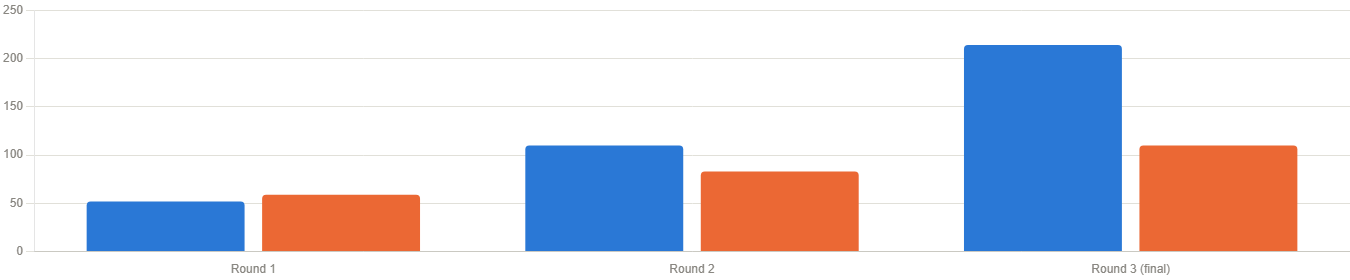
Somalia — Indirect Presidential Election, 15 May 2022
Hassan Sheikh Mohamud Mohamed Farmaajo
(Total votes: 214) (Total votes: 110)
However, the consequences have begun to materialize since the journey towards this constitutional changes began in 2024. Puntland State’s leadership, which had already withdrawn recognition of the federal government in March 2024 over earlier constitutional amendments, reaffirmed its rejection of Mogadishu’s authority following the March 2026 vote, maintaining that it would operate independently until a truly inclusive national consensus is reached. Jubaland State, a member of Somalia’s five Federal Member States, which had similarly suspended relations with the federal government in late 2024, followed suit in deepening its non-recognition stance.
Also, South-West State’s president, Abdiaziz Laftagareen, who was an early ally of Mohamud, sought re-election under his own state’s electoral timeline in defiance of the newly approved calendar. However, the federal government responded by forcing him to resign from his post and replace him with the sitting Federal Parliament Speaker, Madobe, who had presided over the term-extension vote.
Comparison of the Three Cases
While the legislative term extensions between January and June 2026 arose from different geographical regions—Southern Africa (Zimbabwe), Central Africa (the Democratic Republic of the Congo), and the Horn of Africa (Somalia)—with different political systems (the DRC’s semi-presidential system, Zimbabwe’s unitary presidential system, and Somalia’s federal parliamentary system), it is crucial to analyze where the adopted concepts and strategies differ and where they align, in a bid to unravel how African regimes adapt the tools of law and governance to suit their specific domestic needs.
What the Three Cases Have In Common
Despite an evident difference in political systems, governments of Zimbabwe, the DRC, and Somalia succeeded in extending their term limits through legal channels via similar strategies that include utilizing public consultation as a tool of legitimacy, bypassing direct public voting, and justifying term limit extensions by reforms and stability.
In all three cases, the required public hearings or notice periods didn’t gain genuine traction to gather public input. Rather, the scope of public consultations was merely treated as compliance check boxes that had to be ticked. In Zimbabwe, the government reported the consultation as “widely supported,” while opponents alleged it was marred by intimidation. In Somalia and the DRC, they were rushed through while bypassing key political stakeholders.
Also, there was a noticeable avoidance of the true actualization of referendums. Somalia and Zimbabwe bypassed a referendum entirely via parliamentary supermajority to change their voting systems, while the DRC passed a bill to rewrite the constitution, hence resetting the term limit to zero.
Notably, none of these leaders presented a bill that explicitly states that they’ll stay in power longer. Rather, the term-limit extensions were clothed in major structural reforms. Zimbabwe attributed its extension to its Vision 2030 economic development plan, the DRC justified it with ongoing instability in the eastern part of the country, and Somalia wrapped its extension inside a historic transition to a direct universal voting system.
Zimbabwe’s case represents a constitutional retrogression model in its purest form: a single dominant party using a legally available supermajority route, reinforced by public consultation theater and no referendum, to accomplish an outright executive-term extension plus a bunch of institution-weakening provisions. It builds directly on precedent—the 2021 Amendment No. 2—suggesting a pattern of incremental amendment rather than one-off crisis response and offers the clearest evidence among the three cases of amendment being used explicitly to resolve an internal succession dispute in the incumbent’s favor.
What Sets the Three Cases Apart?
The political processing that facilitated each of the cases of term limit extension was completely different. Zimbabwe depended on absolute single-party dominance, using ZANU-PF’s parliamentary majority to approve term extensions and silence opposing voices. The DRC had to navigate complex coalition politics, with the ruling alliance engineering a constitutional reset to manage a highly fractured and volatile legislative environment. Somalia acted within a fragile federal framework, where the central government’s parliamentary vote triggered immediate regional fragmentation and a total breakdown in relations with member states.
In two of the three cases, the escalation of armed conflicts was presented as a justification of term extension. The rise of the M23 rebel insurgency in the DRC and Al-Shabaab terror activities were acknowledged as primary actors behind the constitutional changes. On the other hand, Zimbabwe pushed through its extension in a state of total domestic peace, relying instead on long-term economic development goals to justify the shift.
The ability of opposing forces and civil societies to resist these extensions varied sharply across the three nations. The DRC displayed the strongest civic resistance. The term limit was challenged by a highly unified opposition, “the C64 coalition,” which brought together previously divided parties. This force was backed by influential civil society groups and the powerful Catholic Church. They successfully launched mass street protests, turning the constitutional revision into a highly contested battle.
In Somalia, the political opposition was only vocal in its resistance but relatively weak on its own. However, it later gained massive leverage because powerful regional states like Puntland and Jubaland, who are among the federal member states, completely broke ties with the central government. Somalia’s authorities are now focused on neutralizing the resistance region by region, rather than facing a unified opposition front.
In Zimbabwe, the opposite is the case. Resistance from the opposition was weak, as they lacked the mobilization power to stop the constitutional change despite filing a number of court challenges.
Implications on Democratic Legacy in Africa
The constitutional changes witnessed in Zimbabwe, the DRC, and Somalia within the first half of 2026 carry weighty implications for Africa’s democratic legacy. These changes signify the emergence of a new systemic transformation occurring across the continent. When the practice of extending mandates or resetting term limits under the guise of parliamentary legalism becomes a norm across different sub-regions, such a norm will definitely alter the trajectory of African democracy.
For decades, African democracy was faced with the threat of military coups. However, this threat has become more complex with the events of 2026 in Zimbabwe, the DRC, and Somalia compounding the threat. Governments are now adopting constitutional coups to undermine democratic legacy. In addition, elections were designed to serve as a performance review medium, through which citizens can either renew a leader’s mandate or peacefully vote them out. When terms are extended or reset, the link between executive performance and accountability is broken.
Preserving a democratic legacy relies on citizens and political actors believing that the constitution protects their rights and constrains the powerful. When supreme laws are treated as flexible political scripts that can be edited whenever a sitting president faces a hard exit deadline, public trust in state institutions collapses quickly as citizens tend to lose faith in democratic processes.
Ultimately, a nation’s democratic legacy is solidified by the peaceful transfer of power after credible elections. The cases of Zimbabwe, the DRC, and Somalia directly undermine this principle and pose massive risks for the routine practice of peaceful power transfer. Should this norm become widely adopted, the continent risks sliding back into an era of indefinite rule, leaving future generations with weaker institutions and a fractured democratic legacy.
Policy Recommendations for African Regional Bodies
Across all three cases, African regional bodies, notably the AU, SADC, and IGAD, have generally adopted a pattern of quiet diplomacy, holding to the principle of non-interference in the internal affairs of member states. There hasn’t been any direct condemnation from any of them so far, despite the necessity to preserve democratic legacy in Africa being a primary objective for them.
This is the time for African regional bodies to reform their approach to governance. There is a need for the revision of their foundational frameworks on democracy and governance to prevent the further override of democratic legacy in Africa and safeguard constitutionalism.
It is necessary to expand the definition of an unconstitutional change of government beyond military coups. Securing a term extension or term limit reset through constitutional manipulation/parliamentary majority should be treated as an unconstitutional grab for power.
It is required from the AU and sub-regional blocs to introduce clear and precise penalties for countries that disrupt established constitutional timelines under the legislature’s cover. These bodies must strictly steer away from simply asking if the bills were passed by a two-thirds majority in Parliament and assess the substantial legitimacy of the process.
Conclusion
The 2026 term extension cases of Zimbabwe, the DRC, and Somalia join a longer list of African states, such as Togo, Cameroon, and Uganda, where incumbents have used constitutional amendments to extend rule. What makes the 2026 cases different is that through these constitutional shifts, governments have demonstrated that modern democratic backsliding relies undoubtedly on rewriting the law systematically.
These actions fracture the democratic legacy of African states. In Zimbabwe, the democratic legacy of accountability between the public and the executive is being threatened by bypassing direct voting in presidential elections. In the DRC, the legacy of the 2019 transition, which is the country’s first peaceful transfer of power, now risks getting fractured by the 2026 term reset.
In Somalia, the legacy of peaceful exits, which distinguishes the country from many regional neighbors, is now being sacrificed for political survival. These three cases altogether indicate that the primary threat to democratic legacy in Africa today is not just the act of term extension but the normalization of legal procedures as a reliable and easy route to indefinite incumbency.