For many African economies, the promise of long-term growth and structural transformation is becoming increasingly entangled with a more sobering reality: rising sovereign debt and shrinking fiscal space. As 2026 unfolds, the continent is approaching what financial analysts describe as a major “debt wall”, with Africa’s external debt repayments projected to exceed $90 billion in that year alone. It is a figure that is more than three times higher than what most African countries were servicing barely a decade ago, and it comes at a time when fiscal revenues remain weak and uneven across the region.
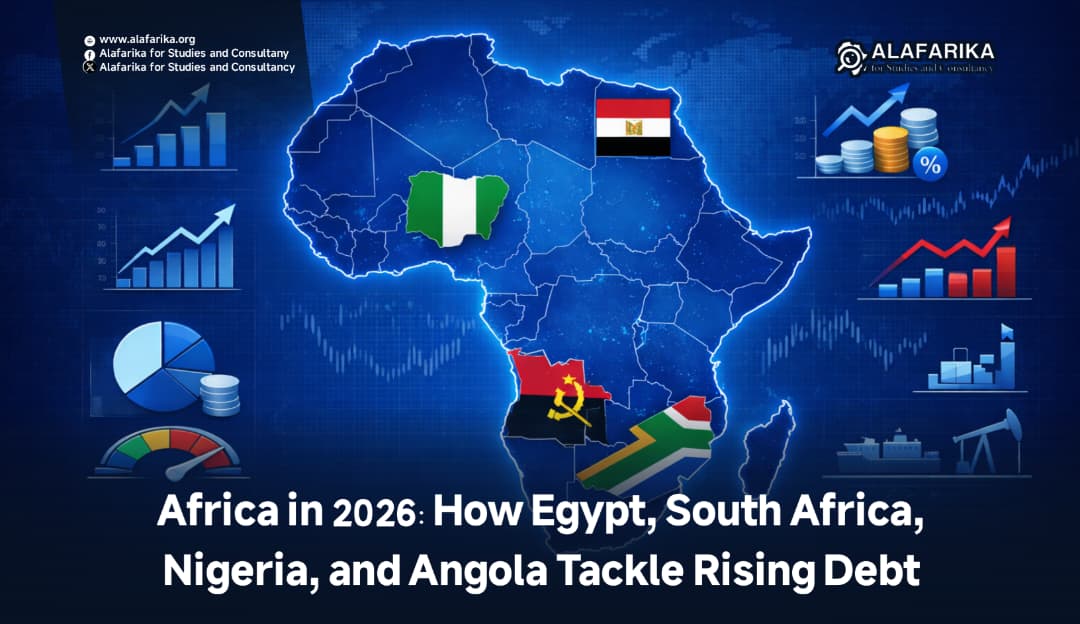
Africa’s total external debt stock reached approximately $1.15 trillion, accounting for around 60 per cent of total public debt across the continent, according to the World Bank’s International Debt Statistics 2025. A small group of countries now carries a disproportionate share of this burden. South Africa, Egypt and Nigeria alone account for more than one-third of Africa’s total external debt, with Angola close behind. What makes this concentration particularly risky is that these same economies are also facing the heaviest repayment schedules in the coming years.
S&P Global Ratings estimates that by 2026, Africa’s external debt repayments will surpass $90 billion, with Egypt alone responsible for nearly $27 billion of that total. South Africa, Nigeria and Angola are expected to account for much of the remaining obligations. These repayments are not merely interest payments but large principal amounts, meaning governments will need to either mobilise significant foreign exchange reserves or return to international markets to refinance existing loans.
The 2026 “Debt Wall”: A Continental Picture
Africa’s debt trajectory over the past decade has been shaped by three overlapping forces: infrastructure financing needs, commodity price volatility, and the global shift toward tighter monetary conditions. After the COVID-19 pandemic, many African governments borrowed heavily to stabilise their economies, fund social spending and manage currency pressures. At the same time, rising interest rates in advanced economies have made borrowing more expensive, particularly for countries with weaker credit ratings.
The result is a sharp increase in both debt stocks and repayment obligations. According to the African Development Bank (AfDB), Africa’s average public debt-to-GDP ratio rose from about 40 per cent in 2013 to over 65 per cent by 2024, with several countries now exceeding the 80 per cent threshold considered risky for emerging markets. Meanwhile, the recent reporting has revealed that external debt stock reached about $1.15 trillion.
Debt Stock: Angola, Nigeria, South Africa, Egypt
| Country | Debt Stock ($bn) | Source |
| Egypt | $155–165 billion
| Egypt’s total external debt reached approximately $161.2 billion by the end of June 2025, according to the Central Bank of Egypt (CBE). |
| South Africa | $193.05 billion
| External debt data for South Africa, showing gross external debt reaching ~USD 193.05 billion in Q3 2025 — 42% of GDP with short-term debt near USD 47.1 billion.
|
| Nigeria | $369 billion | Nigeria’s Debt Management Office reported that the country’s total public debt reached N152.40 trillion ($369 billion) as of June 30, 2025. This is an increase from N149.39 trillion ($362 billion) at the end of March 2025 |
| Angola | $58-60 billion | World Bank / Afreximbank reporting on external debt stocks for African economies. |
This is the core of Africa’s debt dilemma. The problem is not only how much countries owe, but how much they earn. Weak tax systems, large informal economies and narrow export bases mean that even “moderate” debt levels can become unsustainable in practice.
Four Different Paths, Same Problem
Egypt offers perhaps the clearest illustration of the scale of the challenge. With an external debt ratio approaching the low 90 per cent range of GDP by 2026, Cairo faces enormous fiscal pressure. An ever-larger chunk of government revenue is being eaten up by debt repayments, leaving little space to invest in schools, hospitals, or safety nets for the economy. At the same time, the country has had to turn again and again to the International Monetary Fund, securing more than $8 billion in support between 2022 and 2025. While this has helped stabilise foreign reserves, it has done little to address deeper, long-standing problems such as weak export competitiveness and a fragile currency.
South Africa, by contrast, presents a slightly different picture. Even with debt levels that are high by African standards, the country still benefits from deeper financial markets and stronger fiscal institutions. The country has also leaned more on development finance, especially from the World Bank and the African Development Bank, to support infrastructure and energy transition projects.
Nigeria’s debt story reflects a different vulnerability. While its external debt stock is smaller than Egypt’s or South Africa’s in absolute terms, Nigeria has become one of Africa’s fastest-growing borrowers. Oil revenues, which account for over 70 per cent of foreign exchange earnings, remain volatile and increasingly unreliable.
Angola presents perhaps the starkest warning sign. According to Angola’s 2026 budget framework, nearly 46 per cent of total government spending is allocated to debt servicing. In practical terms, almost half of public resources are devoted not to development, but to repaying creditors.
Debt Servicing, Revenue Weakness and the Structural Trap
The IMF Fiscal Monitor indicates that Africa’s average tax-to-GDP ratio remains below 16 per cent, compared to over 25 per cent in OECD economies. This means African states simply have less revenue to manage rising obligations.
Debt Service as Share of Government Revenue (Latest Available, 2025–2026)
| Country | Debt Service / Revenue (%) | Source |
| Angola
| ≈ 58–60% of GDP; debt service ≈ 28.9% of exports
| Trading Economics (Angola Government Debt & Debt Service Projections, 2025–2026)
|
| South Africa
| Debt-to-GDP: 77.4% (≈ $701bn); revenue underperformance limits debt service capacity
| South African Revenue Service (SARS), National Treasury data, 2025 via World Economics.
|
| Nigeria
| 71.8% of total federal revenue
| Nigeria Budget Office – 2026–2028 Medium-Term Expenditure Framework (MTEF)
|
| Egypt
| 96% of total budget revenue (first 5 months FY 2025/26)
| Egypt Ministry of Finance, Monthly Fiscal Report (July–November 2025) |
When government revenues are low, borrowing can seem like a simple way to keep things moving. But as noted in a publication titled “The Debt Trap: How Borrowing Can Lead to Economic Collapse”, repaying those loans often makes the problem worse, locking governments into a cycle of debt just to stay afloat. Over time, interest payments start to eat up a larger share of the budget, leaving less for development, social services, or the kinds of investments that could actually strengthen the economy.
Possible Scenarios
The first scenario is stabilisation through structural reform. In this path, governments successfully expand their tax bases, improve revenue administration, deepen domestic capital markets and prioritise productive spending. In theory, debt levels can stabilise or even fall if the economy grows faster than new borrowing. From an economic point of view, that is the ideal outcome. In practice, however, it is much harder to pull off politically. It demands steady reforms, firm control over public spending, and institutions strong enough to maintain discipline over the long term.
A more likely path under today’s conditions is continued debt build-up, coupled with growing refinancing risks. Revenue growth is still sluggish, even as repayment pressures continue to mount. When governments face this kind of pressure, they often return to borrowing—this time at higher interest rates. That only makes them more vulnerable, increases the risks of having to roll over debt, and ties their financial stability even more closely to the ups and downs of global markets.
Another path is debt restructuring, usually with the backing of multilateral institutions. Countries under serious financial pressure may turn to support from programs like the G20 Common Framework or IMF-backed loans. These deals can offer a short-term lifeline, but they usually come with strict conditions, austerity measures, and the real risk of political pushback at home. Looking at current trends, the second scenario still looks most likely.
Debt as Africa’s Defining Economic Challenge
Africa’s debt crisis is no longer just a financial problem; it has become a deeper governance challenge. As more resources are channelled toward debt servicing, governments face growing difficulty meeting basic development needs. Infrastructure gaps continue to widen, social spending is under growing pressure, and public trust in state institutions keeps eroding.
In this year 2026, Africa stands at a critical turning point. The decisions being taken now between reform and stagnation, real investment and mere consumption, openness and secrecy will ultimately shape whether debt turns into a springboard for growth or remains a heavy burden on the continent’s future.