In Nigeria, the North-East has remained a hotspot for insurgency, primarily driven by groups such as Boko Haram and Islamic State West Africa Province (ISWAP). Despite numerous military campaigns, these groups have morphed in structure and tactics, posing sustained threats to regional stability. However, this understates the complexity and multidimensional nature of Nigeria’s security challenges, which impact all of the country’s regions. At the same time, armed violence is not omnipresent across Nigeria and is primarily concentrated in specific geographic corridors. The Lakurawa first emerged in northwest Nigeria in 2018, when the group started helping locals fight armed gangs known as bandits, local media reported. But the relationship soon soured as residents began accusing Lakurawa of stealing their cattle and seeking to impose strict Islamic law. The group retreated to the border areas of Niger and Mali but would make some incursions into Nigeria. Nigeria defence spokesperson Edward Buba said the group was not initially considered a threat. He said Lakurawa increased its presence in Nigeria after the July 2023 military coup in Niger, which brought a stop to joint military patrols along the countries’ borders.
Meanwhile, the group which was once dislodged in 2020 by combined security agencies in the country later regrouped in December 2023. Sources revealed that the Lakurawa group was invited by local leaders in Gudu and Tangaza LGAs of Sokoto State in 2017 to address the growing threats of bandits in Zamfara State. However, news broke out in 2018 that the group was a terror group cloaked as herdsmen. Since their regrouping in 2024, their activities have expanded. They had set up camps in 10 local government areas of Sokoto and Bauchi states before their operations became exposed to the public. The north-west is currently Nigeria’s most terrorised region with four states in the region among the top 5 states with the highest number of kidnapping incidents between July 2023 and June 2024. Zamfara, Katsina and Kaduna emerged the top 3, with Sokoto coming 5th.
Behind Lukarawa’s Threat.
Lakurawa is not an entirely new phenomenon. The group’s ideological and operational framework stems from Jama’atu Muslimina [Jama’atu Ansarul Musilimina Fi Biladis Sudan (henceforth, JAMBS) or Ansaru], a Mali-based network notorious for its extremist doctrines. Their penetration into Nigeria, particularly through Sokoto and Kebbi States, has revealed a calculated strategy: exploiting local grievances, leveraging hunger, and filling governance gaps with their form of extremist order. Since its emergence, JAMBS has claimed responsibility for various acts of terrorism such as armed attack on a detention facility, ambushing of Nigerian soldiers, and strings of kidnapping of foreign expatriates.
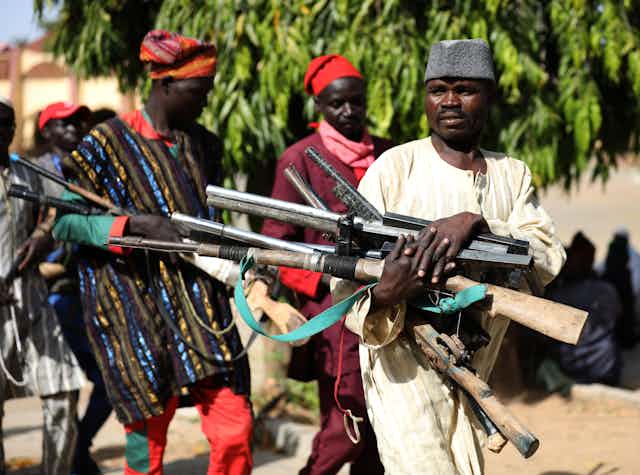
According to observers, communicating in Hausa, Fulfulde, and Arabic, the group’s members are believed to be aged between 18 and 50 years. They have been terrorizing villages by imposing and collecting taxes on cattle. Victims recounted that they come to count the number of cattle in households and calculate taxes to be paid based on percentage taken from the cattle. The itinerant group which experts believe are interested in establishing their own caliphate move from community to community on motorcycles, making it difficult for security operatives to identify their exact location. It was disclosed that the group has between 1,500 and 1,800 followers, but this number has been debunked by other observers that believe their membership is still below 500. Reports show that the group has been luring locals with money, farm inputs, and pumping machines, and like Boko Haram terrorist recruitment strategy, several people have joined Lukarawa because of poverty and hunger. Residents of the affected communities are afraid to report members of the Lukarawa because of threats against them, as the group’s current recruitment drive aims at increasing their numbers.
For instance, what makes Tangaza and Gudu local government areas an easy location for the group? Data from the 2022 Nigeria Multidimensional Poverty Index shows that Tangaza and Gudu are among the poorest areas in Sokoto, with extreme poverty rates of 92.5% and 57.5%, respectively. They are also the least educationally developed localities, with an annual increase of about 58% in out-of-school children. The Lakurawa group is tapping into these conditions to fuel its recruitment, capitalising on high unemployment, poverty, low educational attainment, and limited access to healthcare. Nigeria’s porous borders further complicate matters, creating large expanses of unmonitored spaces that provide fertile grounds for different criminal groups. However, another insurgency could further destabilise the region and suck an already stretched military into a long-drawn fight, security analysts told Reuters News Agency. James Barnett, a research fellow at the Hudson Institute who has conducted fieldwork in the northwest, noted that “the fact that (Lakurawa members) engage in preaching and impose harsh edicts on local communities indicates they are ambitious, potentially thinking big picture about eventually extending their territorial influence to Nigeria.”
Towards Counquering Lukarawa’s Rise In Nigeria.
The Nigerian government, undoubtedly, understands the magnitude of the security threats it faces, and its apparent limitations, and has called for assistance. The rise of Lakurawa has brought Nigeria’s security challenges into sharper focus on the global stage. As the largest economy in Africa, Nigeria’s stability is crucial for the region. The international community, particularly organisations like the African Union (AU) and the Economic Community of West African States (ECOWAS), has a vested interest in supporting Nigeria’s counter-terrorism efforts. The ongoing joint operations with Chad and Niger signal a positive step toward regional collaboration. However, the success of these efforts will depend on sustained political will, adequate funding, and effective coordination among all stakeholders. The recent resurgence of military coups in the region further complicates the security landscape, as political instability often creates a vacuum that extremist groups are quick to exploit. The need for a comprehensive regional security framework has never been more urgent. Initiatives like the G5 Sahel Joint Force and the Multinational Joint Task Force (MNJTF) offer valuable lessons in cooperative security efforts. Nigeria must leverage these platforms to enhance its operational capabilities and address the cross-border nature of the Lakurawa threat.
Additionally, there is a need for more intelligence and security agencies must deploy agents on clandestine missions to live among, identify and route out elements of the organization before their activities become more prevalent. At the same time, community leaders and political leaders must work to alleviate poverty and deny the terror group the opportunity to recruit more locals. The government should take quick action to uproot them before they take root in Sokoto, Kebbi and Bauchi states. Security agencies must also take decisive steps to prevent them from establishing partnerships with other bandits and terrorists in the northern region of Nigeria. Nigeria’s security architecture must take decisive steps to cut Lukarawa off from partnering with other terrorist organisations like Boko Haram, ISWAP, JNIM, AQIM, Ansaru who are active in West Africa and the Sahel. This is to ensure that they do not become a greater security threat for the country and sub-region. Nigeria’s porous borders remains a major problem, and the federal government must ensure that are well policed and that technology is deployed to monitor the border activities. The porosity of Nigeria’s borders poses serious threats to the country’s national security by enhancing the infiltration of criminals and small arms into the country through the border communities. Securing the nation’s borders will enhance security operative’s goal in flushing out terrorist and criminal organisations and decimating their transportation and supply routes. Finally, a forward-looking approach that integrates technological advancements, community participation, and enhanced intelligence capabilities will be crucial in addressing the complex security environment of the future.