The climate impacts of our trash are becoming harder to ignore. Solid wastes are the unwanted substances that are discarded by human society. These include urban wastes, industrial wastes, agricultural wastes, biomedical wastes, and radioactive waste. It contributes directly to greenhouse gas emissions through the generation of methane from the anaerobic decay of waste in landfills and the emission of nitrous oxide from our solid waste combustion facilities.
Increasing climate variability in Nigeria is causing more intense and untimely rainfall. Adding to land degradation, flash floods, landslides, and gully erosion have worsened across one of the ten most vulnerable countries to climate change impacts. The residents dispose of their garbage on unlawful dumps, in open areas, in water bodies, or in storm drainage channels because the community is not involved in waste management rules and procedures. Globally, waste deposited into storm drainage systems or bodies of water causes major environmental issues that always worsen into catastrophic scenarios.
Waste will remain a part of our lives for as long as we exist. While some people may produce more waste than others, everybody produces it every day as leftover food, dirty water, or garbage. By 2050, a whopping 1.33 billion people will inhabit African cities—almost 900 million more than today. Africa’s pace of urbanisation is the fastest in the world, which means that, in 20 years, half of the continent’s population will be city dwellers, as data from the United Nations (UN) indicated. With a large population comes a large amount of garbage.Lower-income cities in Africa and Asia are expected to double their municipal solid waste generation within the next 15 to 20 years, placing a major strain on the continent’s poor infrastructure.
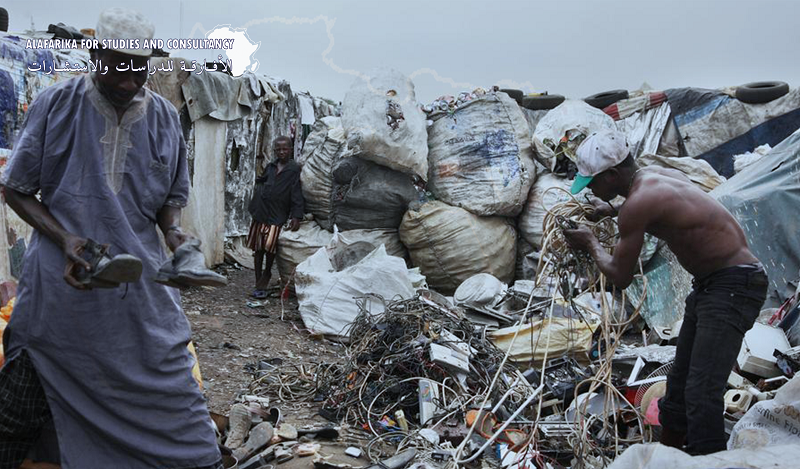
Currently, almost 20 of the world’s 50 biggest dumpsites are in Africa, according to Waste Atlas. Nigeria generates more than 32 million tonnes of solid waste annually, of which only 20–30% is collected. Reckless disposal of MSW has led to the blockage of sewers and drainage networks and the choking of water bodies. Although the problems of solid waste management in Nigeria range from poor collection and disposal methods, a lacklustre waste management database, insufficient financial resources, non-compliance with laws, and a lack of awareness of the dangers of poor sanitary habits.
Accurate data on the quantities of municipal solid waste generated in Nigeria is not easy to come by. While recycling activities are not popular or nonexistent in the country, However, the recovery of materials from waste (scavenging) is practised on a large scale. This type of recovery takes place at both legal and illegal dump sites, where scavengers search continually for valuable metals, plastics, and bottles to be reused or sold to scrap buyers. In general, treatment of solid wastes is not often carried out in Nigeria. The incinerating of wastes or use of approved sanitary landfills is nonexistent. The most common practise is the open dumping and burning of waste within residential areas and at illegal and legal dumps.
Literally Waste-to- Wealth means moving waste from a platform of exhausted utility to a valuable and desirable level. Its transformation requires some form of energy in engineering and a factor of production in economics.Through a systematic approach to waste management, waste products can be converted into wealth. Wealth created through the conversion of waste has to do with harnessing and sensibly packaging waste resources at one’s disposal. In other words, discarded waste could as well be utilised to produce more usable items. The main sources of waste are nondurable goods, durable goods, containers and packaging, and food and yard waste, environmental scientists say. Waste prevention and smart shopping are even more effective at reducing greenhouse gas emissions that result from energy consumption. When we buy fewer or reuse existing products, less energy is needed to extract, transport, and process materials to manufacture products. A robust waste database and strict policies and regulations are important for effective solid waste management in Nigeria.
As of 2021, the total unemployed population in Nigeria was estimated at a peak of around 6.3 million, Statista, an online data company, indicated. This increased from the preceding years, when around 6 million people were not in any form of employment. Last year, President of the African Development Bank, Dr. Akinwumi Adesina, lamented the high rate of joblessness among Nigerians, saying about 40 percent of youths were unemployed. While noting that the youths were discouraged, angry, and restless as they looked at a future that did not give them hope, he, however, said all hope was not lost as youths have a vital role to play if the country should arrive at its destined destination.
Universities engage in research as part of their missions around learning and discovery. This, in turn, contributes directly and indirectly to their primary mission of teaching. Zainab Bilyamin, a Nigerian final-year student at the Federal University of Dutse (FUD) Department of Chemistry, has converted sachet (pure) water leather waste to hybrid fuel (kerosene and diesel) as her final-year project. The research project is titled “Conversion of low-density polyethylene and mixed low-density polyethylene with polyethylene terephthalate into fuel.” The Federal University Dutse (FUD) is an internationally recognised Nigerian university and is located in Dutse, Jigawa State.
The study’s final finding, which cost more than $150, reveals that “the hybrid fuel produced from the pure water leather waste products has similar properties as normal kerosene and diesel, as it was used to light a kerosene lamp and power a pumping machine successfully.” The fuel can be used to power a generator to produce electricity.
“Zainab was motivated to carry out the research after reading about the possibility of converting polymeric (leather) waste into fuel because in Nigeria, polymeric waste keeps piling up on the streets without recycling, which poses an environmental hazard, whereas this waste can be converted to wealth.”
Aminu Dauda, who oversaw her research, stated that he jumped right into the project when Zainab brought up the idea because we all know that combating the threat of polymeric waste pollution has become a global challenge, despite the fact that recycling rates are comparatively low, resulting in more polymeric waste pollution than ever before.
“The research method used in the research is a normal process of thermal cracking where the waste was subjected to high temperatures of about 450–500 °C, which causes the breakage of the molecular bonds and breaks down long-chained, higher-boiling hydrocarbons into shorter-chained, lower-boiling hydrocarbons in the absence of oxygen,” he said. “In the course of the research, they had to design and fabricate a machine (a reactor) at the Kano Technology Incubation Center, which was used for the pyrolysis, the method used to convert the polymeric waste into fuel.”
In order to ease the blockage caused by polymeric waste and at the same time serve as a source of revenue for the government and also a means of reducing youth restiveness, Zainab and her supervisor are urging the government to invest in this field of study.
The other challenge
The Federal Ministry of Environment is responsible for environmental protection, natural resource conservation, and sustainable development in Nigeria, and effective waste management is one of its cardinal focuses. Authorities should partner with privately owned recycling companies to alleviate poverty, increase prosperity, and provide employment opportunities for the citizenry.
Those with expertise in solid waste management, including Tunde Bakare, have counselled the authorities to review the waste management and suggest ways for innovative improvements like the application and selection of suitable technologies and management programmes to achieve reusable and recyclable waste products, which will be a significant step towards lifting the citizens out of poverty.
Bakare believes that the government must improve waste collection by closely monitoring the previously established waste management agencies in Nigeria.”This will scale up an innovative change in eliminating zero profit on waste, and it will open up a source of investment for thousands of Nigerian entrepreneurs who are interested in waste recycling.” “If this is put into consideration, it will be a great alternative and innovative turnaround for Nigeria’s economy.” In order to reduce unemployment in Nigeria, waste can be turned into wealth.