On 28 November 2017, President Emmanuel Macron set out his ambition to renew the relationship between France and Africa through several commitments in a speech in Ouagadougou which has however since set a remarkable influence on French-Africa relations.
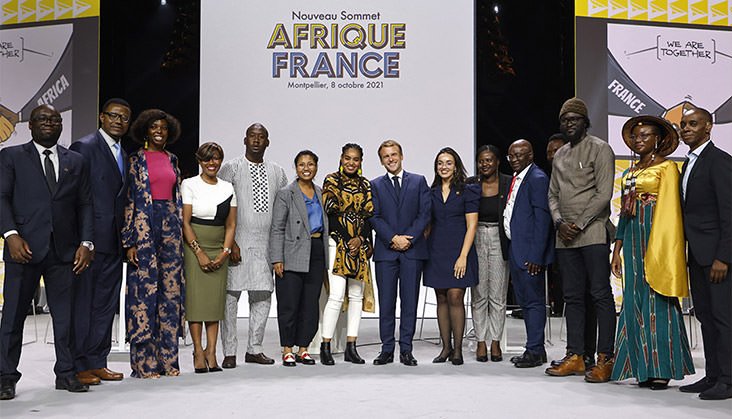
A significant aspect of the speech manifestation is the recently concluded “Africa-France” Summit, which was held in Montpellier on Friday, 8th October 2021 with the aim of addressing challenges, designing a format to offer new generations of both sides a new framework for reflection and action. The summit was endowed with plenary session discussions, dialogues between president Macron, some French talents, and a group of 12 young Africans majorly from Mali, Ivory Coast, Tunisia, South Africa, Kenya
The panel of young Africans that attended the summit was selected after months of talks across the continent led by Cameroonian intellectual, Professor Achille Mbembe, who was tasked by the French president with preparing the summit.
The summit in the context France-Africa relations
The entire activities done as part of the “Africa-France” summit were said to be tailored toward a new strategy of renewed developmental collaboration between France and Africa in governance, culture, and diplomacy.
France, according to Mbembe in his report delivered to Macron after the summit, is deemed to be too disconnected “from the new movements and the political and cultural experiments” being conducted by Africa’s youth.
This however birthed France’s stand that African youths have a key role. They are central to Macron’s commitment as displayed in the summit regarding Africa’s developmental intervention, and they are a source of solutions to address the major challenges facing Africa’s initiation of a clear-cut independent democratic path.
“We must rethink governance in Africa and not copy and paste the European model of governance,” said Clément Dako, a Malian who attended the summit.
The summit is also seen as a new way to go in French colonies in Africa where the influence of France is increasingly disputed, and particularly in Mali and Algeria,whose flames of the open crisis was a result of a recent “collective punishment” meted by Paris to drastically reduce the number of visas for Algerians, Moroccans, and Tunisians. This may instantly be solved through Macron’s announcement of funds that will support initiatives to promote programs allowing greater student mobility, and the establishment of a “Euro-African forum on migration”.
France-Africa summit without African Leaders
The recent summit marked the first France-Africa summit where no leader in Africa got an invitation to participate. The summit began in 1973 as France-Africa summit before it was later rebranded to Africa-France summit.
According to Emmanuel Macron, the non-invitation of African leaders was to allow “the voice of Africa’s youth to be listened to” and to “leave behind obsolete methods and networks, and to break from the opaque dealings that characterized relations for decades known by the evocative Porte-manteau”.
A senior lecturer at the political science department at the University of Rwanda, Ismael Buchanan associated Macron’s decision to exclude African leaders to the “politics of reform towards France-Africa relations.”
His opinion reveals France’s motive to modify its policy towards Africa by working with Africa’s young-led generation and African civil society organizations, rather than traditional bilateral interactions with governments.
African youth grievances
Impactfully, of any former colonial power, a dazed France maintains the largest security presence in Africa. This presence has over the years been complemented by other expanding spheres of influence. One of which is its past economic dealings with African leaders, especially in the Francophone countries.
French supporters have also pinpointed that through French companies, France “contributes” to growth with their investments and the creation of added value in Africa.
Be that as it may, admittedly too, there has been a candid criticism on how the infamous legacy of FrancAfrique has deepened France’s involvement in African issues, and how the network of French politicians and African elites perpetuates French dominance in post-colonial Africa.
Professor Mbembe came under heavy criticism by many African intellectuals for his role in the summit. Although the grievances shown by the youths at the summit reflect the public discontent toward France’s presence in Africa, the straightforward statements, brutal confrontations, and selected topics also indicated Mbembe’s effect in the summit.
“We as Africans feel the pain of colonization every single day,” said Adele Onyango, a Kenyan civil society member who demanded that Macron looks into France’s tumultuous relationship with Africa, citing double standards, lapses in ethics, and unethical behavior.
“The air of denial that France chooses to sit in is uncomfortable not only for Africa but also for France… How can you trust the source of your pain when the source doesn’t acknowledge it?” she added.
Malian activist Adam Dicko also took an insult with the following Macron’s statements, “Without France, there would be no government in Mali”:
“Mr. President, you keep saying that without the intervention of France, there would be no government in Mali. Please know that without Africa, there would be no France. In fact, stop convincing people that you want to help Africans. Terrorism is not only Mali’s problem, but also your problem. We are victims at this point. “Stop making ourselves feel guilty by putting ourselves in the position of being. We should no longer talk about aid but about partnership. Africa is not a place of unemployment or misery, but a continent that is young, optimistic, and full of enthusiasm.”
For Aliou Bah from Guinea, the issue with France is its dealings and supports for African dictators.
“We don’t want you to deal with our dictators. We are already doing that, and we will continue to do so. I come from Guinea; a country that has just been freed from someone who wants to die in power. We don’t want you to deal with our internal issues. Our request is to address someone who has tried everything to stay in power. “Don’t see Chad as different from Mali, Guinea, Ivory Coast. Position yourself as a partner of African peoples, not African leaders,” Bah said.
Another example of this assertion is the revelation of a commissioned report that found Paris carries huge obligations for the Rwandan genocide and was “blind” to the 1994 murders, which killed an estimated 800,000 people. The report represented a rare admission by the French authorities and its readiness to establish amendments.
Arthur Banga from Ivory Coast shared his dream of what Africa should look like in the year 2030. He said: “By 2030, Africa will be free of colonial ugliness. The CFA will end the franc and switch to its own currency. Instead of foreign military bases, it will have its own independent armies”.
The Agence Française de Développement (AFD) which is nearing its 80th anniversary of existence also came under criticism due to its name and demoralizing terms used, according to Eldaa Koama, a young internet entrepreneur from Burkina Faso.
“We want partnerships that are clear, transparent,” Koama said, adding that the AFD name should be modified to get away from the ‘development’ connotation, which conjures up images of an African continent populated by destitute people who need to be rescued.
Macron responded that the name would be changed and agreed that some of the vocabulary used was demoralizing and that France would not be offering development aid, but what he repeatedly called “solidarity investment.” He also promised an open examination of the country’s colonial past, “We must recognize this responsibility and bear it. It is part of our past and of the relationship.”
However, the French president pointed out that his military is solely present at the request of African governments, and he denied that France supported African dictators, telling a Guinean youth delegate that France had publicly objected to Guinean President Alpha Condé’s bid for a third term.
Macron also said he understood the youths’ position, saying that France has an immense role to play. Although France isn’t the only country that organized colonization and overseas trade, he said. But France had a significant role. “So yes, we have to recognize this responsibility,” he added.