Burkina Faso is among a growing number of countries in West and Central Africa that have been hit by a surge in coups and delays to the return of democratic rule. Since taking power in a 2022 coup, its military leaders have launched sweeping reforms, including postponing elections that were expected to restore civilian rule and dissolving the country’s independent electoral commission.
A former French colony till 1960, Burkina Faso has a long history of military rule and coups. Former President Blaise Compaore, who took power in 1983, was ousted in a popular uprising in 2014 after attempting to amend the constitution to extend his rule. Elections were held in 2015 and in 2020, when President Roch Marc Christian Kabore was re-elected in polls that was considered to be fair but marred by ongoing insecurity.
Democracy and the State of the Nation
When Paul-Henri Sandaogo Damiba took power in January 2022, the promise was clear: the military would address the growing security crisis more effectively than the previous ‘elected’ government. Coup leader Lieutenant-Colonel Paul-Henri Sandaogo Damiba became head of the military-led Patriotic Movement for Safeguard and Restoration MPSR that replaced the government.
The military blamed Kabore’s failure to halt an insurgency by jihadist groups in the north. However, Kabore’s ousting was not unexpected. According to Ochieng (BBC, 2022), discontent among security forces had been growing over the lack of support. She notes this was exacerbated further by reports that security forces at a military base in Inata had run out of food in the weeks before they were attacked by an armed group in November 2021. Forty-nine military police officers and four civilians were killed in the attacks.
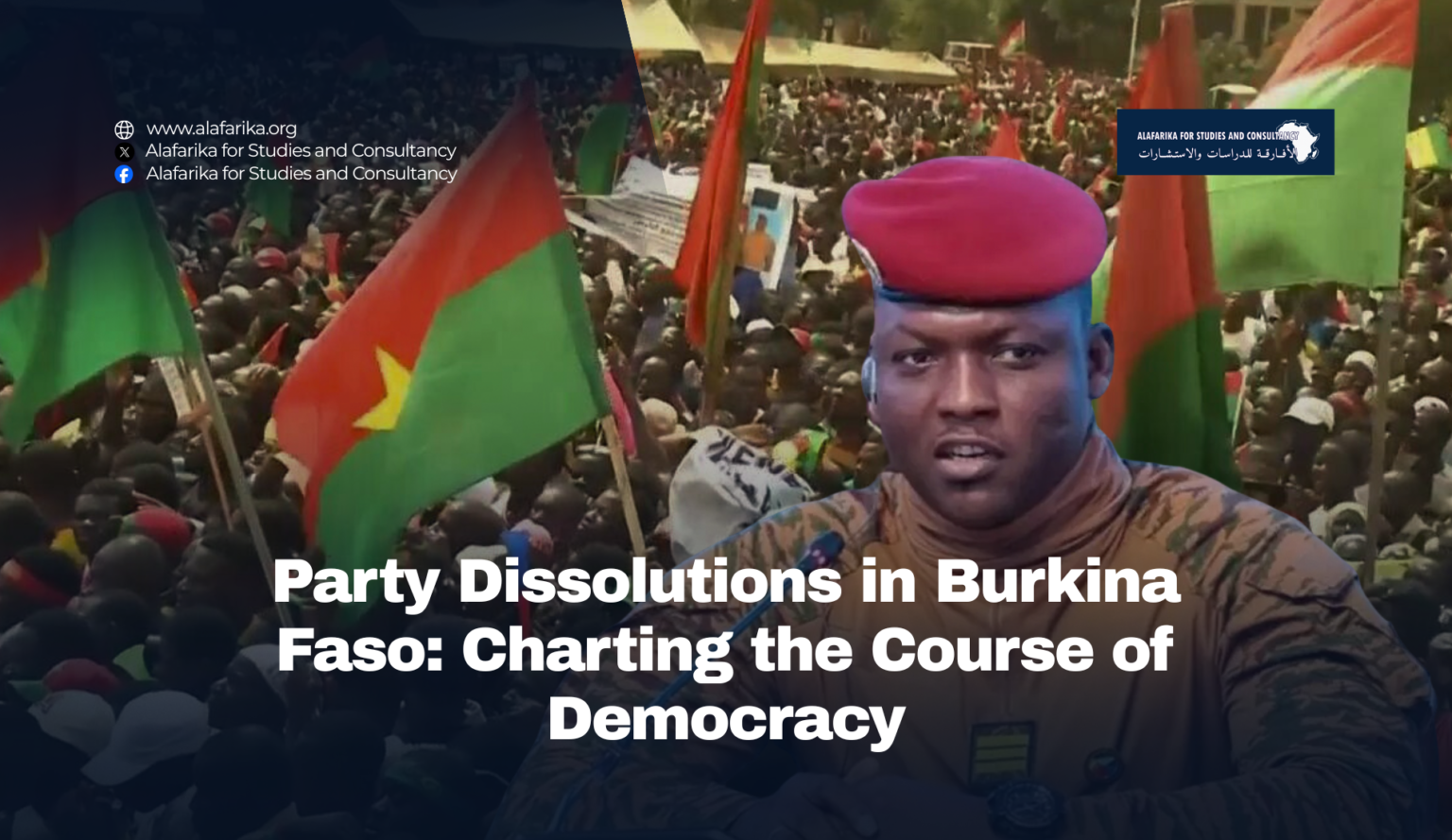
Residents of Burkina Faso on Friday 30 September woke up to the sounds of heavy gunfire near the main military camp and residential areas of the capital, Ouagadougou. A large blast also rang out near the presidential palace. The coup was confirmed by army Captain Ibrahim Traore who announced that former military ruler Lt. Col. Paul-Henri Sandaogo Damiba had been deposed and his government dissolved. The MPSR subsequently appointed Traore as President and head of the armed forces. Traore has since announced plans to hold a national meeting on 14 and 15 October to select a transitional President.
According to the Human Rights Watch (HRW), despite promises to return to civilian rule, Traoré instead consolidated his authority and suspended political parties. In April 2025, he stated that Burkina Faso was “no longer in a democracy,” but rather in a “progressive people’s revolution,” drawing criticism from opposition figures and civil society groups.
On 29 January 2026, the Burkinabè Government announced measures to dissolve political parties and to repeal the legal framework governing them. The authorities have already suspended all activities of political parties since September 2022. A recent report indicates that a bill scrapping party statutes, financing rules and the post of opposition leader will be sent to the transitional council, according to cabinet minutes. All assets of the dissolved parties will be transferred to the state.
Correspondingly, the Interior Minister Emile Zerbo said the decision to stop any political activity was part of a broader effort to “rebuild the state” after what he said were widespread abuses and dysfunction in the country’s multiparty system. Furthermore, HRW notes that the dissolution of political parties comes amid Burkina Faso’s deepening Islamist insurgency, underscoring how the country’s armed conflict is unfolding alongside a sharp contraction of political space.“
The military are putting democratic institutions on trial using the pretext of terrorism,” said Ahmed Newton Barry, a journalist and former president of the Burkinabè national electoral commission who is currently in exile. “The junta believes that the fight against terrorism is incompatible with democracy, but counterterrorism efforts should not undermine civil liberties and the rule of law.”
Implications for Democratic Governance
1-Collapse of Multiparty Democracy
The dissolution effectively ends multiparty competition, a core tenet of democratic systems. Prior to the coup, Burkina Faso had over 100 registered political parties, with 15 represented in parliament after the 2020 elections. The largest was the ruling People’s Movement for Progress (MPP), which had 56 of 127 seats in parliament. It was followed by the Congress for Democracy and Progress, with 20 seats, and the New Era for Democracy with 13 seats.
But the decision to ban political parties does not sit well for democracy, Dakar-based analyst Beverly Ochieng of the Control Risks intelligence firm, told Al Jazeera. “The military government will [remain] highly influential, especially after a recent decree appointing Traore in a supervisory capacity in the judiciary,” Ochieng said, referring to a December 2023 constitutional change which placed courts directly under government control.
2-Erosion of Political Freedoms
Since the coup, the junta has also carried out a relentless assault against perceived political opponents, civil society organisations, the media, and peaceful dissent, shrinking the country’s civic and political space. The military authorities have used a sweeping emergency law to arbitrarily arrest, forcibly disappear, and unlawfully conscript critics, dissidents, judges and journalists (HRW, 2025).
Moreover, “there will be very limited division of powers or autonomy across the civic and political space,” Ochieng said, adding that the military government will likely keep extending its stay in power.
3-Civil Society and Civic Space at Risk
Throughout 2025, the Burkinabè authorities suspended the activities of several national and international organisations, either without any explanation at all, or citing vague grounds, such as unauthorised data collection or “public order and security” (UN, 2026). In July last year, authorities enacted a restrictive new law on freedom of association, while since 11 November 2025, a new law now requires civil society organisations to place their bank accounts with the Treasury, giving the government direct control over their finances.
In Burkina Faso, people are also afraid to speak out online. Commenting on a message that criticises the regime can lead to arrest or disappearance. Detainees are often held incommunicado without trial or contact with their families. At this time, Burkina Faso lives in fear and silence. Meanwhile, authorities have forced dozens of the regime opponents into military service and sent them to fight against armed groups. Several prominent journalists and judges have been arrested after speaking out against increasingly restrictive rules on press and judiciary freedom.
4-International and Regional Repercussions
The dissolution of political parties marks a significant escalation in the country’s democratic backslide. Burkina Faso’s international partners, including the African Union, the United Nations, and the European Union, face a clear choice: remain passive as democratic institutions disappear, or signal decisively that, unless the junta’s trajectory changes, continued repression will carry political, economic, and diplomatic costs.
UN observers say, the combined effect of these suspensions and decisions has sharply constricted civil society’s activity in the country, inconsistent with international human rights law. They are also implemented without support or mitigation measures, and hinder humanitarian operations and access to populations in need.
Possible Scenarios
1-Deep-rooted Military Authoritarianism
Political parties remain banned indefinitely. Power is centralised around Captain Ibrahim Traoré and a small military elite. Governance is conducted through decrees, revolutionary committees, or military-appointed “consultative” bodies. Civil society is tightly regulated; dissent is framed as unpatriotic or aiding terrorism.
The party dissolution removes the last institutional check on the junta. Similar patterns are already visible in Mali and Niger. The security crisis provides a convenient justification for the permanent emergency rule.
As democracy is effectively suspended, freedom of association and expression continues to shrink. While the regime relies on nationalism, anti-West rhetoric, and security narratives rather than elections. Lastly, this scenario transforms Burkina Faso from a “transitioning state” into a de facto military state.
2-Controlled Transition Without Real Democracy
The junta in due course may announce a “transition roadmap.” However, political parties may return, but then again it may be only selectively or under strict state regulation. In the short run elections may also be delayed, engineered, or held with limited opposition. While junta-backed civilian or “technocratic” figure may emerge.
Democracy process may be hollow, as opposition split, chosen, or nullified. While the civil society may be allowed to operate also but within red lines. Lastly, this is democracy in form but not in substance what political scientists call “competitive authoritarianism.”
Conclusion
Burkina Faso is one of several West African states to have experienced military takeovers in recent years, alongside Mali, Niger, and Guinea. The wave of coups has raised alarm among regional leaders and international partners about long-term stability and democratic backsliding in the region.
In an international environment where the multilateralism system is in crisis and the levers for democratic pressure are weakened, the banning of political parties has met little resistance in Burkina Faso before now. Local observers indicate that if the current situation continues, the country risks economic, political and social collapse. The army has concentrated all power in its hands, yet it has failed to resolve the security crisis or improve daily life. The situation is only getting worse.
Therefore, political instability would further complicate the government’s challenges. Rather than restricting the political space, it should consider dialogue with all political forces. This is in line with the government’s intention, from the outset, to draw up a new legislative framework that better organises and regulates the political sector. Aligned with this objective, the authorities should involve all political actors in a dialogue process that drafts a new Charter of Political Parties and produces an electoral agenda for ending the transition.