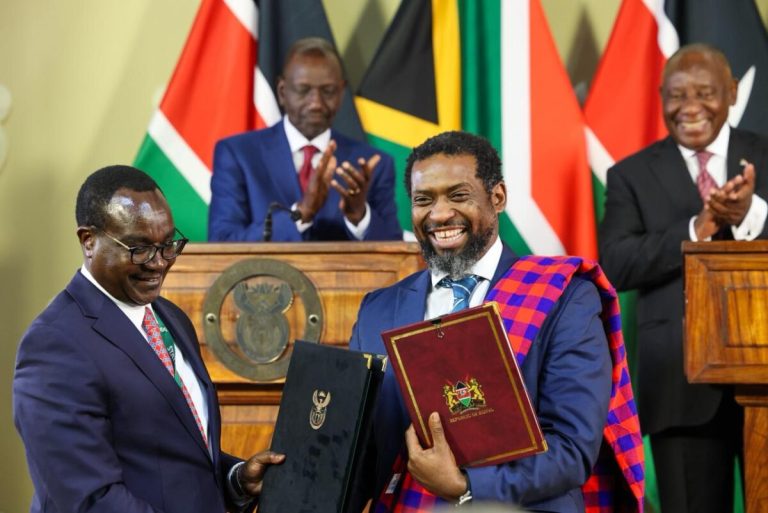
South Africa and Kenya have signed six Memoranda of Understanding to deepen cooperation in trade, maritime transport, skills development, gender equality, arts and culture, and sport during President William Ruto’s state visit to Pretoria. A key agreement on standardization is expected to ease technical trade barriers, while a maritime MoU aims to strengthen shipping links between East and Southern Africa in support of the African Continental Free Trade Area. The agreements bring the total number of bilateral instruments between the two countries to 34, with both presidents are emphasizing the need to maximize opportunities under the AfCFTA.
Mozambique’s President Daniel Chapo has signed a new law requiring 15% state ownership in all mining ventures and local processing of minerals, tightening control over its resources as demand for battery materials grows. The new regulations also prohibit the export of unprocessed or semi-processed mineral products, except where covered by a specific ministerial authorization based on approved plans to eventually process locally. The move places Mozambique among a growing number of African countries, including Zimbabwe and the DRC, which are tightening control over raw exports for greater economic benefit.
Niger’s military ruler, General Abdourahamane Tchiani, was received by President Recep Tayyip Erdogan at the presidential palace in Ankara, where the two leaders discussed bilateral relations and regional issues before holding a joint press conference. The two leaders signed several cooperation agreements, including on higher education and the establishment of a Joint Economic and Trade Commission. This is Tchiani’s first state visit outside Africa since seizing power in a coup in 2023, signaling a push to expand Niger’s diplomatic footprint beyond traditional Western partners.
Tanzania’s President Samia Suluhu Hassan held talks with Vladimir Putin at the start of a three-day state visit to Moscow—her first official trip abroad since winning last year’s disputed election—as she faces isolation by the West over a violent security crackdown following the October polls in which an estimated 1,000 people died. Russia and Tanzania reported a 25% rise in trade turnover in 2025. Hassan was accompanied by a business delegation to cement deals in trade, tourism, and minerals, with the only current concrete joint project being a long-planned uranium mine.
The political coalition backing Guinea’s president, Mamady Doumbouya, has won a major victory in the country’s recent parliament elections. The coalition, known as the Generation for Modernity and Development (GMD) took at least 100 out of 147 seats, giving the president much more control over the nation. The vote happened while opposition groups were banned, leading critics to call the election unfair. Doumbouya, a former special force commander, seized power in 2021 and won a seven-year presidential term in December.
Malawi will join other countries in repatriating its nationals seeking to leave South Africa, where attacks on African migrants have been reported in parts of the country, with the program limited to citizens who have voluntarily requested assistance. Mozambique said five of its citizens were killed in violence in the coastal town of Mossel Bay over the weekend, while Ghana repatriated hundreds of nationals the previous week. Anti-immigrant groups have set a June 30 deadline for undocumented foreigners to leave South Africa, fuelling fear among migrant communities.
The World Health Organization and the Africa Centres for Disease Control and Prevention announced a $518 million plan to combat the Ebola outbreak in the DRC and Uganda, running from June to November and covering emergency coordination, surveillance, testing, infection prevention, clinical care, and community engagement. The outbreak, declared in the DRC on May 15, has since infected at least 452 people and caused 82 deaths, involving the rare Bundibugyo strain, which has no licensed treatments or vaccines. Uganda has recorded 19 confirmed cases and two deaths so far.
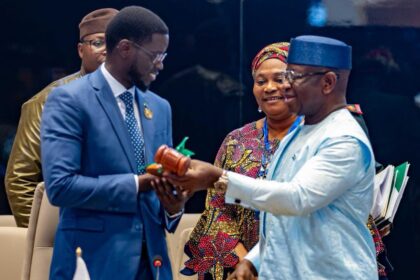
Senegal’s President Bassirou Diomaye Faye announced a new government featuring some members and allies of the Pastef party led by sacked Prime Minister Ousmane Sonko, who pledged his group would not participate. Faye named senior economist Ahmadou Al Aminou Mohamed Lo as the new prime minister, saying he had the expertise to steer Senegal out of its crippling debt crisis. The IMF had previously frozen its $1.8 billion lending program with Senegal following the discovery of misreported debt that pushed debt levels to 132% of economic output.
Zimbabwe’s parliament is considering a controversial constitutional amendment bill that would extend President Emmerson Mnangagwa’s term by two years to 2030 and do away with general presidential elections, giving parliament the power to appoint the head of state. Mnangagwa’s ZANU-PF party holds a two-thirds majority in the lower house and overwhelmingly controls the upper house, giving it the numbers to change the constitution, with the The legislative process is expected to take about a month. Opposition figures and civil society groups say the move is undemocratic and unconstitutional.
The United States plans to sharply reduce the number of embassies and consulates in Africa processing visas, cutting the network from almost 50 locations to just 20 designated centers, as part of the Trump administration’s broader push to tighten immigration controls. Applicants from countries without a hub will be required to travel to another country for visa processing. The 20 approved hubs include Nairobi, Lagos, Accra, Dakar, Addis Ababa, Johannesburg, and Kigali, among others. Consular sections in non-hub countries will remain open for US citizens and emergency cases only.