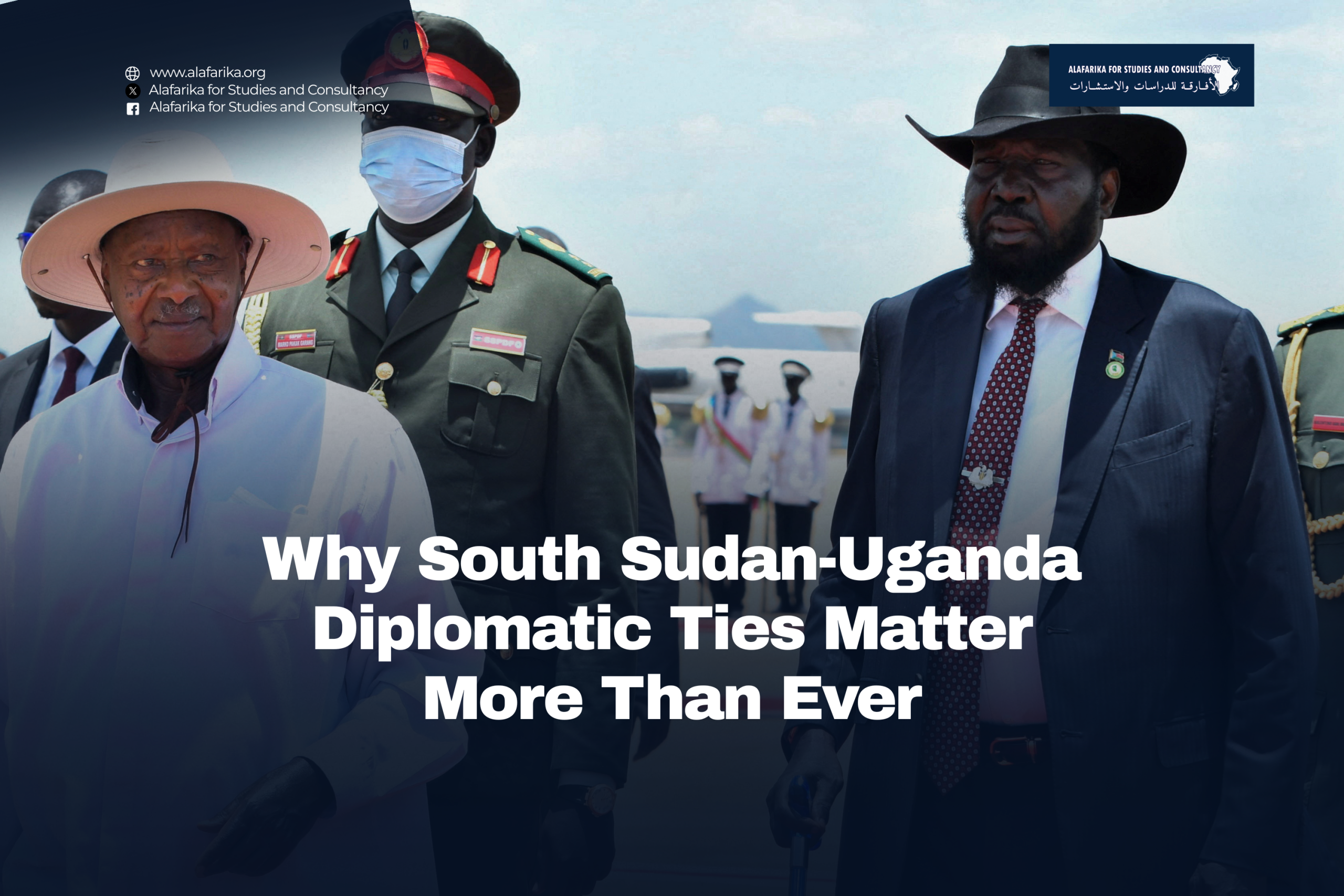
 South Sudan separated from Sudan in July 2011 after a protracted and bloody civil conflict. One of the first heads of state to recognize South Sudan’s sovereignty was Uganda’s President Yoweri Museveni, who was instrumental in helping the fledgling nation. The establishment of closer ties between Uganda and its southern neighbour as a result of this action was seen as a huge boost to South Sudan’s sovereignty.
Bilateral diplomacy has been crucial in the case of Uganda in promoting stability and peace in both South Sudan and Uganda. Despite the fact that the two countries have signed a number of agreements to strengthen their economic and security cooperation, such as a memorandum of understanding on trade and investment and a military cooperation agreement that would allow them to collaborate on issues like intelligence sharing and joint military training exercises, there are still other unresolved issues that may be harming their bilateral relations.
The Politics of States Interdependency
Relations between Uganda and what would become South Sudan were initially transnational. Since colonial times and the establishment of central governments, the two territories have shared a long border, traversing the home areas of several ethnic groups. The management of those people in the borderlands required coordination between the colonial governments.
From the 1940s, the South Sudanese people attended schools in Uganda, and many fled across the border and sought sanctuary in 1955 following mutinies – and subsequent government repression – in Equatoria. This marked the beginning of two trends still evident today: South Sudanese searching for education in Uganda, and people in each country seeking refuge in the other.
The Sudanese civil wars (1963–1972 and 1983–2005) added proxy war to bilateral relations. South Sudan was still part of Sudan, and during the first war, Sudan was allied with Egypt. After the Six Day War in 1967, Israel armed and trained rebels in South Sudan, using Ethiopia and Uganda as conduits. Since the 1970s, Ugandan refugees had found sanctuary in South Sudan, where elements of the Ugandan army also operated.
Proxy warfare was pursued on a larger scale during the second civil war. Initially (1983–91), Sudan and Ethiopia armed each other’s rebels, but animosity between Kampala and Khartoum escalated during the 1990s, and proxy warfare intensified. Uganda’s President Yoveri Museveni and his National Resistance Movement had close ties with the Sudan People’s Liberation Movement/Army (SPLM/A) under John Garang. Khartoum responded by arming and training rebel groups in northern Uganda and the Democratic Republic of the Congo, including the Lord’s Resistance Army (LRA).
As a consequence of this mutual interference, Sudan–Uganda relations during the 1990s were frosty. The SPLM/A was allowed to operate inside Uganda, where hundreds of thousands of South Sudanese lived in refugee camps. With efforts to end the conflict in Sudan, relations between Khartoum and Kampala improved during the early 2000s. Sudan’s President Omar Hassan Ahmad al-Bashir allowed the Ugandan army to pursue the LRA inside Sudan, while Museveni contributed to the pressure on Garang to negotiate a solution to the Sudanese civil war.
In recent times, Ugandan forces have been deployed to South Sudan to help support President Salva Kiir against forces loyal to Vice President Riek Machar. Ugandan special forces are deployed in Juba, the capital, and elsewhere in South Sudan. Observer says, the standoff between Kiir and Machar, who led opposing forces in a 2013-2018 civil war that killed hundreds of thousands, has led the United Nations to warn that the world’s young nation could be on the brink of all-out conflict along ethnic lines.
Machar’s mostly Nuer forces were allied with the White Army militia during the civil war, but his party denies government accusations of ongoing links. Uganda’s military chief Muhoozi Kainerugaba, who is also Museveni’s son, said recently he had ordered Ugandan forces to stop attacking the White Army so long as it ceases offensives against Ugandan troops. Machar’s party says the Ugandan intervention is a violation of South Sudan’s arms embargo. Analysts say Kiir, 73, appears to be attempting to shore up his position amid discontent within his own political camp and speculation about his succession plan.
The Key Drivers of South Sudan–Uganda Diplomatic Relations
Although there are multiple longstanding ties between Uganda and South Sudan. The following are the key factors that steer South Sudan–Uganda diplomatic ties:
1- Security and Border Stability
For many years, several communities living along the border have coexisted and have shared cultural, social, and economic ties. However, as both countries have recently grown and developed, the need for clearly defined borders has gradually become more pressing. The discovery of natural resources such as gold, diamonds, and marble around and in the Ilemi Triangle has driven the desire for political and economic stability, further fuelling the need for a conclusive border agreement.
Problems at the border date back to the demarcations made during the British colonial era between Sudan, which South Sudan was once a part of, and Uganda. Despite setting up a joint demarcation committee (unknown when), the two countries have failed to agree on border points. Regrettably, in July 2025 troops from Uganda and South Sudan clashed along the border between their countries in a firefight that left at least four dead, according to a Ugandan military official, as tensions flared over disputed border demarcations. Leaders from the two countries have set up a joint border demarcation committee whose work is ongoing, per report. Officials from both countries have previously said that they expect to reach a firm decision in 2027. Although there have been sporadic border clashes over the years, the exchange of fire between the military allies is rare.
2- Refugee Dynamics
Already Africa’s largest refugee-hosting country and the third largest globally, Uganda is currently home to 1.93 million refugees, over a million of whom are below the age of 18. Yet, the humanitarian response currently faces one of the worst funding crises in decades, says UNHCR, the UN Refugee Agency. Over 630,000 refugees have since arrived in Uganda and thousands continue to arrive every week, bringing the total number of South Sudanese refugees and asylum-seekers to over 900,000.
Yet, the humanitarian response currently faces one of the worst funding crises in decades, says UNHCR, the UN Refugee Agency. Dominique Hyde, Director for External Relations, UNHCR, recently visited refugee settlements hosting Sudanese and South Sudanese in Uganda and warned that more children will die of malnutrition, more girls will fall victim to sexual violence, and families will be left without shelter or protection unless the world steps up, as emergency funding runs out in September.
Uganda’s progressive refugee policy allows refugees to live, work, and access public services, but funding shortfalls are drastically impacting aid delivery and threaten to undo years of progress. Currently, refugees are only receiving a third of what they require to meet their basic needs annually.
3- Trade and Infrastructure
Uganda Exports to South Sudan was US$536.46 Million during 2023, according to the United Nations COMTRADE database on international trade. In March 2025, in a shift in regional trade patterns, South Sudan emerged as Uganda’s top export destination, overtaking Kenya, according to the data from the Bank of Uganda. Media report says this marks a significant change in the region’s economic landscape and highlights the growing trade ties between Uganda and South Sudan.
Likewise, the data shows that in January 2025, Uganda exported goods worth $55.9 million (Shs206b) to South Sudan, representing a 54 percent increase from the previous month when the country exported goods worth $25.4m (Shs94b). Also, this surge propelled South Sudan to the top spot, pushing Kenya to third place.
Experts say this shift is a significant boom for Uganda’s economy, which has been seeking to diversify its export markets. South Sudan’s growing demand for Ugandan goods, including cement, cereal flours, and raw iron bars, is expected to continue driving growth in bilateral trade.
Moreover, the development is also a testament to the growing economic ties between Uganda and South Sudan, which have been fostered through various regional trade agreements and infrastructure development projects. They argue that as Uganda seeks to expand its export base and reduce its reliance on traditional markets, the growth in trade with South Sudan is a welcome development.
Still, customs processing in South Sudan remains cumbersome largely due to weak staff capacity and inefficiency in customs administration. Poor road quality and numerous roadblocks and informal payments between border posts and Juba drive up the trading cost further. The current trade pattern between the two economies is highly asymmetrical the rapid growth comes solely from a skyrocketing increase in Ugandan exports to South Sudan.
It is also largely informal, where women play significant roles and are sensitive to local security conditions. Even with the recent growth in trade, physical and institutional constraints in trading are still substantial, and addressing those issues would further enhance trading opportunities for South Sudan with its neighbours and sustain its trade ties with them (World Bank, 2025).
4- Regional Diplomacy and EAC Integration
South Sudan is a United Nations member state, a member state of the African Union and of the Intergovernmental Authority on Development. In July 2012, South Sudan signed the Geneva Conventions. South Sudan has also applied to join the Commonwealth of Nations, considering that it was part of the British Empire, and has 2 Commonwealth Republics, Kenya and Uganda as neighbouring states. The previous year, on November 11, 2011, it submitted an application to formally join the East African Community (EAC), a regional organization consisting of Burundi, Kenya, Rwanda, Uganda, and Tanzania. The country became a full member of the East African Community on 5 September, 2016. South Sudan acceded into the EAC in a situation different from previous Partner States in terms of its development goals and needs. The well-developed EAC framework has the potential to unleash tremendous economic growth. It is in the interest of South Sudan to utilize the framework, incorporate the new customs regime, and exploit the policy flexibility.
A New Era of Cooperation Can Shape the East Africa’s future
Notwithstanding, since the early years of colonialism and particularly in post-colonial times, the consequences of an unsolicited integration made by the colonialist in their scramble for and partition of Africa has left with Africa myriads of almost intractable problems to fix, ranging from ethnic rivalries, minority agitations, religious intolerance to civil wars.
Unpalatably, these experiences have continuously taken bloodletting, violent and high profiled murderous approaches, to talk less of its influence in clogging the political stability and economic development of the African states in post-colonial times.
Despite the EAC being smaller compared to other African Regional Economic Communities (REC), it is today one of the most advanced regional communities in terms of legal instruments. The EAC implemented the Customs Union in 2005 and the Common Market in 2010; and Partner States expect to implement the Monetary Union by 2023 while still striving for a political federation.
It should be argued that a peaceful settlement of the border issue would avoid further violence and consolidate the economic and political ties between South Sudan and Uganda. These nations will mutually benefit more, increasing trade, security cooperation, and regional stability. Resolving the border dispute peacefully would also set a positive example for other African nations that face similar challenges.
Study recommends that if bilateral diplomacy is to blossom in Uganda and South Sudan, there must be enhanced peace and stability effectiveness levels. This can be done by the establishment of regular high-level dialogue. Besides, if bilateral diplomacy is to thrive in Uganda and South Sudan, there must be concerted efforts to promote economic cooperation amongst the two sister countries. Additionally, experts recommend that if bilateral diplomacy is to thrive in Uganda and South Sudan, there must be concerted efforts to promote trust building amongst the two sister countries.