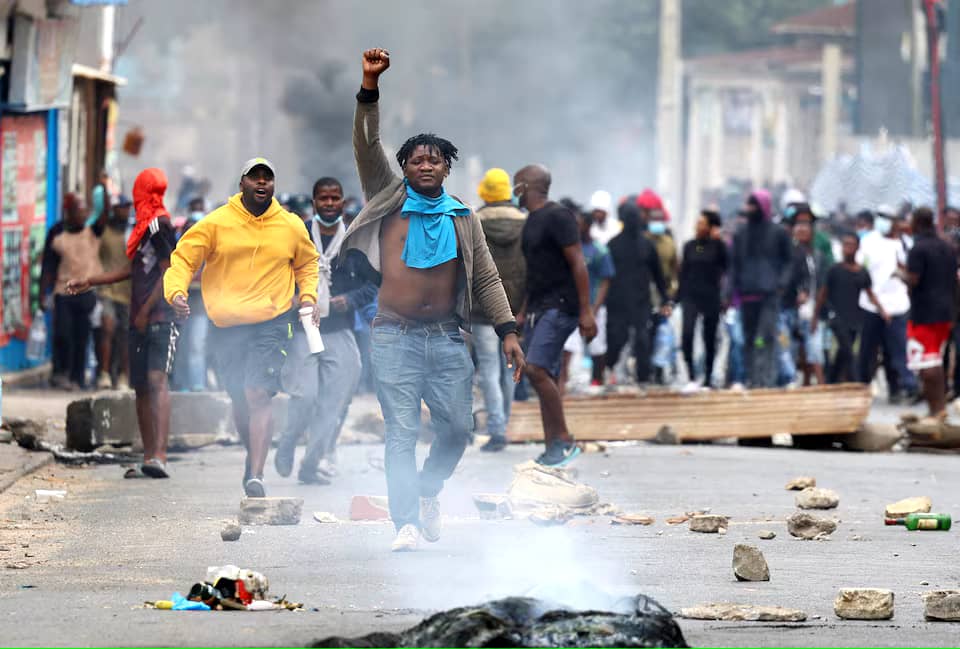
Mozambique’s post-election protests and their implications have sent shockwaves throughout the country, leaving a trail of violence, death, and destruction in their wake. The protests, which began after the announcement of the election results on October 24, 2024, have been met with brutal force by the security forces, resulting in the loss of many lives.
The election, which was held on October 9, 2024, was marred by allegations of vote-rigging and irregularities. The opposition candidate, Venâncio Mondlane, claimed victory, but the electoral commission declared the ruling Frelimo party candidate, Daniel Chapo, the winner with 70% of the vote. This announcement led to widespread protests across the country, with opposition supporters demanding a recount and alleging rigging. The weeks-long protests have descended into violent clashes with law enforcement, resulting in a devastating toll: at least 67 lives lost, according to Plataforma Decide, a local monitoring group that has been tracking the unrest.
Mondlane, who is reported to be hiding now, has revealed to the media that he thinks pressure from the protests could force Frelimo into negotiations. However, the electoral commission has rejected claims by Mondlane that Frelimo, Mozambique’s ruling party since independence 49 years ago, manipulated the election results to maintain power. Media reports indicate that he disappeared from public view on October 20, just before the election results were announced. This sudden disappearance came on the heels of allegations against the police for threatening behavior, which was compounded by the tragic shooting deaths of two of his aides.
“What is most hurtful to me is not being able to be with the people on the streets, to take part in their fight and their protests, to lead these demonstrations. This pains me every single day,” he said.
However, Mondlane proceeds to ginger his supporters via social media: “But [they] need to carry on for longer, maybe two to three months, in this same pace… The combination of diplomatic contact, protests and international pressure will do it.”
The Role of the International Community
International election observers raised concerns over the elections, citing irregularities and manipulated numbers during the counting process. The European Union Election Observation Mission (EU EOM) reported instances of unjustified alteration of election results at polling stations and district levels. “The EU EOM considers that it is the responsibility of the electoral administration to clarify the irregularities and of the Constitutional Council to address them during the validation of results process, in respect of the will of voters. The EU EOM will remain in Mozambique to follow the next phases of the electoral process. It will later issue a final report, including its assessment and recommendations for improvement of the electoral framework”, part of the statement issued reads.
The Commonwealth Observer Group also urged Mozambique to uphold principles of peace and tranquillity. As part of its activity, the observer group stressed that the National Election Commission should announce the results with due diligence and transparency. The Carter Center, which has been working in Mozambique since 1998, has also observed irregularities in previous elections, including issues with voter registration and tabulation processes. The above-highlighted issues formed part of what led to social tensions and election-related violence.
The African Union (AU) and European Union (EU) have taken steps to address the post-election violence in Mozambique. For example, the planned emergency session by the AU Peace and Security Council on November 12, 2024, to discuss the post-election situation and also the issuance of a press statement by the EU Election Observation Mission expressing concerns over the transparency of the counting and tabulation process has been helpful. However, it should be noted that the international community has a more crucial role to play in promoting peace and stability in Mozambique. The African Union and other regional organizations should press the government to respect the rights to freedom of expression and peaceful assembly, and to investigate allegations of human rights abuses.
The international community should also support efforts to promote dialogue and reconciliation between the ruling party and the opposition. Furthermore, the international community should also provide technical assistance to the electoral commission to ensure that future elections are free, fair, and transparent. This could include providing training and support to electoral officials, as well as deploying election observers to monitor the electoral process. The international community should also consider imposing targeted sanctions on individuals responsible for human rights abuses and electoral irregularities. This could include freezing the assets of these individuals and imposing travel bans on them.
The Economic Implications
The post-election protests and violence have significant economic implications for Mozambique. The country is heavily dependent on foreign investment, and the current crisis is likely to deter investors and undermine economic growth. Foreign Direct Investment (FDI) inflows have been the main source of external financing for Mozambique, exceeding the averages for sub-Saharan Africa and low-income countries. In 2020, FDI inflows to Mozambique totaled $2.3 billion, accounting for 12.6% of the country’s GDP. If this violence should last longer, it may warrant the World Bank to revise Mozambique’s GDP growth rate downward, and cite the crisis as a major factor. The key sectors will be encompassing agriculture, manufacturing, and services that might have been severely impacted.
The tourism industry too, which is a major source of revenue for the country, is apparent to have also been affected by the crisis. Many tourists must have cancelled their trips to Mozambique, and the industry is likely to suffer significant losses as a result.
The economic implications of the crisis are also likely to be felt by the country’s poorest citizens. Many Mozambicans are already living in poverty, and the current crisis is likely to push even more people into poverty. The government should take steps to address these challenges, including providing support to poor households and ensuring that social safety nets are in place.
The Human Rights Implications
The violence has also significantly affected the rights of Mozambicans. It has been reported by the media that the government’s response to the protests has been heavy-handed, and the use of excessive force has resulted in the loss of many lives. The security forces have also been accused of arbitrarily arresting and detaining opposition supporters, as well as targeting human rights defenders. These actions are a clear violation of the rights to freedom of expression, assembly, and association, as well as the right to life and liberty.
However, a publication on BBC revealed that Mozambique’s police commander Bernadino Raphael blamed Mondlane’s supporters for the deaths.
“They are using children as shields in front of them while they remain behind,” he alleged.
The report stated the commander added that in many instances police had no choice but to defend themselves from protesters who had unleashed violence, including killing six officers and looting and burning property and vehicles.
In contrast to the above, the Human Rights Council-appointed independent experts have recently stated that the “violations of the right to life, including of a child, deliberate killings of unarmed protesters and the excessive use of force by the police deployed to disperse peaceful protests across Mozambique are very disturbing,”
“We call on the Mozambican authorities to promptly and impartially investigate all the unlawful killings”, they added.
It is important that the government should take steps to address these human rights violations, including investigating allegations of abuse and holding those responsible accountable. The government should also take steps to ensure that the security forces are trained in human rights and the use of force, and that they are held accountable for any abuses. It is pertinent to note that the vulnerable class of citizens, including women, children, and the poor will likely feel these implications most. These groups are often the most affected by conflict and instability, and the international community and the government should take steps to ensure that their rights are protected and promoted.
It is safe to conclude that, addressing this current crisis is simple: the protesters should not encroach on the law boundary and the ruling party should respect the rights to freedom of expression and peaceful assembly, while ensuring that the security forces do not use excessive force. There is also a need to investigate allegations of human rights abuses and hold those responsible accountable. There is also a need to ensure accountability and transparency in the electoral process, and take steps to address the economic and human rights implications of the crisis. Till all these are done, the path to lasting peace and stability in Mozambique will remain elusive.