Reports emerged of yet another devastating flood in the Democratic Republic of the Congo (DRC), leading to the death toll rising to nearly 400. According to officials, 200 dead bodies, with many more missing, had been announced as of last week.
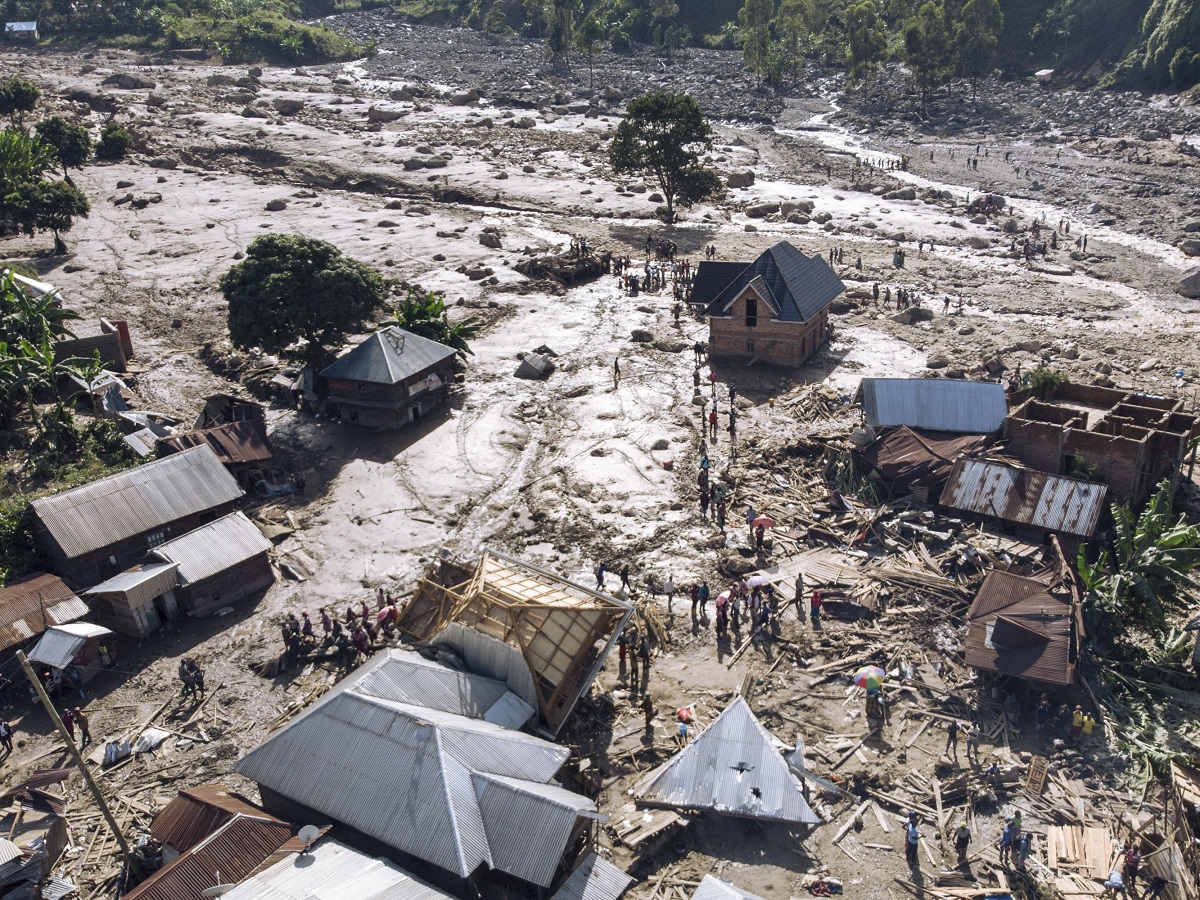
However, the death toll from the floods has risen to nearly 400, an administrative official said Sunday. The flood happened in the east of the Democratic Republic of the Congo when heavy rainfall in the Kalehe region of South Kivu province caused rivers to overflow, causing landslides that engulfed the villages of Bushushu and Nyamukubi.
Congolese government spokesman Patrick Muyaya confirmed the death toll provided by the administrator of Kalehe territory, albeit putting forward a figure of 401 deaths during a press briefing.
This is coming after the provincial governor, Theo Kasi, revealed, “We have 401 deaths in Bushushu and Nyamukubi villages in Kalehe territory,”
Drone footage shows how villagers in the Democratic Republic of the Congo congregate among the rubble of homes that were devastated by the flooding that struck South Kivu province last week. The videos also show buildings that were carried away by the flood and muck, with debris scattered around the settlements.
Numerous villages were reportedly flooded, a large number of homes were destroyed, and crops were also completely destroyed.
Reactions
The international community has reacted to the disaster, and not-for-profit organisations have taken steps to rescue victims of the incident. Also, philanthropists have taken steps in terms of medication to aid the victims.
Denis Mukwege, a Congolese doctor and Nobel Peace Prize winner, whose clinic is located in Bukavu, the capital of South Kivu, said Saturday he had sent a team of surgeons, anaesthetists, and technicians to the area to “provide the population with emergency medical aid.”
Also, the U.S. Embassy in Kinshasa has offered its deepest condolences for the loss of life, livelihoods, and homes due to devastating flooding in the affected communities of the DRC.
Through the U.S. Agency for International Development (USAID), the United States has been reported to be currently assessing the most urgent needs of the affected communities and closely coordinating with the government of the DRC and other humanitarian partners to ensure the efficient and effective delivery of assistance.
Also, representatives from the DR Congo government travelled to Nyamukubi and Bushushu, villages in the east of the country that were devastated by the floods, to hand out coffins and aid to disaster victims. The provincial government also sent a boat filled with beans, flour, other food, tarpaulins, and medicine.
A day of national mourning was also announced to be observed, with flags lowered at half-mast “in memory of the lost compatriots”.
Not the first time
The Democratic Republic of the Congo has been hit by a major flood crisis in recent times, leaving thousands of people homeless and causing widespread devastation. For example, a flood was caused by heavy rainfall in October 2019 and continued for several months, leading to the overflowing of rivers and lakes in the country.
The flood crisis affected several regions in the country, including Kinshasa, the capital city, and the provinces of Kasai, Kongo Central, and Nord-Ubangi. The flood caused significant damage to infrastructure, including roads, bridges, and buildings, making it difficult for aid agencies to even reach the affected areas.
There were reports that the flood also led to a significant increase in the number of cholera cases in the country, with over 33,000 suspected cases and 913 deaths recorded as of January 2020.
The frequent flood crisis in the DRC highlights the vulnerability of communities in the country to natural disasters and the need for long-term investments in disaster risk reduction and preparedness. The crisis also underscores the importance of addressing the underlying causes of vulnerability, such as poverty, inequality, and inadequate infrastructure.
Another signal to Africa on climate change
The DR Congo’s flood disaster came two days after floods killed at least 131 people and destroyed thousands of homes in neighbouring Rwanda, a country in East Africa.
The UN Secretary-General, Antonio Guterres, has offered his condolences to the victims of the “catastrophic floods” in Rwanda and DR Congo.
“This is yet another illustration of accelerating climate change and its disastrous impact on countries that have done nothing to contribute to global warming,”
According to experts, climate change is causing an increase in the frequency and severity of extreme weather occurrences. Climate problems like floods are becoming more frequent, wreaking havoc and taking lives across Africa.
In recent years, several countries in Africa have experienced severe flooding, leading to the displacement of communities, damage to infrastructure, and the loss of crops and livestock. For example, in 2019, Mozambique was hit by two major cyclones, Idai and Kenneth, which caused widespread flooding, destroyed homes, roads, and bridges, and displaced over 200,000 people.
Similarly, in 2020, Ethiopia experienced severe flooding, which affected over 200,000 people and caused significant damage to homes, crops, and infrastructure. The flooding was attributed to heavy rainfall, which caused rivers to overflow and dams to burst.
In Nigeria, floods have become an annual occurrence, with devastating consequences for communities living along the Niger and Benue rivers. In 2018, over 200 people died in floods that affected 12 states in the country, and over 100,000 people were displaced. Reports also indicated that the floods in Nigeria in late last year were the most disastrous season of floods the country has ever experienced in a decade, as the flood resulted in over 600 fatalities and the displacement of 1.3 million people from their homes since September.
The impact of climate change on Africa’s weather patterns, including increased rainfall and rising sea levels, has been identified as a major contributing factor to the increase in flooding in the region. Other factors include deforestation, poor land management practises, and inadequate infrastructure.
The impact of flooding on communities in Africa goes beyond the immediate loss of life and damage to property. It affects livelihoods, exacerbates poverty, and hinders economic development. The cost of rebuilding after a flood is often beyond the means of affected communities, leading to long-term displacement and vulnerability.
Africa’s vulnerability to climate change and its impact on weather patterns, including flooding, is a major challenge for the continent. The impact of flooding on communities in Africa goes beyond the immediate loss of life and damage to property, affecting livelihoods, exacerbating poverty, and hindering economic development. Addressing the underlying causes of vulnerability, such as deforestation and inadequate infrastructure, is crucial to mitigating the impact of climate change on Africa.