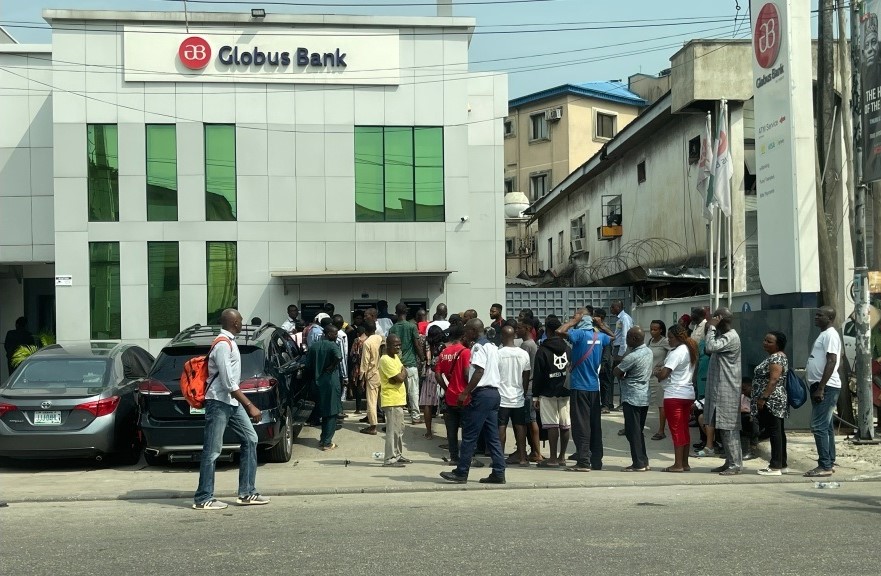
The development on Naira notes will be an unforgettable saga in the history of Nigeria. This is because not enough new notes are being released, leaving Nigerians without cash to pay for vital items. It came to the extent that there have been violent protests in recent days as people struggled to get hold of newly designed banknotes.
Nigerians have faced long lines at cash machines, with some sleeping outside banks to try and be first in line to get some money. The frustration boiled over into widespread protests, with several commercial banks attacked by angry crowds. Several claim that in a nation where currency is still often used, they have been forced to forego meals and have been unable to pay for essential services like bus or taxi fares.
According to estimates, 40% of the population lacks access to a bank account, and issues with using commercial banks’ mobile applications for payments coincided with the new currency revamp.
However, the Governor of the Central Bank of Nigeria (CBN), Godwin Emefiele, later succumbed to citizens’ pressure, precisely 10 days after the country’s Apex Court’s judgement mandated the use of old N1000 and N500 notes as legal tender till December 31, 2023. The CBN Governor officially ordered commercial banks to comply with the court verdict.
In a statement titled “Old N200, N500, and N1,000 banknotes remain legal tender—CBN,” the acting Director, Corporate Communications, Isa AbdulMumin, disclosed thus: “In compliance with the established tradition of obedience to court orders and sustenance of the rule of law principle that characterised the government of President Major General Muhammadu Buhari (retd.), and by extension, the operations of the Central Bank of Nigeria, as a regulator, have been directed to comply with the Supreme Court ruling of March 3, 2023.
“Accordingly, the CBN met with the Bankers’ Committee and has directed that the old N200, N500, and N1,000 banknotes remain legal tender alongside the redesigned banknotes till December 31, 2023.” “Consequently, all concerned are directed to conform accordingly.”
The development, however, at least put an end to the turmoil over the legality of the old naira notes. But it has not totally cured the suffering of many Nigerians, who are still facing severe hardships over the scarcity of new naira notes and the old naira notes after depositing the latter in the commercial banks.
Commercial Banks’ Mobile Applications’ Network Ellipses
Nigeria’s mobile payments have grown significantly in scale over the past few years as a result of domestic, international, market, technological, and regulatory considerations. The use of mobile banking and payment applications has significantly increased over time, and this appears to be related to a number of factors, including domestic and international market, technological, and regulatory considerations, as well as rising mobile phone adoption, government initiatives to support financial inclusion, and the demand for more efficient payment methods among financial market participants. It is rather intriguing to learn that the majority of Nigerians rely on mobile applications when there is a cash shortage, yet the services provided are not satisfactory.
According to reports, the banking public in Nigeria continues to have difficulty getting access to their money as long as there is a lack of currency and other methods are, at best, problematic.
Statistics from the Nigerian Inter-Bank Settlement Systems (NIBSS) indicate that at least N30 trillion in transactions are carried out on electronic platforms each month. And the platforms for these services are collapsing at a time when it is anticipated that these electronic transactions will increase due to the redesign of the naira and the scarcity of physical cash. According to analysts, the frequent outages of various banking applications and alternative channels have demonstrated that operators in the Nigerian financial sector have not made sufficient investments in technology.
The difficulties Nigerians face
The problems facing the banking industry were made worse by banks’ USSD platforms’ inability to satisfy customers. Due to their inability to obtain cash over the counter in the banking halls and the fact that the automated teller machines (ATMs) are not dispensing cash, many bank customers switched to the USSD platforms to conduct financial transactions.
In addition, some banks’ mobile applications have not been able to open for days or are usually fluctuating. Since the beginning of the Naira redesign, Nigerians have been unable to easily access cash, and a lot of drama usually ensues in the banking halls while many ATMs are not dispensing cash. The few ATMs available for dispensing cash are being besieged by mammoth crowds trying to withdraw cash.
The different alternate channels, however, have not functioned as well as hoped, with many transactions hanging or failing to complete. Yet, the telecom firms deny any involvement in the current difficulties bank customers are having accessing their platforms; they say that there is only an overflow at the banks.
The Emergence of the Microfinance Banks and Their Impacts
Microfinance is the “form of financial development that has its primary aim to alleviate the poverty of the poor, who generally remain unserved or are offered improper financial services.” Banks and other financial institutions are currently estimated to provide services to only 25% of potential clients worldwide. It has been opined that only 2% of microentrepreneurs are being served by banks. It is also opined that the size of the unsaved market among existing financial institutions is large.”
By enhancing the socioeconomic situation of the poor and their ability to generate revenue, microfinance banks are created to fill the void left by the conventional financial sector. Microfinance has received a lot of attention from researchers, development professionals, and institutions as a potential means of reducing poverty, one measure of which is the standard of living.
Microfinance is defined “as the provision of a broad range of financial services, including loans, savings, insurance, remittances, and transfers to low-income households and their microenterprises. For the purposes of this article, the focus will be on the services that are most commonly associated with microfinance: loans and savings. The selection of these two services is also in line with the focus on the banking sector, as these are the two services provided by the banks with microfinance operations.”
The microfinance banking system was introduced by the Nigerian government in 2005 with the goals of reducing poverty, creating jobs, fostering rural development, and offering financial support to economically engaged impoverished people who were snubbed by conventional banking.
The formal financial sector is made up of the ministry of finance, the Central Bank of Nigeria (CBN), banks, other financial institutions, the Nigerian Stock Exchange (NSE), etc. Although this formal sector can to some extent exist alongside an informal financial sector due to the fact that people can lend and borrow “directly from each other through methods like esusu, daily contributions, and cooperatives,” However, the existence of microfinance banks in Nigeria has been attributed to a number of factors, including the concentration of people in rural areas, the majority of whom lack access to banking, a low level of literacy, the collapse of trust in the banking system as a result of economic hardship, elitist banking practises, and the lack of other financial institutions in these areas.
The situation in Nigeria has been similar in that the monetary authorities have had to watch helplessly as their monetary policy measures fail to achieve the anticipated results. The Nigerian governments have struggled with poverty and unemployment over the years, in addition to their struggles with money management. The government has made an effort to do this, utilising a variety of programmes.
According to research, “some of the programmes ironed out to address the problems of poverty and unemployment by successive Nigerian governments are: rural banking scheme, Peoples Bank, operation feed the nation (OFN), green revolution, Nigerian Bank of Commerce and Industry (NBCI), Nigerian Agricultural and Cooperative Bank, Nigerian Economic Reconstruction Fund (NERFUND), Nigerian Directorate of Employment (NDE), Family Economic Advancement Programme (FEAP), Poverty Alleviation Programme (PAP), Nigerian Industrial Development Bank (NIDB), Bank of Industry (BOI), NigerianAgricultural Cooperative and Rural Development Bank (NACRDB), community banking, and microfinance
But microfinance banking is getting far ahead of these programmes. This is because it has features that distinguish it from other forms of formal financial products. These include the smallness of loans advanced and savings collected, the near absence of asset-based collateral, and the simplicity of operations.”
Conclusively, as the Naira note saga continues to hit Nigeria, the impact of microfinance banks cannot be overemphasised. Although some of them also sometimes face issues with telecom networks, their mobile applications are very swift and responsive during transactions.