Article is available in Arabic
The Nigerian 2023 elections have been slated to be held on February 25th and March 11th, 2023, according to the timetable released by the Independent National Electoral Commission (INEC), the election regulatory body in the country. While the presidential and National Assembly elections will be held on February 25th, twenty-eight governorship elections will be held alongside elections to the 36 Houses of Assembly on March 11th.
However, it is certain that due to the issues facing the country, it will typically be marred by conflicting interests and controversy; it is a game where the strong will take advantage of the weak. The only tunes that citizens can hear are whether ballots are more powerful than bullets or the other way around.
When talking about elections, Nigeria is currently at a turning point—making Nigerians divided in actuality, even though Nigerian politicians are notorious for slanting events in their favor.
The politicians have become “politically” active, and the social media platforms are being used to doctor some narratives; the politicians’ voices are now being heard loud and clear. As a result, in Nigeria’s electoral politics, power belongs to the people rightly. Still, God-fatherism in the Nigerian political atmosphere has made power belong to the few.
The Update
The nature of the polity in Nigeria is of stomach infrastructure and political sentiments. Politics in Nigeria has gone towards the base gratification of people’s needs. Money and food products have become the temptation to disturb the electorate’s voting preferences. Given the extreme poverty in Nigeria, it doesn’t take a lot of thought to understand how individuals may be persuaded to vote against their better judgment with just a few Naira notes and a sack of rice.
By taking advantage of the need to motivate voters with food products like bags of rice and cash, politicians have begun giving Nigerians the financial benefits of democracy. The politics of the stomach infrastructure project has kicked off, and the images of politicians and the parties they support are now being strategically placed on the bags of rice and other food items.
However, due to Nigerians’ pervasive poverty, they are now at the mercy of politicians who bind them to the snarl of stomach infrastructure. The politics of stomach infrastructure is a reality that Nigerian politicians project onto their electorate, a group of people who are encouraged to give up their fundamental right to choose their government in exchange for short-term satisfaction because of poverty.
The defenders of stomach infrastructure have always contended that while the stomach is empty, the government cannot make significant investments in physical infrastructure. As a result, vote-buying and money politics have assumed a prominent role in Nigerian political activities. Any politician in Nigeria who refuses to openly or covertly exchange money to buy support would be viewed as inexperienced.
The main issue is describing democracy as the best form of government in the world, which many regard as operating on the parlance of stomach infrastructure. However, this has frequently undermined the electoral process by preventing elections from being free and fair. The project of stomach infrastructure draws attention away from the lack of urgent and existential infrastructure impeding true development in Nigeria, such as the lack of schools, hospitals, roads, power, water, and other democratic benefits.
With the nature of this polity, the reasons for winning elections in rural areas and communities with the poorest of the poor are not farfetched because people there would sell their rights for a bowl of foodstuff at the expense of physical infrastructure.
Clearly, as the 2023 elections approach, Nigerians’ social media rants appear meaningless because a political party may win over a million votes by providing basic necessities such as food and money. It is improbable that Nigeria could completely eradicate this despicable behavior come 2023.
Sadly, when the general election in 2023 is over, many Nigerians will start trying to hold the government accountable for effective administration by complaining about poor roads, an unstable power supply, severe unemployment, insecurity, and other issues.
It saddens that by giving food to the hungry, Nigerian politicians can buy people’s loyalty. However, only a few people realized that the physical infrastructure, including the schools, hospitals, roads, power, water, and other democratic benefits, in the process of the nature of politics of stomach infrastructure, are being sacrificed in order for these politicians to achieve their goals—and unfortunately, the nature of this polity seriously jeopardizes Nigeria’s democracy.
Who’s who in the context of 2023?
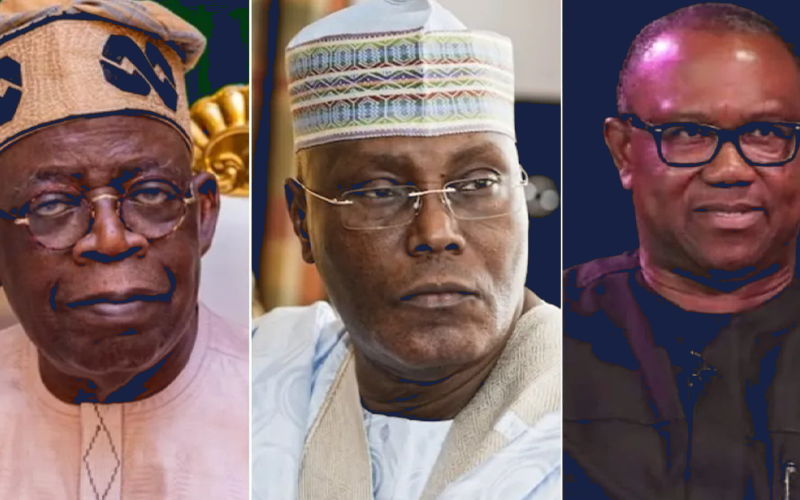
The 2023 presidential election has been termed a three-horse race between the candidates of the Labour Party (LP) and former Anambra State governor, Mr. Peter Obi; the All Progressives Congress (APC) and former Lagos State governor, Mr. Bola Tinubu; and the Peoples Democratic Party (PDP) and former Vice President of Nigeria, Atiku Abubakar.
The result was based on a poll which was commissioned by the Anap Foundation and conducted by NOI Polls Limited in early September, and the result recently predicted that the presidential candidate of the Labour Party, Mr. Peter Obi, will emerge as the winner of the 2023 presidential election. This was contained in a statement issued on Thursday and signed by the President and Founder of the Anap Foundation, Mr. Atedo Peterside, who claimed that the polls were conducted in all the six geo-political zones.
“The polls showed a substantially close race between Obi, the All Progressives Congress (APC) presidential candidate, Asiwaju Bola Tinubu and Atiku Abubakar of the Peoples’ Democratic Party (PDP).”
The statement reads: “All other contestants polled results that are statistically insignificant. The results showed a significant lead for Mr. Peter Obi, with 21% of voters proposing to vote for him if the presidential election were to be conducted today and 13% each proposing to vote for Asiwaju Bola Ahmed Tinubu and Atiku Abubakar, who are both tied in second place. “
According to the poll, the age groups between 46 and 60 exhibited the greatest readiness to vote. The poll indicates that, on average, roughly 8 out of 10 registered voters are positive that they will cast a ballot in the upcoming presidential election. If they continue to be dedicated, the elections in February 2023 may see a record-breaking turnout.
Though the poll results reveal some significant trends, the jostling for the presidential seat can be hindered by the undecided voters who stand on neutral ground, as the undecided voters are large enough to turn the tables.
However, the opposition parties responded to unrealistic statistics by predicting victory for the Labour Party’s presidential candidate, Peter Obi. The APC Presidential Campaign Council on Thursday, in a statement, “rubbed” the NOI Polls, saying they are inconsistent with Nigerian reality.
According to the Council, the poll conducted by the NOI polls made wild and incredible permutations on the presidential elections, claiming that with research, NOI polls “have been off the mark at critical election periods in recent times.”
The statement argued that “for example, preparatory to the March 2015 presidential elections, NOI published in October 2014 the results of a “Viability Poll” which used the concepts of familiarity and net favourability position to survey.
According to the findings, NOI claimed that President Goodluck Jonathan has the highest overall familiarity rating of 99%. In contrast, NOI dismissed the then-All Progressives Congress candidate, Muhammadu Buhari, as a “borderline candidate” who required “huge public relations” to improve his performance.
But when the Nigerian people went to the polls, who won? The APC candidate and now President, Muhammadu Buhari. “This is not the only instance when the NOI has turned its political bias in an election period to fraudulent statistics.” The Council argued
In reality, however, Nigeria’s social media or opinion polls hardly justify ballot voting. Hence, many supporters of the Labour Party’s presidential candidate, Peter Obi, have been regarded as social media warriors who can wail online, with some of them not possessing voters’ cards. Also, in reality, the northern part of the country usually generates the highest number of vote counts.
It may turn out to be unsurprising if Peter Obi of the Labour Party appears not to be the winner of the 2023 general election. His popularity on social media might end there because the number of people supporting him online cannot be quantified with the number of people not supporting him offline.
Factors that might determine the winner
It is a well-known fact that politics is a game of dice. The top three contenders are familiar faces in Nigerian politics. And while the coming presidential elections seem like a game between the APC and PDP all over again, the supporters of the LP candidate believe Peter Obi is different, even though he was a member of the PDP till May 2022, when he left the party due to disagreements on the party’s presidential ticket.
For the APC supporters, the Bola Asiwaju Tinubu (BAT) family, their determining factors range from sentiment to “brief-case/portfolio contractors” and “businessmen who have no viable means of livelihood or ability to create wealth outside of government.” According to a political analyst, the supporters of APC/Tinubu are mostly those that rely on government patronage and the existing corrupt system by depending on the government to live. Hence, the BAT family will make sure to do all that is necessary to retain the power of their party. Other determining factors, as claimed by most of his supporters, are his contributions towards “humanity”, being a “king-maker”, a political strategist, and a calculator. Another determining factor for him is his “Muslim-Muslim” ticket. However, it could also be said that his chances and potential are being affected by the performance of the current APC administration of President Buhari.
On the contrary, the Atiku family, who are PDP supporters, appear to be the capitalists who have not been benefiting “from APC’s maladministration, with the hope that Atiku’s presidency will somehow allow them to make money from the treasury”. They can’t wait to snatch power from the reigning party, despite their bad record of administration for the last seven years. Their determining factor could be the politics of stomach infrastructure projects or a lot in between – with promises.
While the LP people, the Obi family, who are majorly called “Obidients,” appear to be revolutionists, Obidients claim to be independent individuals whose only goal is to have a functioning government. They believe Nigeria can work again and has vast and enormous potential. Hence, they desire a fresh start for Nigeria and an end to the pervasive corruption. But the bone of contention and the scary part is whether their online presence could galvanise the ballot boxes. The strength of youth across the country is a major determining factor for him.
It is, therefore, safe to conclude that whatever the case or the outcome of the 2023 forthcoming election will have a shadow of this present administration: the legacy built and the criticisms on the other side; the bad side and good side of the Buhari administration; the present president’s efficiency and deficiency; the public perspectives and the strength of the youth; and also everything that revolves around it, will also be the key determiner of the future.