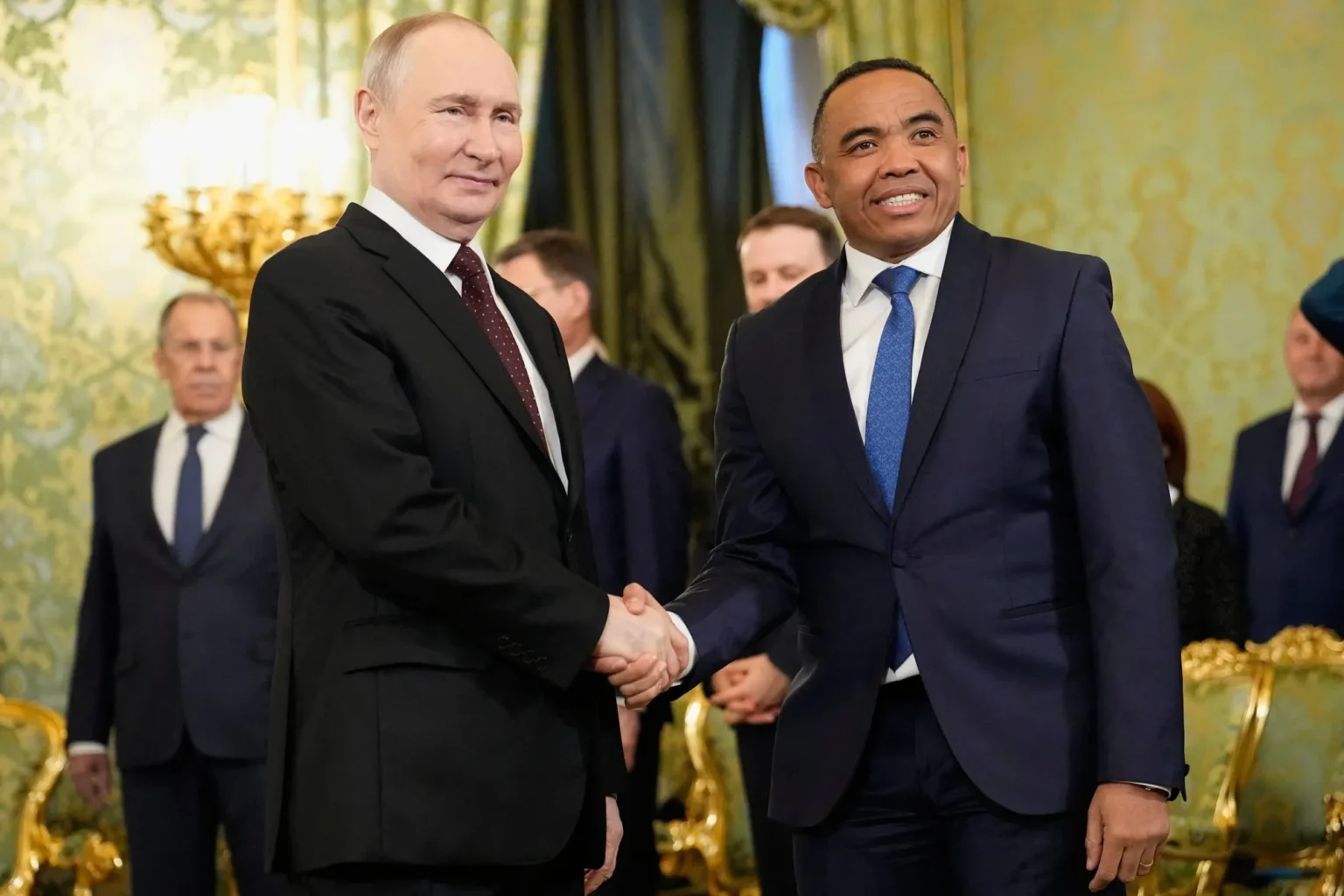
This week, Russian President Vladimir Putin hosted Madagascar’s President Michael Randrianirina at the Kremlin, offering strong support for expanded bilateral cooperation. Putin described Madagascar as a valuable partner and highlighted areas including agriculture, energy, healthcare, education, and geological exploration. Randrianirina, whose government has been navigating internal challenges and the aftermath of devastating cyclones, expressed gratitude for support and signaled interest in deeper engagement across multiple sectors. Russia’s outreach fits into a larger push to cement influence in Africa through diplomatic, educational, and economic linkages, including training opportunities for Malagasy students in Russian institutions. The meeting underlines Russia’s broader strategy to strengthen ties with African nations amid shifting global geopolitics and Western pressures.
In Nairobi, dozens of Kenyan families staged a protest demanding urgent government action to repatriate relatives who were allegedly lured into fighting for the Russian military in Ukraine. According to a report presented to the Kenyan Parliament by the National Intelligence Service, more than 1,000 Kenyans have been tricked into enlisting under false pretences, including promises of lucrative employment, only to find themselves on the front lines of Russia’s war. Families say many recruits were deceived by recruitment agencies and collusion involving rogue officials, leaving them stranded, injured, or missing. Loved ones of the missing have begun submitting petitions to government offices and international partners for assistance, amid fears for their safety and calls for diplomatic dialogue to secure their return.
Gabon’s national media regulator indefinitely suspended access to social media platforms including Facebook and TikTok, following concerns over “conflict-inducing” content — including misinformation, defamatory posts, and threats to social cohesion. The suspension comes amid wider unrest, with teachers striking over wages and broad discontent among public servants less than a year after President Brice Oligui Nguema was elected. Authorities justified the ban by citing risks to national stability, claiming that unregulated content could fuel social conflict and harm democratic processes. The move has stirred debate over freedom of expression in Gabon, with opponents warning it could undermine political openness and restrict civic engagement.
The United States deployed 100 soldiers to Nigeria as part of a training mission aimed at bolstering the Nigerian military’s capacity to confront escalating threats from armed groups. The U.S. contingent is tasked with providing training and strategic support to Nigerian forces confronting insurgencies and escalating attacks in several regions. Nigerian officials say the training will focus on modern combat techniques, intelligence sharing, and improved operational planning. However, human rights groups caution that without parallel efforts to address governance issues and civilian protection, military training alone may not stem the broader crisis affecting millions of Nigerians.
Zimbabwe introduced a new HIV prevention drug known as lenacapavir, seen as a breakthrough in reducing the risk of HIV infection. Lenacapavir works by blocking key stages in the virus’s replication cycle and offers a months-long prevention window. Health officials say the rollout could dramatically reduce new infections, particularly among high-risk populations who struggle with adherence to daily regimens. Zimbabwe’s health ministry is partnering with international agencies to ensure broad distribution and community education. The initiative is part of a larger push by Southern African nations to adopt advanced treatments and prevention tools to meet global HIV reduction targets.
Turkish President Recep Tayyip Erdoğan made a significant visit to Addis Ababa, marking a new phase of expanded cooperation between Turkey and Ethiopia. The trip highlighted growing political, economic and strategic engagement, with Ankara emerging as a key investor and diplomatic partner. Trade between the two countries has grown steadily, making Turkey one of Ethiopia’s top investors. Erdoğan’s diplomacy also reflects Ankara’s broader role in regional affairs, including mediation efforts and discussions on security, infrastructure, and energy cooperation. Ethiopian leaders welcomed Turkey’s involvement, emphasizing deep historical links and potential for future collaboration.
Niger and Algeria announced a partnership focused on energy infrastructure, particularly pipeline cooperation after high-level talks between authorities of both countries in Algiers. The discussions aimed to deepen regional energy integration and boost export capacity for Niger’s natural gas, potentially benefiting both countries’ economic growth. Leaders emphasized shared interests in energy security and regional stability, with Algeria positioned as a key hub for West African gas transit to international markets. The talks also covered broader economic cooperation, including trade facilitation and investment opportunities. This renewed dynamic signals a shift toward closer West African collaboration on energy projects that could attract foreign investment and strengthen regional institutions.
A Tunisian court sentenced lawmaker Ahmed Saidani to eight months in prison after he was convicted of insulting President Kais Saied in a social media post. The ruling has drawn criticism from opponents and human rights groups, who argue it reflects President Saied’s tightening grip on political dissent and shrinking space for free expression. Saidani, once a supporter of Saied’s policies, became a vocal critic, describing the president with derogatory language in a Facebook post. His imprisonment is seen as part of a wider trend under Saied’s rule, where critics, journalists, and opposition figures have faced legal sanctions or detention. Tunisia’s political landscape has been contentious since Saied dissolved parliament and assumed expanded powers in 2021.
China announced plans to implement zero tariffs on imports from 53 African nations starting May 1, 2026, as part of an expanded trade and economic partnership strategy. This move, reported by Chinese state media, aims to bolster market access for African exports and strengthen diplomatic ties. The tariff elimination is expected to particularly benefit agricultural and industrial goods, making African products more competitive in China’s massive market. African leaders have welcomed the announcement as a potential boost for economic growth and diversification, though some analysts note challenges related to infrastructure, product standards, and domestic manufacturing competitiveness. The tariff policy is seen as part of China’s broader strategy to deepen economic engagement across Africa amid global geopolitical competition.
Zambia’s mining regulator has lifted a suspension on operations at the Mufulira copper mine owned by Mopani Copper Mines, allowing underground work to resume immediately after the company implemented new safety measures. The Minerals Regulation Commission originally suspended mine activities last week because the company had failed to comply with safety rules requiring an accurate accounting system for all workers underground — a critical safeguard for miners’ safety. Following the suspension, Mopani installed improved safety systems including enhanced tracking technology to verify that no workers remain underground after shifts and closed-circuit cameras to monitor activity. Regulators said these adjustments now meet the requirements of Mining Regulation 218, ensuring a safer working environment. The mine’s reopening comes shortly after regulators had ordered a comprehensive safety review following recent accidents, underscoring heightened scrutiny of compliance in Zambia’s mining sector.