Russia and African countries thrived in economic ties. The diversification of geographical distribution in the range of goods traded in terms of rail material, fertiliser, pipes, and high technology equipment was adopted by both economies to boost bilateral trade relationships and economic activities. Since 2006, Russia has sought to build its presence and role in Africa. The age of imperialism and scramble for Africa significantly impacted Africa’s continent and left a considerable positive and negative legacy concerning contemporary society. Russia-Africa tie made an impact in terms of project/infrastructural development and humanitarian aid to African countries.
Also, these projects and aid were given in return for natural resources from Africa. The scholarship awards across different African regions benefited many who subjugated Africans to be loyal to the Russians and built a sphere of influence on the continent by promoting foreign policies against the United States and European Union. The terms of trade were very imbalanced between Africans and Russians. The economic policies favored the Russians and expressed much superiority against the Africans.
Ethiopia had a larger population of 24 million people, making Ethiopia the second most populous country in sub-Saharan Africa. Ethiopia had the potential for significant agricultural development if the country had political stability bolstered by financial help. And Ethiopia was considered more diverse in its ethnicities and religions. Ethiopia’s diplomacy and its strategic positioning towards neighboring countries and the geo-political areas of the horn of Africa based on foreign policy pillars. Ethiopia’s foreign affairs policies towards neighbouring countries are a pre-condition for safeguarding its sovereignty.
It is mainly to establish an environment favourable for international cooperation and internal economic development as well as the political stability of Ethiopia. Because of its accelerated economic growth and pivotal role within the African Union, Ethiopia is a much respected and preferred country for foreign direct investment and for political and diplomatic influence in the Horn of Africa. Ethiopia’s diplomatic cooperation towards neighbouring countries is prioritized to establish strong multilateral and bilateral relations.
Ethiopia has external relations with Russia. The relation between the two countries was strengthened with Cold War superpower rivalry and regime changes in Ethiopia in 1974. Their relationship again revived after the 2018 political transition in Ethiopia. Hence, this research aimed to address whether the political transition in Ethiopia has opened new avenues for strategic partnership with Russia or recalibrated an existing relationship within a changing geopolitical context.
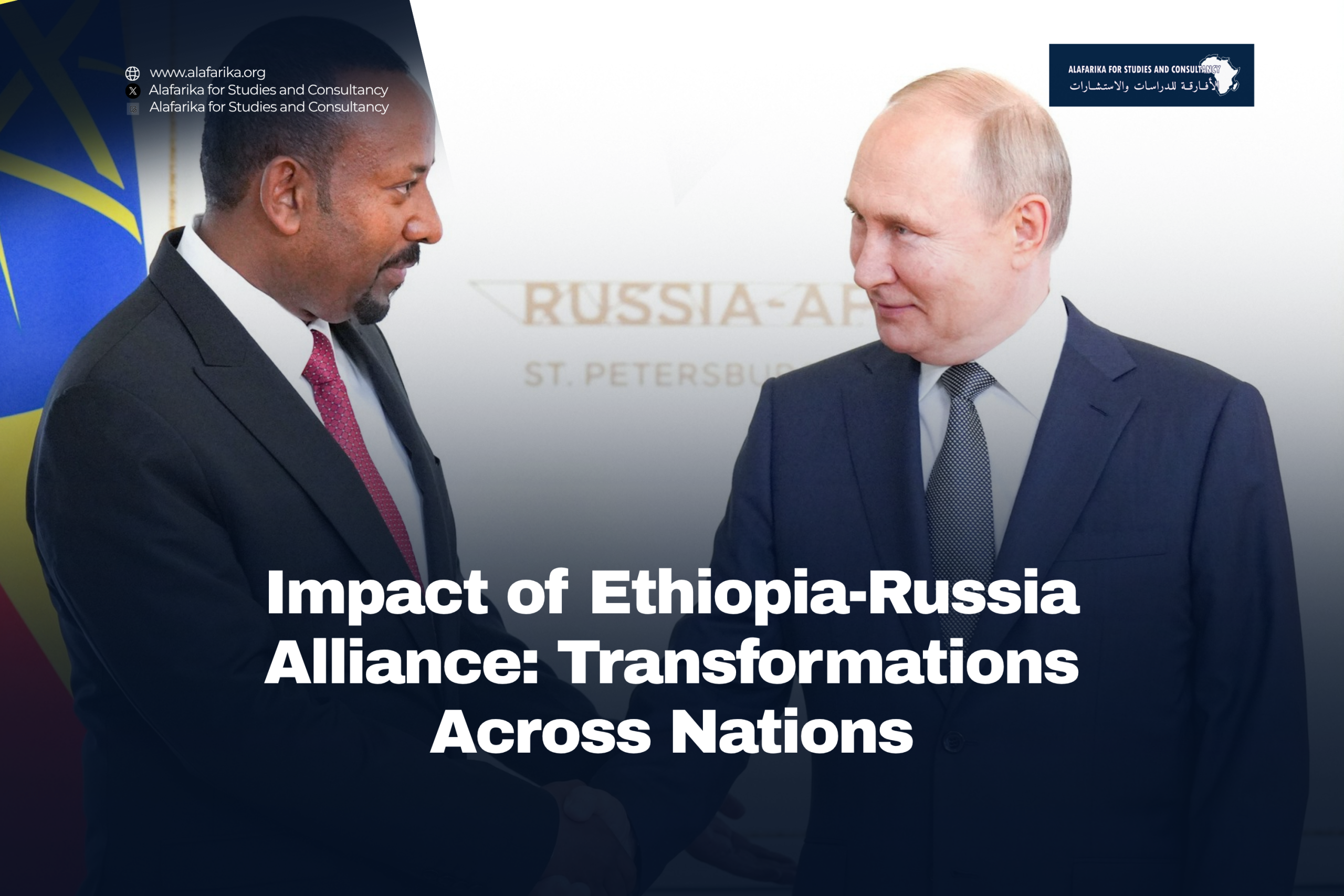
Russia is a friendly country for Ethiopia and already has sound cooperation. Both countries linked with each other at a level not ever seen before. They are building a community of a shared future by connecting two nations. Development, mutual cooperation, and mutual benefit have become the common goal of two countries. To ensure cooperation, they need to work harder based on the shared aspirations of two nations. Russia and Ethiopia each have a time-honoured history and impressive cultural exchanges. It needs to advance more, and Ethiopia and Russia youth are the future of the countries. They also need to hold in their hands the future of both countries’ friendship. Russia and Ethiopia’s relations have been based on economic, political and cultural issues.
The main directions and projects of cooperation are fixed in the “Medium-term programme for the development of trade, economic, scientific, and technical Cooperation between the Russian Federation and the FDRE” (2002). It includes the following sectors of the economy: the oil and gas industry, electric power industry, geology and natural resources, industry, water management and irrigation, land development, agriculture, health care, and training of national personnel. Of great importance for the country was the cancellation in 2005 of Ethiopia’s debt to the USSR / RF (1104 out of 1268 million US dollars) and the restructuring of its balance for 30 years.
How the alliance transforms Ethiopia internally
Ethiopia in modern borders arose only at the end of the 19th century as a result of numerous conquering campaigns of Emperor Menelik II. Diplomatic relations with the Russian Empire were officially established during the reign of Menelik II in Italian colonisation in the Battle of Adua on March 2, 1896. For the first time in history, an African country defeated a European colonial empire and became independent. Special mention should be made of Russia’s participation in the events in Ethiopia. In confronting the colonial power, Russia provided diplomatic and partial military assistance, helping Ethiopia with weapons and ammunition free of charge.
The regime change in Ethiopia in 1991 and the collapse of the USSR led to a reduction in bilateral interaction. Since the late 1990s – early 2000s, there has been an increase in the mutual economic interest of the two countries. This is facilitated by the bilateral Intergovernmental Commission on Economic, Scientific, and Technical Cooperation and Trade (IPC), established in 1995. During a visit to Moscow in December 2001, Ethiopian Prime Minister Meles Zenawi signed a Declaration on the principles of friendly relations and partnership.
On February 25, 2023, the Russian Embassy in Ethiopia solemnly celebrated the 125th anniversary of the establishment of diplomatic relations between the two countries. In his speech, Ambassador of the Russian Federation E. Terekhin emphasised that relations between the two countries are based on friendship, mutual respect, and trust and now have a multifunctional, mutually beneficial character.
In Ethiopia, Moscow’s bilateral engagements are bearing fruit. To start with, Russia’s re-connection with Africa was accelerated by geopolitical shifts in the Sahel. These have challenged the dominance of traditional powers and created an economic and security vacuum in the so-called Coup Belt. Meanwhile, Russia sees opportunities to expand cooperation with Ethiopia in industry, energy, agriculture, and other sectors, according to a report by the Russian news agency, as Minister of Economic Development Maxim Reshetnikov stated: “Russia views Ethiopia as a key partner on the African continent.’’
Trade: Russia’s trade volume with Africa in 2022 (US$18.4 billion) was lower than the continent’s traditional partners, such as China (US$199 billion), Italy (US$76.3 billion), France (US$67.8 billion), the US (US$65.7 billion) and Germany (US$45 billion). Also, Russia’s foreign trade turnover with Ethiopia increased by almost 46% in 2024 compared to 2023, and tripled in January–August 2025 compared to the same period in 2024,” the Russian Economic Development Ministry quoted Reshetnikov as saying.
Reshetnikov added that the supply of Ethiopian coffee to the Russian market continues to grow. “Last year, grains constituted the bulk of our exports. In 2025, fertiliser shipments have accounted for the majority of bilateral trade,” he said, noting “significant opportunities for expanding cooperation in various areas—from agriculture and industry to energy, science, education, and information technology—with great prospects opening up in investment and infrastructure projects.”
Energy and Education: Russia and Ethiopia signed ‘The Agreement on Cooperation in the Field of Peaceful Use of Atomic Energy’, which is designed for the long term. It laid the legal foundation and outlined hopeful areas in which Russian cooperation should move forward. Furthermore, Russia has reopened lots of scholarship programmes for Ethiopians. Certainly, during the Soviet period, about 600 Ethiopian students were admitted to Russia universities each year. Today, these numbers are considerably lower, but Russia continues to deliver government scholarships for Ethiopian citizens.
In September 2025, Russia and Ethiopia signed a document, calling for the planning and construction of a nuclear power plant in the East African country. Furthermore, the document said the two sides agreed to create a detailed construction plan and a “road map” for the technical and economic foundation of the project and an intergovernmental agreement to proceed. The agreement also calls for training for staff in operating the plant and developing the nuclear sector.
Security: Russia’s growing security role in parts of Africa, including in countries such as Mali, Central African Republic, and Equatorial Guinea, is viewed with concern by the West, and has come at the expense of former colonial power France, whose forces have departed or been expelled from several West African countries over recent years, and the United States.
Russia is also cooperating in military-technical cooperation for Ethiopia. Its main tool is the regular meetings of the Intergovernmental Working Group on Military-Technical Collaboration. In July 2021, the Group discussed in Addis Ababa with the Russian delegation. The prospects for the development of both countries’ cooperation, the possibilities of expanding it in the field of using technologies, skills and knowledge were agreed. Thus, the Ethiopia’s ‘New Beginning’ and new leadership policy prospects are hoping to give priority for Ethio-Russia strategic cooperation relations.
Conclusion
Russia’s growing presence shouldn’t necessarily be seen as a risk, and its increasing footprint may complement Africa’s relations with new and traditional partners. But while African states have become less concerned about the war in Ukraine, the continent has remained a priority for Ukraine, Russia and other major powers. As these global contenders seek Africa’s support or neutrality, countries on the continent must avoid being used or becoming a belligerent in a proxy war.
Profound vicissitudes are taking place in Ethiopia’s relations with the rest of the world, with closer cooperation among Ethiopia and international societies. Thus, adopting policies Ethiopia must give full thought to both domestic and international issues. As a not colonised country by any external warriors in the past, Ethiopia must develop a distinctive diplomatic approach suitable to its role as regional players and should start developing strong country.
In order to understand relations with other countries, Ethiopia should first know the neighbours’ countries relations key areas and their vitality. Neighbouring countries have long-standing links with Ethiopia in such areas as language, culture, history, and natural resources. Changes in Ethiopia touch them directly, and what happens to them has an influence on Ethiopia. There are natural resources and rivers that connect countries and have a direct bearing on Ethiopia’s development. This is principally true of Sudan, Somalia and also Kenya.
Considering its promise to peace, stability, and democracy, Russia has an important influence to make towards Ethiopia’s efforts to achieve peace, both in Ethiopia and the whole region. Russia has been backing Ethiopia’s efforts to boost the capacity of Ethiopia’s security issues as well as the efforts to resolve conflicts through just means. This is likely to continue with greater strength in the future. In front of many international leaders, Russia officials expressed their positive attitudes and support for Ethiopia’s legitimacy government, together with China and other Ethiopian friends’ countries leaders globally.
Russia has at all times been and still remains a friend of Ethiopia. Russia attempts to build equal relationships based on mutual respect. Russian are “A friend in need is a friend indeed”, and are ready to provide Ethiopia with all conceivable help. Russia adheres to the principle of non-interference and believes that the situation in Ethiopia is still a purely domestic issue. Russia remains a vigorous country and is likely to continue to play a significant role globally. There exist long-standing cultural bonds between the people of Russia and Ethiopia, and Russians have a warm nature towards Ethiopia. Russia can contribute to Ethiopia’s economic development in terms of providing a market for exports, and a source of investment, technical assistance, in culture and education sectors.