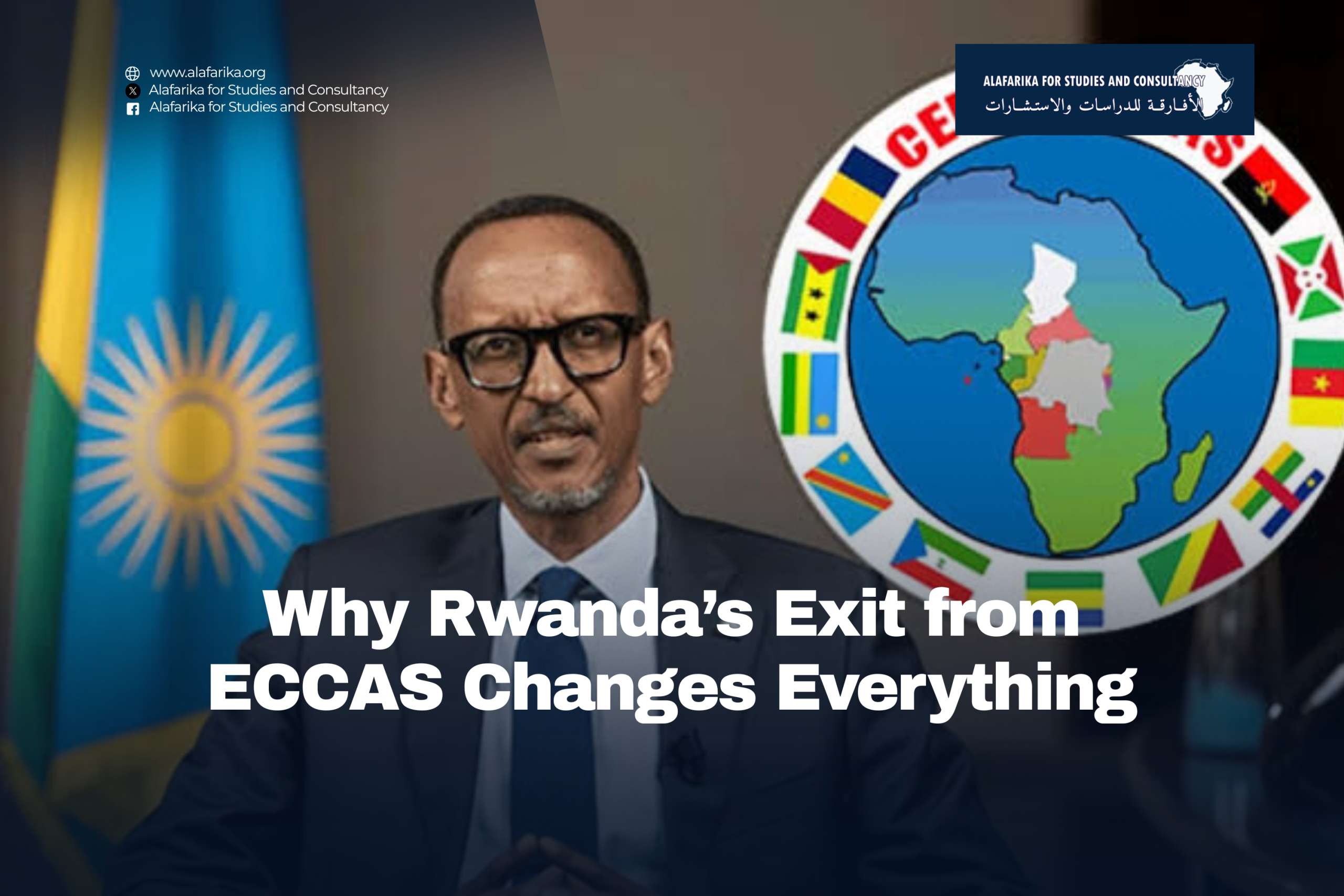
The Economic Community of Central African States (ECCAS) stands as a regional economic body for countries located in the central region of Africa. Since its establishment in 1983, with the signing of its constitutive treaty in Libreville, the bloc’s objectives have aimed at fostering regional development and promoting socioeconomic integration and maintaining economic stability through cooperation. Following an institutional reform in December 2019, the bloc acquired the status of commission, with the hope of attaining a common future in an environment of peace, security, and stability, ensured by sustainable development, good governance, the growing improvement of the living conditions of citizens, freedom, and justice, embedded in its renewed vision.
Being a designated pillar of the African Economic Community (AEC), the bloc is projected to play important roles in the continent’s integration agenda. The economic body is also among the eight Regional Economic Communities (RECs) recognized by the African Union (AU). However, the bloc’s aspirations to foster regional development have been challenged over the years. The recent official withdrawal of Rwanda from the bloc, amidst stormy challenges facing the region, calls for a critical look into the bloc’s current state and raises concerns of possible implications.
Prior to the withdrawal, the body was made up of eleven member states, namely Angola, Burundi, Cameroon, Central African Republic, Chad, Democratic Republic of Congo, Equatorial Guinea, Gabon, Republic of the Congo, Rwanda, and São Tomé and Príncipe. Following the departure, the bloc remains a 10-member state body, with a heap of socioeconomic challenges battling it.
ECCAS’s Journey: The Triumphs and Trials
Numerous factors have challenged ECCAS”s operations since its establishment to date, hindering its efforts aimed at achieving regional integration and socioeconomic development. According to the signed treaty that gave birth to its establishment, six key areas of integration were outlined as priorities for the bloc to achieve its missions through regional self-reliance. These areas include political integration aimed at achieving peace and security through political cooperation across member states; economic and financial integration aimed at creating a common market that will guarantee free intra-regional movement of goods and flow of trade; physical integration aimed at regional infrastructural development; environmental integration aimed at rural development by ensuring food security and increased productivity; social integration and human development aimed at eradicating poverty and guaranteeing access to quality education, healthcare, and other basic amenities; and lastly, institutional integration aimed at organizational reform.
However, these areas have witnessed significant setbacks resulting in a low success compared to other regional economic communities. Among these challenges is the persistent political instability and conflicts that the region has continued to face over the years. The Anglophone crisis in Cameroon, ongoing demonstrations against current president Biya, who has been in office since 1982, clashes between rebel groups, militias, and government forces in the Central African Republic (CAR), violent activities by numerous armed groups in the Democratic Republic of Congo (DRC), most particularly by the M-23 rebels, the separatist insurgency in Cabinda, Angola, insurgency attacks and intra-communal clashes in Chad have all contributed to the region’s instability. These conflicts have resulted in the absence of mistrust among the heads of member states of ECCAS and thus hinder the region’s development.
Also, the lack of economic diversification and overdependence of the member states economies on natural resources, oil, and minerals constitute the economic challenges facing the ECCAS. Historically, the bloc had performed weakly in fostering trade within the region, compared to other regional blocs such as SADC and ECOWAS. From 1992 to 1999, it experienced significant financial struggles and ineffectiveness due to numerous factors, including member states’ non-payments of fees. This resulted in slow implementation of developmental projects, as they reportedly exceeded the planned timeframe for execution.
Why Rwanda withdrew from ECCAS
Rwanda, a founding member of ECCAS in 1983, had once departed from the regional bloc temporarily in 2007 so as to maintain a balanced participation in its membership in numerous regional trade blocs. This decision was taken to make Rwanda concentrate its efforts in other regional bodies, such as the East African Countries (EAC) and COMESA, most particularly. However, Rwanda rejoined ECCAS in 2016, citing its interest in widening its economic prospects and broadening its political influence and diplomatic stance within the Central African region.
The recent withdrawal announced by Rwanda on June 7, 2025, didn’t stem from the country’s interest in balancing its participation in other blocs. Rather, it was an apparent show of Rwanda’s grievance and displeasure over the bloc’s administrative process. The reason behind the withdrawal this time around was a dispute over the rotational chairmanship of ECCAS. While Equatorial Guinea retained the leadership role of the bloc, Rwanda claimed its right to lead the bloc for the 2025-2026 term, citing Article 6 of the ECCAS Treaty as the stipulated law that backs its claims. This move was interpreted by Rwanda as a deliberate attempt of the bloc to “impose the DRC’s diktat” and undermine its rights within the ECCAS.
Prior to this, Rwanda had been excluded from participating in the 22nd ECCAS Summit in 2023, held in Kinshasa, under the leadership of DRC. This exclusion was protested to the African Union by Rwanda, citing it as deliberate and illegal, but the silence from the AU leadership further buttresses Rwanda’s claims that ECCAS no longer upholds its outlined principles. Ultimately, Rwanda claimed that it no longer saw any justification to remain in the bloc, as its current functioning goes against its foundational principles. The Rwandan Minister of Foreign Affairs also tagged ECCAS as one of the least effective economic communities within the AU, citing dysfunctional leadership as its crucial problem.
Implications of Rwanda’s departure
Rwanda’s withdrawal from ECCAS carries critical implications for the bloc’s political landscape, economic integration, and regional security. Putting into consideration the structural weakness and inherent ineffectiveness that ECCAS has long grappled with, it can be easily denoted that Rwanda’s withdrawal from the bloc is a result of perceived political biases among the bloc’s member states. The long-standing unresolved conflicts in Eastern DRC and alleged accusations of Rwanda’s support to M23 rebels—which Rwanda denies—also contribute to Rwanda’s stated reasons for its withdrawal.
The departure of Rwanda from ECCAS leaves the bloc with serious political implications that extend beyond the withdrawal of an ordinary member. The departure based on alleged manipulation and denial of rights further weakens the bloc’s institutional effectiveness and deepens tensions and mistrust among Central African states. It clearly calls public attention to the fragmentation of the bloc’s political mechanisms. Since the withdrawal was announced, the bloc’s legitimacy has been impacted directly, as critics continue to justify Rwanda’s departure and criticize the bloc, questioning its capacity to effectively function as a regional body.
A former U.S. diplomat, Tibor Nagy, described ECCAS as “the least effective of Africa’s regional blocs, doing little more than having meetings.” This further proves the bloc’s vulnerability to assert itself as a serious functioning regional body in Africa. Allegations of the bloc’s failure to abide by its rules, failure to uphold its principles, and non-adherence to founding treaties, as leveled by Rwanda against the body, can serve as the fastest exit route for more member states. Each member state might begin to question the relevance of its membership if political agendas are being considered in enforcing rules and taking decisions. The bloc’s political credibility, relevance, and influence among persisting members and international communities are currently at stake in the aftermath of Rwanda’s departure.
Another implication of Rwanda’s withdrawal from ECCAS is the potential threat to achieving economic integration in the region. Over the years, the bloc has been reportedly marred by financial struggles, making its quest towards fostering economic integration very challenging. Its interregional trade accounts for just 5% of all African trade, indicating difficulties in deepening economic relations among its members. The bloc, despite being characterized by limited economic integration, is prone to being more fragmented economically as a result of Rwanda’s withdrawal. The possible disruption of the Dar-es-Salam corridor, which serves as an important supply chain for Rwanda, looms ahead.
In the coming days, we might witness a complication of bilateral trade flows between Rwanda and other member states of ECCAS, most particularly the DRC, a notable trade partner to Rwanda. The bloc’s pace in executing infrastructural projects within the stipulated timeframe has also been very challenging, even during Rwanda’s membership. Henceforth, the execution of key regional infrastructural projects, such as the Central African Pipeline System, might witness longer delays, as Rwanda’s withdrawal creates a void in mediating disputes, leaving key projects to regional strife.
Rwanda’s departure, rather than causing a collapse, technically exposed ECCAS’s economic fragilities, denoting that the bloc’s strategic steps towards economic integration are insufficient. Also, the departure of a key member like Rwanda, which is open to integration opportunities with other regional economic bodies, such as EAC and COMESA, further limits the bloc’s chances of becoming a regionally balanced market. Other member states might begin to shift focus on seeking economic integration elsewhere by creating or strengthening bilateral trade relations with other regions.
In addition, the departure of Rwanda, being a military-capable state, will further weaken ECCAS’s military capability in responding to security threats in the region. The absence of Rwanda from the bloc’s peace and security mechanisms, such as the Council for Peace and Security in Central Africa (COPAX), further reduces the bloc’s collective ability to counter armed groups and manage intra-border security threats. Also, Rwanda’s withdrawal, which came at a crucial time when the U.S.-led peace talks are ongoing between DRC and Rwanda over the persisting conflicts in Eastern Congo, might cause a drastic setback in fulfilling the peace deal agreements.
ECCAS is in dire need of mitigating the implications of Rwanda’s withdrawal on the region’s development by embarking on a serious internal reform through a thorough self-assessment of its overall effectiveness, aimed at rebuilding trust among member states, portraying good and credible governance, and revitalizing its economic integration efforts.