The Western Sahara is a desert region located on the northwest coast of Africa, characterized by a sparse population of 565,000 people, known as the Sahrawis. The territory has a landmass area of 266,000 sq. km and is bordered by Morocco to the north, Mauritania to the south, and Algeria to the east. Its Atlantic coastline, which borders the region to the west, is rich in fishing waters, while its arid landscape has substantial phosphate deposits lying beneath it. The region, which is constituted by Sahrawis mainly of Arabic origin and related to those of Morocco and Mauritania, is often regarded as Africa’s “last colony” due to a prolonged conflict over the region between Morocco and the Algerian-backed Polisario Front, with recurring deadlock of peace resolutions. It is for this reason that the conflict is often described as a “frozen conflict.”
The Spark of the Conflict: Historical Genesis
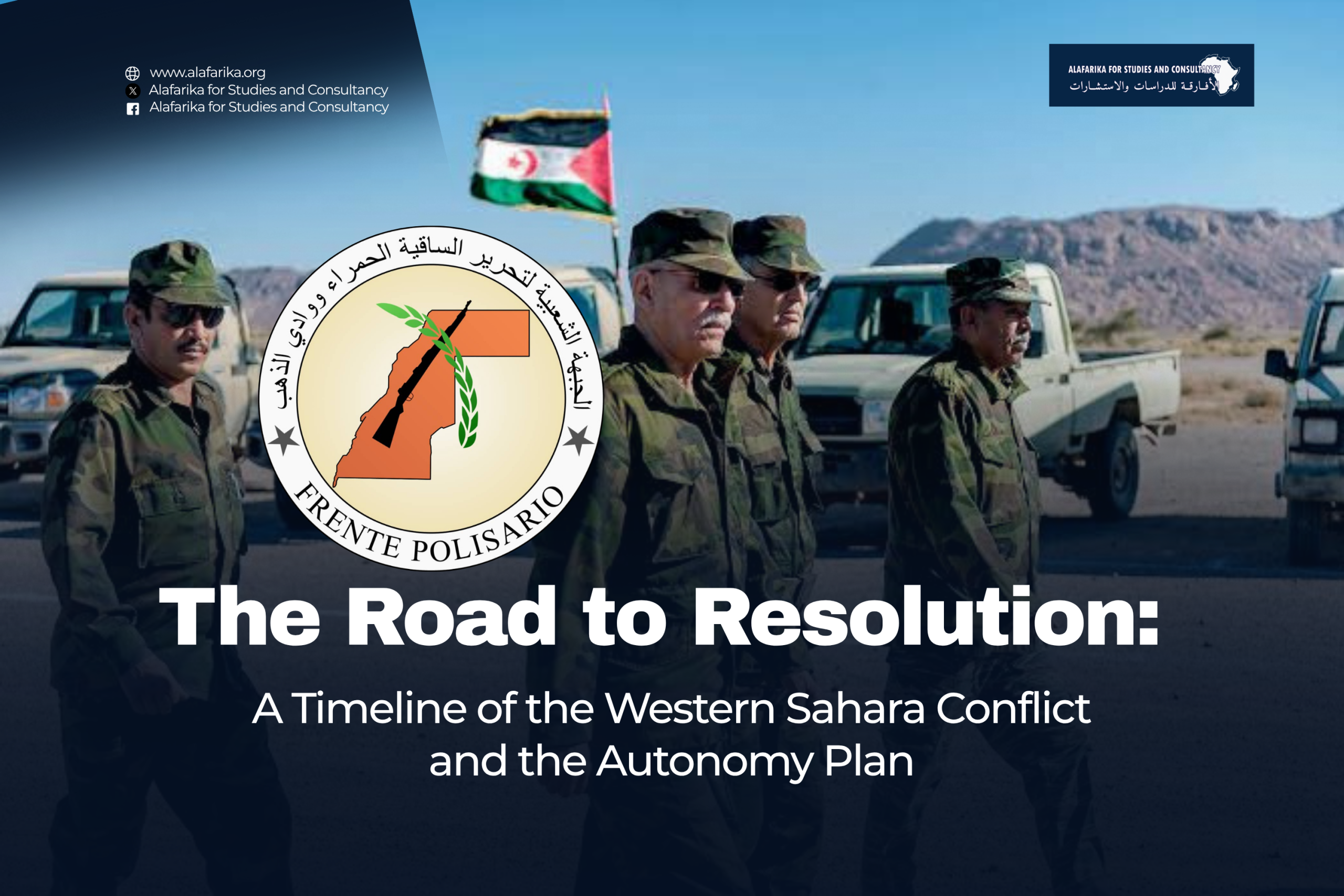
The Western Sahara was under Spanish colonial rule from 1884 till 1975. The coastal region, which was initially claimed by Spain as a protectorate, had its northern Saguia el-Hamra and southern Río de Oro districts turned into a Spanish Sahara province in 1958. Throughout the colonial era, the indigenous Sahrawi tribes displayed consistent resistance against the Spanish rule through the launch of rebellious activities, such as the 20th-century resistance movements led by Ma al-Aynayn. This resistance later resulted in the birth of organized movements to challenge the colonial power, such as the Harakat Tahrir, which emerged in 1967. Afterwards, it took a more militant turn with the formal establishment of the Polisario Front on May 10, 1973, with the sole aim of forcing an end to colonization. The force began to launch several attacks against the Spanish powers, gaining control rapidly over strategic locations of the Western Saharan desert, leaving Spain with no other option than to withdraw from the territory.
In 1974, Spain showed its readiness to withdraw from the Western Sahara by announcing its plan to conduct a referendum on independence and self-governance. The proposed referendum was planned to be carried out with the UN’s backing, support, and supervision. However, the plan was later stalled due to an opposed view raised by Morocco and Mauritania, with claims that the control of the Western Sahara belongs to them both. Therefore, an advisory opinion was sought from the International Court of Justice (ICJ) in 1965, which was later delivered in favor of the Western Sahara, citing the fundamental right of the Sahrawi people to self-determination. Despite the ruling, Morocco continued to claim its territorial control of the region and organized a symbolic migration of over 300,000 Moroccans into the Western Sahara, historically known as the “Green March.” This prompted Spain to transfer the administrative control of the region to Morocco and Mauritania through the signing of the Madrid Accords on November 14, 1975, without organizing the proposed referendum, and officially ended its presence as colonial powers in the territory on February 26, 1976.
In a bid to repel the Moroccan and Mauritanian control of the Western Sahara territory, the Polisario Front formed a government-in-exile in Algeria, known as the Sahrawi Arab Democratic Republic (SADR), on February 27, 1976—a day after Spain officially ended its presence in the territory. The force also launched an armed resistance, which resulted in the Western Sahara War (1975-1991), gaining robust military, political, and logistical support from Algeria. The 16-year-long guerrilla war caused severe military and economic damage to both Morocco and Mauritania, making the latter withdraw from the conflict in 1979, abandoning its territorial claims over Western Sahara, and signing a peace treaty with the Polisario Front afterwards, while the former adopted a new defensive strategy by constructing a sand wall known as the “Berm” or “Moroccan Wall” to serve as a defensive barrier to attacks from the Polisario Front.
The U.N.-Led Peace Efforts: Interventions and Obstacles
A UN-led ceasefire agreement in 1991 ended the armed conflict between Morocco and the Polisario Front, marking a crucial step towards a political resolution. The UN Mission for the Referendum in Western Sahara (MINURSO) was established and mandated to conduct and oversee a referendum in which the people of Western Sahara would choose between full independence and integration with Morocco. However, the process was hindered due to disagreements over voter eligibility, as Morocco requested the inclusion of all individuals living in the territory, including thousands of Moroccan settlers, while the Polisario Front insisted on limiting eligibility to citizens identified by the 1974 Spanish census and their direct descendants. After extensive work, MINURSO identified approximately 80,000 eligible voters, aligning closely with the 1974 census data. Subsequently, Morocco opposed the list and raised concerns about over 100,000 rejected applicants, resulting in the ultimate stalemate of the whole referendum process.
In an effort to find a lasting political solution, James Baker III, a former US Secretary of State, who was appointed as the UN Personal Envoy for Western Sahara, introduced two proposals, tagged as the Baker I (2000) and the Baker II (2003), respectively. The first proposal demands the autonomy of Western Sahara within the Moroccan state, granting the Sahrawi people the right to govern themselves internally, while Morocco oversees their foreign and defense affairs. But the Polisario Front rejected this proposal, citing that it is void of self-determination, while Morocco welcomed the proposal, seeing it as an acknowledgement of its sovereignty in the territory. The second proposal planned a five-year period of Saharan self-rule under a Western Sahara Authority, to be followed by a referendum on independence, in which all residents of the territory shall be granted eligibility without discrimination. This proposal was unanimously accepted by the UN Security Council and the Polisario Front. Yet, Morocco rejected it, emphasizing that it won’t consider any independence-included resolution. Baker eventually concluded that a consensual approach was impossible and resigned from his position in 2004.
The Moroccan Autonomy Plan: A Path to Resolution?
In April 2007, Morocco submitted a proposal to the UN for the establishment of a Sahara Autonomous Region, stating that it proposed a sizable autonomy for the inhabitants of Western Sahara under the sovereignty of Morocco. The autonomy plan recommends that the region have its own legislative, executive, and judicial bodies, with a head of government appointed by the King of Morocco based on the advice of the regional parliament. Also, all sovereignty attributes and functions, such as foreign relations, external defense, and national symbols, shall remain in Morocco’s jurisdiction, while the regional government would be granted exclusive powers to oversee cultural affairs, develop infrastructure, manage local administration, make local policies, and possess necessary financial resources for the development of the region. In addition, a referendum would be conducted in which the autonomy statute shall be decided upon by the Western Sahara populace.
However, the Algerian-backed Polisario Front vehemently rejected the Moroccan Autonomy Plan, viewing it as an infringement on the fundamental rights of the Sahrawi people and reaffirming its support for the implementation of the initial planned UN-backed referendum with the inclusion of independence for the territory. As Morocco continues to reject every proposed solution that includes total independence for the region, the Algerian-backed Polisario Front also continues to reject every suggested solution that is void of gaining total independence, thus leaving no other options as a way out.
Notably, the Moroccan Autonomy Plan has gained growing international support, signifying a shift in the diplomatic context of the conflict. The U.S., France, Spain, the U.K., and key Gulf states such as Qatar, the U.A.E., Kuwait, and Saudi Arabia, alongside a growing number of African and Latin American countries, such as Ghana, Kenya, Hungary, Slovenia, and Croatia, all make up the list of over 117 countries that have expressed their endorsements for the autonomy plan. However, the international community remains divided, as a significant number of countries still recognize the Sahrawi Arab Democratic Republic (SADR).
Navigating the Road to Resolution
Taking a critical look into the roots of the Western Sahara conflict, it can be deduced that the conflict evolved around the Sahrawi people’s internationally recognized right to self-determination and Morocco’s assertive claims of territorial sovereignty over the region. The ICJ’s 1975 advisory opinion acknowledges that the right to self-determination is a principle enshrined in global resolutions and agreements, making it a right that every territory must enjoy. While Morocco acknowledges the Western Sahara as a significant part of its historical territory, it attempts to offer self-governance under Moroccan sovereignty. Apparently, the main obstacle hindering a mutually acceptable solution lies in the interpretation of “self-determination” by both parties. The Polisario Front believes that true self-determination of the Western Sahara can only be achieved through gaining full independence, an option that Morocco has always thrown in the bin.
Another notable factor that seems to keep obstructing both parties from arriving at an acceptable solution is the unwavering role that Algeria plays in the conflict. It is glaring that Morocco recognizes Algeria as the main factor behind the repeated refusal of the Polisario Front to the autonomy plan and its insistence on gaining full independence, probably due to the long-time rivalry between the two giant countries in North Africa. The lack of trust between the two countries keeps on hindering constructive dialogues aimed at ending the conflict.
Achieving a mutually acceptable resolution in Western Sahara now probably requires a shift in the core positions of at least one of the main warring parties or a unified international diplomatic step. The current rise in the international support of the autonomy plan depicts the path that future negotiations might tread. Yet, it is still uncertain whether the inviolable stance of the Polisario Front on full independence can be changed.