Since independence, Gabon has been a stable country, baring the 1964 coup attempt and the turmoil that led to the return to multiparty politics in the 1990s. Even when electoral cycles have generated tensions, as the last presidential election, the country has been able to avoid destabilizing violent strife. In Gabon, the government comprises a bicameral Parliament composed of a National Assembly and a Senate. The National Assembly has 120 deputies elected by direct popular vote for a five-year term, whilst the Senate has 102 seats, with senators elected by municipal councils and regional assemblies for a six-year term. The most recent elections were in 2009 for the Senate, and 2011 for the National Assembly. The next Senate election was scheduled for January 2015 and the next election for the National Assembly is due in December 2016. The President is elected for seven years with no presidential mandate limitation.
The Making of a Monarchical Republic: Gabon Under the Bongos.
In March 1968, President Omar Bongo dissolved all existing parties and replaced them with a single new party, the Parti Démocratique Gabonais (PDG). Between 1968 and 1990, this single-party authoritarian political regime, supported by former colonizer France as well as foreign oil and mining corporations, mismanaged and looted a country that, with its small population and ample natural resources, could have been the Kuwait of Africa. After the Cold War ended, under pressure from French President François Mitterrand, President Bongo summoned a national conference in 1990 which amended the constitution to permit the restoration of multiparty politics. Since then, the PDG has been forced to electioneer in order to maintain its power, which it has successfully accomplished through bribery, fraud and intimidation in every presidential, legislative and local election. In this way the Bongo clan consolidated control over the formal institutions of government through the façade of democratic elections, while regime opponents, either suppressed or purchased with oil rents, became increasingly divided.
Gabon’s leader of 42 years, Omar Bongo Ondimba, died in office on 8 June 2009. He was succeeded by the President of the Senate, Rose Francine Rogombé, who was sworn in as Acting President on 10 June 2009. A presidential election was held on 30 August 2009, resulting in a plurality win for Ali Ben Bongo Ondimba, son of the late president. Bongo’s election was rejected by the opposition and triggered mass protests and charges of interference by France. Violent protests by opposition parties in Port-Gentil, the second largest city in the country and opposition stronghold, produced four official deaths but local reports suggest many more. In an effort to quell the unrest, the military was deployed to the city for three months. This violence triggered a review of the elections by the Constitutional Court. This judicial body subsequently verified the veracity of his victory leading to the inauguration of Ali Bongo on 16 October 2009. Following the 2009 presidential election, the results of which were contested, some leading members of the PDG, including two former prime ministers, left the party and joined the Alliance for Change and Restoration (ACR) and the National Union (UN), although the latter was dissolved in July 2011. Given this backdrop, the general election was a crucial test for the reconfiguration of the Gabonese lower house and symbolised the easing of political tensions following the presidential election. A new, smaller government was formed on 29 February 2012. Its main priority is to implement the actions envisaged in the emergence policy advocated by the head of state.
In August 2021, the minister of justice stated there were no political prisoners in the country, however, one civil society group classified some individuals as political prisoners. An estimated 60 protesters were detained in 2017, including opposition leader Pascal Oyougou, who spent 41 months in pretrial detention and was released temporarily in February 2021 through the end of his trial. In June 2021, he was sentenced to five years in prison for association with an insurrectional movement and participation in an unauthorized public demonstration. According to multiple domestic and international news reports, former Gabonese Democratic Party (PDG) deputy Bertrand Zibi Abeghe was arrested following violence after the 2016 presidential elections as a political reprisal. In 2019 Zibi was convicted of inciting violence and possession of a firearm and sentenced to six years’ imprisonment. He was released on September 13. Many observers considered the charges and conviction politically directed and the evidence fabricated. In 2021, the government proposed a new law that would require presidential candidates to have lived in Gabon for at least six months in each of the two years preceding an election. The law reportedly targets members of the Bongo family who might contest the 2023 election against the president.
Oligui Nguema: The man that “turned the page”?
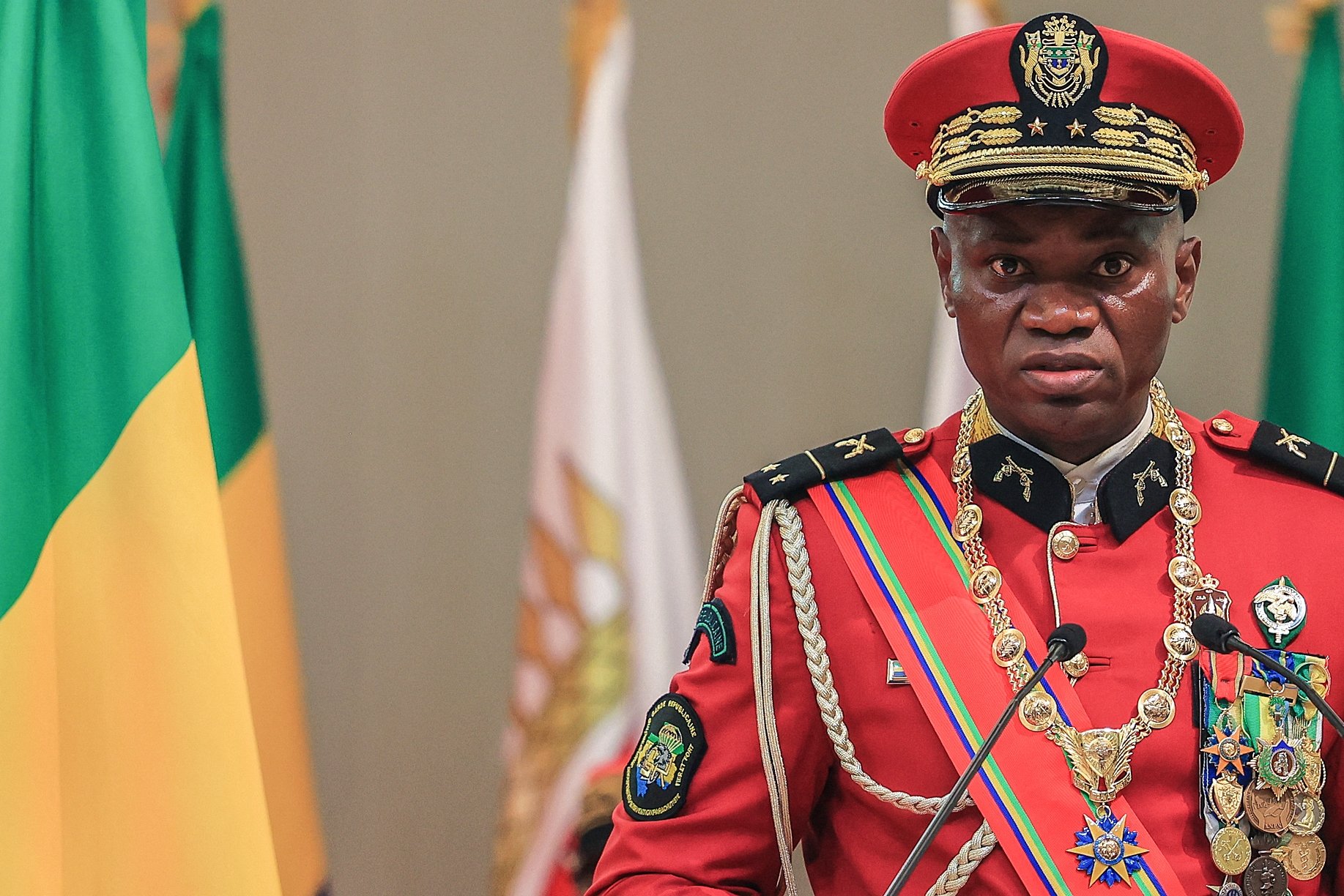
On 30 August 2023, an hour after the official announcement of Bongo’s election to a third term since 2009, a military junta proclaimed his rule was over, denouncing what they said was a rigged poll. The soldiers put him under house arrest, accusing him of irresponsible governance and massive embezzlement that risked leading the country into chaos. The junta released Ondimba a week later on humanitarian grounds, allowing him travel abroad for medical treatment. While Brigadier General Brice Clotaire Oligui Nguema is appointed president of the Gabonese transition. Born to a Fang father, Gabon’s main ethnic group, Nguema, then 48, mostly grew up with his mother in Haut-Ogooue province, a Bongo stronghold. Just hours after soldiers in Gabon announced the new leader, president of neighbouring Cameroon, Paul Biya, who’s been in power for 40 years, shuffled his military leadership, and Rwandan President Paul Kagame “accepted the resignation” of a dozen generals and more than 80 other senior military officers. Even Djibouti’s Ismail Omar Guelleh, in power in the tiny former French colony in the Horn of Africa since 1999, condemned the coup in Gabon and denounced the recent trend of military takeovers. The main opposition candidate in the election, Albert Ondo Ossa, initially called the coup a ‘family affair’ since coup leader General Brice Oligui Nguema is reportedly a relative of Bongo. Surprisingly, media report indicated that Ossa later met with Gabon’s new strongman.
In sub-Saharan Africa, when the military take over governments, the tendency for them to relinquish power is very low even after returning to civilian rule. This is manifested in twenty-two years of Yahya Jammeh’s rule in The Gambia, the continuous rule of Paul Kagame in Rwanda since 1994, Yoweri Kaguta Museveni in Uganda since 1986, and the octogenarian Teodoro Obiam Ngeuma Mbasogo of Equatorial Guinea since 1979 – the second-longest serving president consecutively-serving current non-royal national leader in the world (after Paul Biya in Cameroon). While Gabonese largely welcomed Bongo’s ouster, some analysts were concerned the junta would seek to remain in power. Last year, having secured a 91.8% ‘Yes’ vote in the 16 November referendum on the new constitution, transitional head of state General Brice Clotaire Oligui Nguema is set to run for the presidency in elections slated for August 2025 – despite his initial disavowal, like most of his putschist peers in the region, of any plans to extend his stay in power. They say, should Oligui win the election, Gabon’s “transition” should not be interpreted as a successful return to civilian rule, but yet another case of soldiers legitimising their seizure of power. Although, Nguema has defended his military roots. In a rare interview with Jeune Afrique in Febuary, he claimed: “Our critics refuse to admit that a military officer has outperformed so-called political experts.”
Hence, it appears military leader General Brice Oliqui Nguema’s decision to seek the presidency may have the support of nearly all opposition parties. This, after another leading opposition member, Thérence Gnembou Moutsona of the Citizen Awakening Party, declared his support for General Oliqui. Gabon will hold presidential elections on April 12 to end military rule which began with a coup on April 30, 2023. Alexandra Pangha, spokesperson for Gnembou Moutsona, tells VOA’s James Butty, Moutsona believes General Oliqui will be able to carry out the reforms he promised. Despite the predominantly positive feedback received from the Gabonese authorities concerning progress of the transition, some reservations and concerns were also expressed by civil society representatives regarding the actual inclusivity of the transition notably during the Inclusive National Dialogue (DNIthe and the constitution-making process. There were other concerns related to and the contents of the draft constitution, notably as regards the form of the political regime; the separation of powers the length of the presidential term; the eligibility conditions for president and; the representation of women in state institutions. They also highlighted potential risks of undemocratic drifts in the forthcoming elections, which may not be genuinely free and competitive but rather consecrate the Transitional President as the new ‘strong man’ of the country. Experts say, overlooked in the coup and the subsequent managed transition is that there is an organized civilian opposition that has been vigorously contesting recent elections in Gabon despite the lopsided playing field. According to media report, his main challenger is seen as Alain-Claude Bilie By Nze, Ali Bongo’s last Prime Minister. Nguema will also face Doctor Stéphane Germain Iloko, a former executive of the Gabonese Democratic Party, PDG, which dominated politics from 1961 to 2023.The final candidate is Joseph Lapensée Essigone, a lawyer and tax inspector. All four are running as independents with campaigning scheduled to begin on 29 March.
All the same, the 2025 elections are unlikely to yield surprises but remain significant for assessing Gabon’s trajectory under Oligui’s rule. The role of international advocacy and civil society will also be crucial in promoting democratic renewal. Using political transitions as a tool to prevent coups offers the prospect of long-term stability, reconciliation and regional cooperation. To succeed though, political transitions must be repositioned towards coup prevention. Such an approach – involving diplomatic, political and security measures – is imperative for Central Africa and needs the support of the Economic Community of Central African States (ECCAS). The transition authorities now face a historic opportunity to pivot toward a more transparent and inclusive model of governance, but overcoming decades of entrenched institutional practice will require sustained reform efforts to achieve a point of no return.