Since the end of World War II, Third World nations, represented by China and African countries, have achieved independence and development one after another, and have been endeavouring to redress the historical injustices of the modernization process. The Chinese government and people have continued to lend a helping hand to developing countries, least-developed countries, and low-income economies in Africa, providing a large number of concessional low-interest loans and investments for infrastructure development. Before now, China had granted zero tariffs on 98 percent of tariff items from 27 least-developed African countries, and signed bilateral investment promotion and protection agreements with 34 African countries, as well as double avoidance agreements with 21 African countries.
While China’s imports of African goods reached $60.1 billion in the first half of this year, up 14 percent year-on-year. In addition, the African continent has seen a sharp rise in Chinese direct investment. As of the end of 2023, China’s direct investment stock in Africa exceeded $40 billion. In an interview with Global Times, Teka Gebreyesus Entehabu, a former Ethiopian state minister of industry and trade noted that China-Africa cooperation focuses on infrastructure, which is crucial for development. China emphasizes that building infrastructure is essential for growth and modernization. As African countries intensify efforts to boost intra-Africa trade, quality infrastructure, such as roads and railways, is needed to support the free movement of goods and support trade on the continent, Alan Khan, senior director of corporate affairs at Durban University of Technology in Durban, South Africa said.
Understanding the Forum on China-Africa Cooperation (FOCAC)
The Forum on China-Africa Cooperation (FOCAC) is the most comprehensive platform that promotes the China-Africa relationship. Since its inception in 2000, FOCAC has aimed to facilitate collective dialogue and practical cooperation between China and Africa. Central to FOCAC’s operations are the triennial ministerial conferences and summit meetings, alternately hosted by China and African countries. These gatherings serve as platforms for high-level discussions, policy coordination, and the formulation of cooperation frameworks. Notably, FOCAC emphasizes pragmatic cooperation through initiatives like the China-Africa Development Fund, the China-Africa Industrial Capacity Cooperation Fund, and the Belt and Road Initiative (BRI), aiming to facilitate infrastructure development, industrialization, and sustainable growth across Africa. Also, through joint efforts under the frameworks of the Forum on China-Africa Cooperation, the China International Import Expo and the China-Africa Economic and Trade Expo, China and Africa have made continuous and solid progress in fields such as industry, agriculture and health, epitomizing the unique resilience and vitality of African countries and their relations with China.
Yet, China’s engagements in Africa have also attracted criticism in recent years for increasing Africa’s debt burden. Chinese lending in Africa ballooned fivefold to $696 billion between 2000, when FOCAC was established, and 2020. Chinese lenders now account for 12 percent of Africa’s public and private debt, making China a central actor in the debate on African debt sustainability and responsible borrowing. China, however, tends not to entertain debt forgiveness or cancellation, as highly indebted countries like Angola, Ethiopia, Kenya, and Zambia have discovered. Likewise, Boston University’s Global Development Policy Centre noted that Chinese lending plummeted from its peak of about $28 billion in 2016 to around $1 billion in 2022 and $4.6 billion in 2023. According to BBC Africa, Kenya is seeking funding for multiple infrastructure projects including the completion of the transnational Standard Gauge Railway to Uganda, which China discontinued in 2020. This comes despite its massive debt to China, which triggered countrywide protests. Another concern from countries like South Africa is the balance of trade being in China’s favour.
The FOCAC 2024 Agenda
The last FOCAC summit was held virtually in Beijing and Dakar, Senegal in 2021, owing to Covid-19 restrictions. Commitments to continued economic and political cooperation were made. Whereas the recently concluded summit addressed state governance, industrialisation, agricultural upgradation, and improved cooperation over China’s infrastructure financing via the Belt and Road Initiative (BRI). Currently, the FOCAC counts 53 African nations as its members – the entire continent except Eswatini, which has diplomatic ties with Taiwan against Beijing’s “One China” Policy. The African Union Commission, the continental bloc tasked with ensuring cooperation and economic integration across its member countries, is also a member.
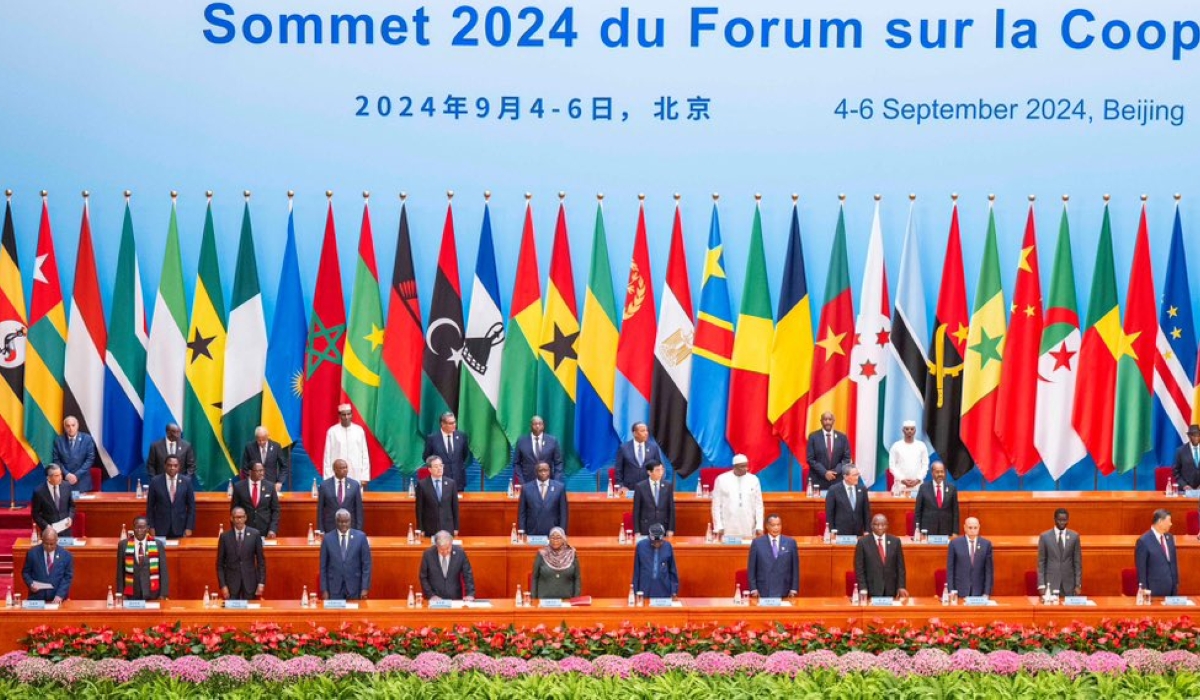
Themed “Joining Hands to Advance Modernization and Build a High-Level China-Africa Community with a Shared Future”, the 2024 Beijing FOCAC Summit is the largest diplomatic event China has hosted in recent years. The Beijing Summit and Ninth Ministerial Conference of the Forum on China-Africa Cooperation (FOCAC) was held in Beijing from September 4 to 6, 2024. The Heads of State, Government and delegation of China and 53 African countries and Chairperson of the African Union Commission and their ministers of foreign affairs and of economic cooperation attended the summit and ministerial conference respectively.
This year’s gathering comes as China’s longstanding relations with Africa appear even more critical for Beijing amid rising frictions with Washington. The US and Europe have also been ramping up their own efforts to engage Africa and access its critical minerals, widely seen as a bid to counter inroads that China has made both politically and in the continent’s resources sector. China is not seen by analysts to be the main cause of African debt distress in most cases, as countries also owe huge sums to multilateral banks and private lenders. But its hefty loans have upped debt burdens and Beijing has been criticized for not moving quickly enough or being flexible in helping distressed or at-risk countries.
Analyst has outlined the 2024 summit into four main outcomes as observe: First, China has entered into strategic partnerships with all African countries having diplomatic ties with China. During the Summit, China established or elevated its strategic partnerships with a total of 30 countries. Second, the characterization of the overall China-Africa relations was elevated to an all-weather community with a shared future for the new era. Thanks to nearly 70 years of concerted efforts, the China-Africa relationship is now at its best in history. Third, a six-point proposition on China-Africa joint efforts to advance modernization was articulated. President Xi Jinping pointed out that China and Africa should advance modernization that is just and equitable, that is open and win-win, that puts the people first, that features diversity and inclusiveness, that is eco-friendly, and that is underpinned by peace and security. This proposition is widely accepted by African leaders, and has become a political consensus between China and Africa. Fourth, a blueprint was drawn up for China-Africa cooperation going forward. The two sides adopted a Beijing Declaration and Action Plan for strengthening China-Africa cooperation in the next three years. President Xi Jinping announced ten partnership actions that China would take with Africa to advance modernization in the next three years, covering the areas of mutual learning among civilizations, trade prosperity, industrial chain cooperation, connectivity, development cooperation, health, agriculture and livelihoods, people-to-people exchanges, green development, and common security.
Future Outlooks
At the moment, Africa is the world’s most dynamic region in terms of economic and population growth. China has emerged as the continent’s largest trading partner and is the largest single-country source for investments and loans for many African countries. For this year’s summit, experts say this not only reflects the sincere welcome that African countries and their people have extended to China’s assistance in promoting Africa’s economic and social development and improving livelihoods over the years, but also highlights the strong appeal of Chinese modernization to Global South countries, including the vast majority of African nations. Still, modernization should not be a simple copy of other countries’ models; rather, it should take into account the unique local aspects of each country.
Although, Africa has benefitted from FOCAC, but more proactive engagement is needed. African engagements tend to be ad hoc and poorly structured, putting the continent at a distinct disadvantage. African countries must become more strategic, include nongovernmental voices, be mindful of the pitfalls of unrestrained and unaccountable borrowing, and, by establishing more transparency of FOCAC agreements, ensure that African representatives place national interests ahead of personal ones. Similarly, there is a need for enhanced, independent monitoring mechanisms in between FOCAC summits to take stock of commitments, identify problems and areas of improvement, and ensure that benefits accrue to ordinary citizens, who rightly demand a greater say and accountability in how their governments engage foreign partners. Above all, there must be a realization that China, or any other actor, cannot develop Africa. Africa will develop through its own sweat and effort. Relationships with external partners must be managed with that understanding.