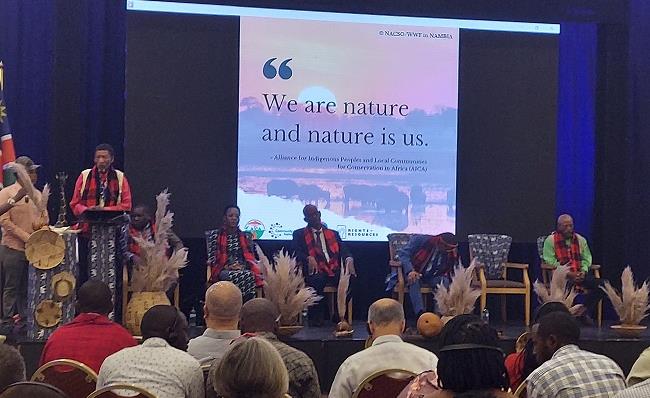
Namibia, late last month, collaborated with the Alliance for Indigenous Peoples and Local Communities for Conservation in Africa (AICA) and the Rights and Resources Initiative (RRI) and successfully hosted Africa’s first-ever community-led conservation congress in Windhoek.
The Congress was seen as a platform for Africa to develop its own framework for people-centred conservation policy, one that supports inclusive, egalitarian, rights-based governance and conservation throughout Africa.
At the congress with the theme “We are nature and nature is us,” approximately 300 leaders of local and indigenous communities, government officials, policymakers, and representatives of national, regional, and worldwide conservation organisations, groups, and networks were present.
The Congress was held for three days—Wednesday, October 25th, to Friday, October 27th, 2023—wherein some resolutions and deliberations were made.
What led to the Congress?
The central focus of the conference was to discuss and plan ways to enable local communities to have a bigger part in African conservation initiatives.
Large international non-governmental organisations (NGOs) have historically dominated the conservation scene in Africa. Against the status quo, the congress aimed to advance the notion that community-driven conservation is a key component of environmental protection on the continent.
During the event, it became clear that, while community involvement and engagement are important, a more balanced strategy is required, one that includes both NGOs and policymakers in fair partnerships.
According to Rights and Resources, the event was set to “help define the Alliance’s implementation roadmap over the next five years” as it sought to articulate a “rights-based, people-centred conservation strategy for the continent and promote inclusive, equitable, and rights-based governance and conservation in Africa.”
“Indigenous and local community leaders, conservation organisations, government officials, and donors from over 100 countries shared their lived experiences, lessons, and challenges around community-led conservation approaches.”
Rights and Resources had earlier emphasised that the 3-day Congress would be a place to learn about climate issues and human-wildlife interaction. The Congress facilitated “cross-regional learning on community-led conservation and knowledge systems and provided an opportunity to discuss and recognise Indigenous Peoples’ and local communities’ priorities.”
The context of the event is due to the fact that, with a network of protected areas encompassing 17% of its land mass—including national parks, game reserves, and forest reserves—Africa is home to 25% of the world’s biodiversity, and this percentage is expected to rise. “More than 20 African countries have already committed to increasing the number of protected areas to at least 30% by 2030.”
Numerous of these potential and existing protected areas also fall under the territorial claims of Indigenous Peoples and local communities, who have long preserved these ecosystems through creative governance techniques, collective ownership, and ancestral knowledge. To make room for conservation, many of these groups have been driven from their homes and criminalised, endangering their continued existence.
Thus, in response to the human rights violations, “the Indigenous Peoples and local communities—including women and youth—from 53 African countries created the Kigali Call to Action during the African Protected Areas Congress (APAC) held in Rwanda in July 2022. They also issued a Declaration, which proposed the creation of an Alliance for Indigenous Peoples and Local Communities for Conservation in Africa. AICA is conceived as a platform to share concerns, actions, programmes, and cross-learning in the region and to follow up on the commitments made in Kigali.”
The above highlighted the key rationale for convening the first Indigenous Peoples’ and local communities-led conservation congress on the African continent.
Namibia’s decision to host the Congress
Namibia’s decision to host the first-ever Community-led Conservation Congress in Africa is like opening a big door to everyone who cares about nature; the decision reflects a growing understanding that local communities play a vital role in taking care of their environment. The unique gathering signals a change from the usual way of doing things in conservation. Instead of having decisions made only by big organisations or governments, the idea was to include the people who actually live in and around the natural areas. The event brought together people from different regions, leading to a place where everyone could share their knowledge about the land and wildlife.
Jose Monteiro, Secretary-Director of the Nature Based Resource Network (ReGeCom) in Mozambique, detailed what has happened since the Kigali Call to Action and Declaration were signed in July 2022, emphasising the importance of involving local communities, which makes the strategies for conservation make sense for the people living there.
Also, Namibia’s Minister of Environment, Forestry, and Tourism, Honourable Heather Sibungo, analysed that the event demonstrated the role that local communities play in conservation and the price they pay living with wildlife.
The Honourable Royal Johan Kxao IUiloloo, Deputy Minister of Marginalised Communities of Namibia, also stated: “We should apply Community Participation and Representation (CPR). Nothing about us without us… The rights of Indigenous Peoples and local communities must be protected, celebrated, and respected.”
From the above analysis, the reason behind this decision is that Namibia understands that the people who live close to the wild places have special knowledge. They know the animals, the plants, and the land really well because it is like their backyard. So, instead of only letting the big organisations or governments decide how to protect these places, Namibia wants to hear from the people who know them best. This way, the plans for taking care of the environment can be more practical and effective because they come from the people who live there.
Also, another important reason is that Namibia believes in teamwork. Getting everyone involved, from local communities to experts and leaders, is like forming a big team dedicated to keeping nature safe.
What it means for Africa
Being the first-ever community-led conservation congress in Namibia means that Africa believes in the power of its people. Each person, from the smallest village to the biggest city, has a part to play in keeping the natural beauty alive. During the event, Myriam Graba, from Algeria, said, “There’s a need to adapt tradition to modernity and balance the two. We can’t say no to technology and innovation. Opening these doors will bring us closer to young people.”
The Congress also highlights the fact that African nations are recognising the importance of local knowledge and community engagement in conservation efforts. Reports from the congress revealed some community members in East Africa, with generations of experience living alongside wildlife, shared successful coexistence practices with a community in West Africa facing similar challenges. This exchange of wisdom allows for more effective, localised conservation strategies that respect the cultural and ecological diversity found across the continent.
Mary Ama Kudom-Agyemang, Chairperson of the Bono East Regional Lands Commission and Executive Director of the Media Platform on Environment and Climate Change (MPEC) in Ghana, revealed “the cases of Benin, Liberia, and Ghana, where governments have increased national discussions around the recognition of Indigenous Peoples in conservation.
“We want to include the Alliance’s vision in the Forest Convergent Initiative created by ECOWAS and ensure that the voices of Indigenous Peoples are heard.”
The Congress is not for Namibia only; it is a continent matter: welcoming people from different African countries sitting together and talking about how they can protect the animals, plants, and beautiful places they all call home. It means that Africa is opening a big conversation where everyone’s voice simply matters.
Representatives from seven countries in the Central Africa Region—Burundi, Cameroon, République du Congo, Gabon, RDC, Rwanda, and Chad—shared a lengthy list of projects that involve multisectoral cooperation between local and national governments as well as international development partners.
“Our ambition with AICA is to have strong Indigenous Peoples and local communities in Africa with a single voice and a cooperation framework. For now, we’ll bring the results of this Congress back to our communities and will continue to support the strengthening of our networks.”.
The above shows Africa is family and is now very keen on finding a new way of doing things in nature protection. Each leader gets a chance to take care of their own part of Africa more from the lessons garnered. It is like giving each family member a special role in making sure the home stays safe and happy. By learning from each other, sharing tips, and deciding together, it is a stronger, united effort to keep the environment healthy.
The Congress was also a chance for Africa to celebrate its diversity, as it featured an array of tribal dances and cultural exhibitions. Also, it indicates a shift towards sustainable development practices. For instance, lessons learned at the Congress might inspire a Southern African nation to implement community-based eco-tourism initiatives, benefiting both local livelihoods and conservation efforts. The sharing of such success stories and innovative approaches at a continental level can spark inspiration and encourage the adoption of environmentally friendly practices, promoting a harmonious relationship between communities and nature across Africa. All in all, the Congress wholly sets the stage for a collective and impactful approach to safeguarding Africa’s natural wonders for current and future generations.