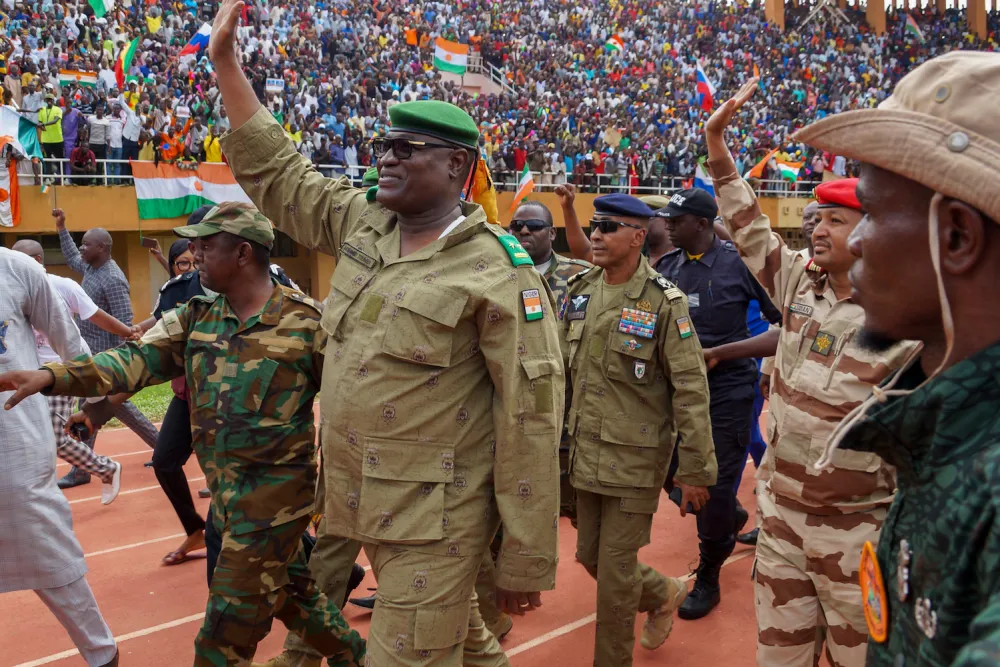
Media reports emerged that Niger’s Presidential Guard staged a coup on July 26, 2023, and detained President Mohamed Bazoum and his family. The National Council for the Safeguarding of the Homeland (CNSP), a junta made up of senior members of the defence and security services (FDS), proclaimed its takeover of power through a televised broadcast.
Colonel-Major Amadou Abdramane, the army spokesperson, said in a statement broadcast on a state-run television channel that “the defence and security forces… have decided to put an end to the regime you are familiar with”. According to the army, the move followed the continuous “deterioration of the security situation and the bad social and economic management.”
On July 28, the head of Niger’s presidential guard, General Abdourahamane Tchiani (also called Omar Tchiani), proclaimed himself head of state after the seizure of power and warned against any regional or foreign interventions.
There were mixed reactions immediately after the coup, as pro-Bazoum demonstrations were broken up by pro-CNSP marches, including those by students in the country. Some students demonstrated in the country’s capital, Niamey, calling for the support of the military. They frown at sanctions and threats of military intervention by leaders in the Economic Community of West African States (ECOWAS).
One of the student protesters, Karimou Soumana, said: “I’d like to appeal to the media and even to the people of Niger to understand that what ECOWAS or the international community is doing is nothing more than intimidation and that we don’t even believe in (armed intervention).
“All people have to do is keep their Nigerien spirit alive, and that’s what’s going to get us out of this intimidation.”
The Nigerien Armed Forces also joined the CNSP on July 27 and stated that they were doing so to protect the president and his family and prevent a potentially fatal conflict.
While the international community denounced the coup, including significant bodies and countries like the United States, France, the European Union, and the Economic Community of West African States (ECOWAS), the CNSP appears not to be giving in. A cursory look at this latest development gives a hint that, most often, international organisations are toothless bulldogs, and internal sovereignty matters when it comes to each country’s affairs.
Against this backdrop, ECOWAS had earlier given a one-week ultimatum to Niger’s military junta to reinstate the democratically elected President. However, the expiration has passed, and there is no sign of military intervention by the armies of the West African bloc, despite Niger closing its airspace. It is quite important to note that the fragmentation of interests in Niger may hamper the ability of regional organisations like ECOWAS to enforce decisions in the country.
Niger itself has political issues that need strategic priorities. This is clear from the different local dimensions given to the coup. For example, some believe the reason behind the coup might be because of the concern of some ethnic groups in Niger about losing control. While others believe it might be due to the conflict within the regime and the power tussle between the leaders of the ruling party, the Nigerien Party for Democracy and Socialism, or specifically between former President Mahamadou Issoufou and his successor, President Muhammadu Bazoum, who was also the former Minister of Interior and Issoufou’s right arm.
Related report available to read in Arabic:
Continue reading below.
Another angle of analysis is that the coup might be influenced by President Bazoum’s expected decision to refer General Abdourahamane Tchiani, the head of the Presidential Guard, to retirement, as he was expected to announce that a few days before the coup, a move that would have ended the influence of Issoufou and Tchiani, head of the presidential guard unit that carried out the coup and a close ally of Issoufou, who ruled Niger from 2011 until April 2021, under whose reign Tchiani attained several ranks.
Down memory lane and with records of past coups, there is usually a reluctance to consistently adhere to directives from international bodies like ECOWAS. It often stems from a complex interplay of factors rooted in the countries concerned with their colonial experience, sovereignty matters, and internal governance challenges.
Are Coups the Last Resort?
In Africa entirely, the combinations of historical, political, economic, and social factors often influence the governments’ structures, which usually lead to the incidence of military coups. While it is important to emphasise that not all African military forces participate in or support coups, the historical backdrop and unique circumstances of each African country have a big impact on how the military embarks on the coups’ journey.
In Niger, when Mohamed Bazoum was sworn in as president, it marked “the country’s first peaceful transfer of power in a democratic watershed that was overshadowed by an alleged coup attempt that underscored stability fears in the country.”
Since the nation’s independence from France in 1960, Bazoum’s inauguration was the first time Niger has had a change in elected leadership. Yet, there was an alleged coup attempt then, which, according to security sources, was foiled by multiple arrests as it overshadowed the milestone achievement.
This boils down to the hypothesis of colonial legacies’ footprints on the country: colonial experiences have left a lasting impact on the country. The history of exploitation and colonisation has fostered a deep-seated mistrust of democracy and external influences, leading to a propensity to resist interventions that may be perceived as neo-colonial attempts to assert control. This historical backdrop seems to have shaped Niger to the extent that coup plotters are usually determined to “allegedly” maintain the country’s independence and protect the country’s sovereignty.
Already, many African countries have a history of colonisation, during which external powers imposed governance structures that were often authoritarian. This legacy has left a mark on political culture, with a focus on centralised power. In some cases, coups are perceived as a way to break free from non-satisfying governments and establish a different form of governance.
However, according to human rights activists, coup plotters would shirk responsibility for the security crisis in Niger as they lack the mandate or expertise to run the economic and social governance of the country.
“The people of Niger duly exercised their constitutional right and elected President Mohamed Bozoum on February 21, 2021, and their sovereign choice must be respected by all, including the military. Besides showing a reckless disregard for the progress and well-being of the people of Niger, the coup is a flagrant violation of Niger’s constitution and the ECOWAS Protocol on Democracy and Good Governance, which states that “every accession to power must be made through free, fair, and transparent elections,” as released by The Media Foundation for West Africa (MFWA).
Also, ECOWAS, before giving a week’s ultimatum, revealed that “the ECOWAS leadership will not accept any action that impedes the smooth functioning of legitimate authority in Niger or any part of West Africa.”
“We will do everything within our powers to ensure democracy is firmly planted, nurtured, well-rooted, and thrives in our region,” said Bola Ahmed Tinubu, Nigeria’s president and chairman of the regional bloc. But things have yet to turn around positively.
Another hypothesis that seems to be the underlying socio-political factor in the recent coup in Niger is the country’s lack of democratic culture. Apart from Niger’s coup plotters’ belief that they can better manage the economy and allocate resources fairly, after perceiving Bazoum’s leadership as failing in these aspects, Niger as a country lacks a democratic culture. Niger has a history of weak democratic institutions and limited experience with democratic processes. Hence, it is not surprising that the military factions most often believe that they are better equipped to maintain stability.
Influence of Foreign Actors
Though not all coups in Africa are influenced by foreign actors, foreign actors’ involvement in sponsoring coups in Africa is a complex issue driven by a combination of geopolitical, economic, strategic, and ideological motivations. Africa is rich in natural resources, including minerals, oil, and agricultural products, which are vital for the global economy. The reason why foreign countries lobby is primarily to gain access to and control over these resources.
Even before the most recent coup, Western nations courted Niger’s cooperation to safeguard their economic interests and reduce African immigration to Europe. The United States and France both have military installations on the territory of Niger, which leverages aid from the West to strengthen its armed forces. Germany maintains a logistics base in Niamey and, like Canada and Italy, participates in the training of Nigerien Special Forces.
Niger has recently been regarded as the West’s final ally in the area. The United States and the European Union poured in aid, investments, and training. Although, as it is now, the coast is yet to be cleared regarding partnerships,
The highest-grade uranium ores in Africa can be found in Niger, which is also one of the key suppliers of uranium to Europe. Niger is the seventh-largest producer of uranium in the world. The country’s former colonial master, France, imports a significant amount of Nigerien uranium to fuel its sizable civil nuclear industry.
But “amid escalating anti-French rhetoric, the junta allegedly said that it was suspending exports of uranium to France. The radioactive ore is impoverished Niger’s main export and has, over the years, brought the country into the global spotlight—most notoriously in 2003, when dodgy intelligence about a possible Iraqi purchase of 500 tonnes of Nigerien “yellowcake” uranium formed part of the American case to launch the “preemptive” invasion of Iraq.”
The most recent coups in West Africa had the same foreign influences as those that occurred in the post-independence era. In the coups in Mali in 2021 and 2020, as well as the one that happened in Burkina Faso, for instance, Russia is mentioned. Assimi Gota, the mastermind of both coups in Mali, was also reported to have received instruction and support from the US.
For instance, Paris supported Mahamat Déby’s covert coup in Chad. China joined Russia in blocking a UN Security Council resolution that would have sanctioned Mali on border control and economically. Russia has also been actively endorsing coups in Africa. Often working through the Wagner mercenary group, it was reported that Moscow has strengthened a close relationship with the military throughout Sudan’s democratic transition and agitated for it to seize power.
Due to its uranium production, Niger serves as a focal point for military and humanitarian efforts and is a key ally in the Sahel’s war on terrorism and insurgency. Numerous development partners have given Niger significant funding because of its significance in the fight against terrorism. However, foreign powers are obtaining advantageous trade agreements, resource extraction agreements, and economic gains by promoting pliable regimes that promote their objectives, frequently at the expense of the host country’s sovereignty.
But with the current coup saga, what will happen to France regarding the uranium business is now hanging in the air. Also, all eyes are on the other foreign nations to see if they can find ways to work with the junta and negotiate concessions in exchange for natural resources.
It is, however, safe to conclude that fire often doesn’t quench fire. It is important for ECOWAS, foreign countries, external actors, and other international bodies to find ways to be diplomatic, as “democratisation in Africa requires a re-orientation to suit local circumstances.”