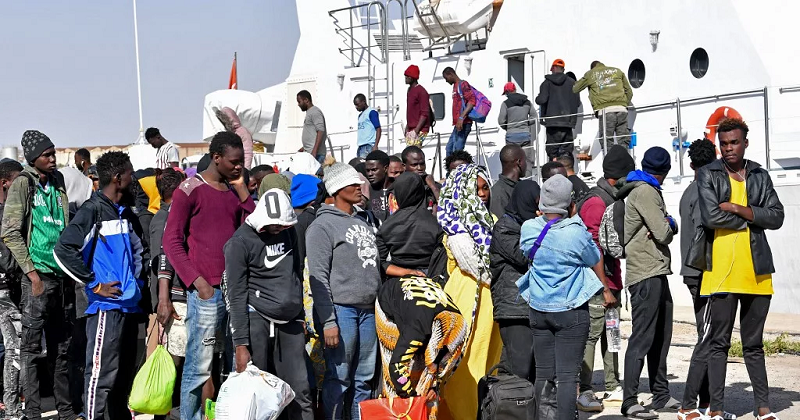
An unprecedented migration crisis has hit Tunisia in recent months as thousands of undocumented African migrants have descended on the city of Sfax in an attempt to board traffickers’ boats bound for Europe. According to official figures, 75,065 boat migrants had entered Italy as of July 14, compared to 31,920 over the same period the previous year. More than half left from Tunisia, overtaking Libya, which has traditionally been the main Launchpad.
Also, given that several portions of Tunisia’s coastline are less than 150 kilometres from the Italian island of Lampedusa, Tunisia has become a major transit country for people trying to cross the Mediterranean Sea to reach Europe, including an increasing number of Tunisians and residents of other African nations.
Reports emerged recently that Tunisia and the European Union (EU) had signed a “strategic partnership” deal on July 16, 2023, in response to a dramatic rise in the number of boats leaving Tunisia for Europe. The pact involves combating human traffickers and tightening borders.
The agreement results from weeks of talks and Europe’s commitment to provide Tunisia with significant aid totaling $1.12 billion in order to support the country’s struggling economy, restore state finances, and address the migratory situation, though, as revealed, the majority of funds are subject to economic reforms.
The agreement emanated when the outgoing “Dutch Prime Minister Mark Rutte and Italian Prime Minister Georgia Meloni accompanied European Commission President Ursula von der Leyen on the trip to Tunis, the trio’s second in a month.”
However, while in Tunisia, the delegation “held talks with President Kais Saied on how to tackle the growing problem, and then the visit was capped by a signing ceremony.”
“It contains agreements on disrupting the business model of people smugglers and human traffickers, strengthening border control, and improving registration and return. All essential measures are essential for bolstering efforts to stop irregular migration,” Dutch Prime Minister Mark Rutte revealed.
The head of the European Commission, Ursula von der Leyens, announced that the bloc will provide Tunisia with 100 million euros to aid in the country’s fight against illegal immigration. The agreement indicates support for lawful immigration, trade and investment, a green energy transition, and macroeconomic stability.
Italian Prime Minister Giorgia Miloni had also said, “We are very pleased; it is a further important step towards the creation of a true partnership between Tunisia and the EU, which can address in an integrated fashion the migration crisis.”
Early this year, Tunisia’s president, Kais Saied, linked African migrants to “violence and crimes”, basically due to most migrants arriving in Tunisia in an attempt to migrate to Europe by sea. The president made the speech during a meeting of the National Security Council “devoted to the urgent measures that must be taken to deal with the arrival in Tunisia of a large number of illegal migrants from sub-Saharan Africa,” according to a press release from the presidency. He also made some comments that were considered racist and condemned by many. His comment also incited a wave of violence against migrants from Sub-Saharan African countries.
Why the agreement?
The issue of illegal migration has been a pressing concern for both Tunisia and the European Union (EU). The movement of migrants seeking better opportunities and security has created challenges for countries of origin, transit, and destination. Apart from Libya, Tunisia, situated on the Mediterranean coast, has been a key departure point for irregular migration to Europe. To address this issue, Tunisia and the EU forged a significant partnership aimed at curbing it.
Internationally, migration to Europe from sub-Saharan African nations has significantly increased during the past ten years. In fact, since 2010, there has been an increase in the number of sub-Saharan Africans applying for asylum in Europe.
However, the reasons why people leave sub-Saharan Africa—as well as the routes they take to get there—vary from nation to nation and person to person. According to a Pew Research Centre analysis of data from Eurostat, Europe’s statistical agency, the population of sub-Saharan migrants has increased in Europe due to the entry of nearly 1 million asylum applicants (970,000) between 2010 and 2017. Migrating illegally to Europe from Africa can be a challenging and risky endeavour, and there are several bad effects and disadvantages associated with it. Among the negative ripple effects are humanitarian risks, legal vulnerability, economic exploitation, strain on European Countries, xenophobia, and discrimination, including impacts on African development, among others.
Hence the Tunisia-EU pact on curbing this illegal migration, a move that has been welcomed by some who see it as a crucial “commitment” to creating a safer and more prosperous future for citizens while upholding humanitarian values and respect for human rights. However, it has also been criticised by others who think it’s pitting African countries against each other for the benefits of Europe and that it is not addressing the main issues influencing or forcing this migration, especially as Europe itself is not innocent of being part of the causes of illegal migration.
Beyond agreement, implementation matters
Over the years, the European Union (EU) and African nations have signed several pacts and agreements aimed at addressing migration-related issues and curbing irregular immigration. These agreements have sought to foster cooperation, manage migration flows, and address the root causes of migration but appear not to be effective.
Some notable past pacts include the Rabat Process (2006), a multilateral dialogue and cooperation framework between the EU and North, West, and Central African countries aiming to address issues related to migration, including human trafficking, smuggling, and the root causes of irregular migration. Also, the Valletta Summit on Migration (2015) brought together European and African leaders in Valletta, Malta, to discuss migration issues and strengthen cooperation. During the summit, a Joint Valletta Action Plan was adopted, outlining specific actions and projects to address the challenges of migration, including measures to enhance border control, address root causes, and promote legal migration channels.
However, together with the above, many other frameworks seem not to be working to curb irregular migration, perhaps due to a lack of enforcement. Although migration pacts and agreements represent important steps in fostering cooperation between the EU and African nations to tackle challenges associated with the activity in a comprehensive and collaborative manner, it is crucial to reiterate that migration is a complex and ongoing issue that requires continuous efforts and adaptations in policy and cooperation.
What Africa needs to do
Curbing migration from Africa requires a comprehensive and multi-faceted approach that addresses the root causes of migration and creates opportunities for Africans to thrive in their home countries.
In 2015, approximately 15 million migrants who were born in Africa reported having lived or living outside the continent sometimes. The primary factor steering this migration is simply the failure of most African governments to provide citizens with opportunities within their countries of origin.
Hence, there is a need for African governments to prioritise economic development and job creation to provide opportunities for Africans. This can be achieved through investment in key sectors such as agriculture, manufacturing, infrastructure, and technology, which can stimulate economic growth and create employment.
It is also crucial to establish social welfare systems and safety nets that can provide support to vulnerable populations, which will reduce the need for people to seek economic opportunities abroad due to poverty and a lack of basic services.
It is also pertinent to strengthen healthcare systems and address incessant political instability. By implementing a combination of these strategies, African countries can work towards curbing migration and creating an environment where individuals can find opportunities and prosperity within their own nations. However, it is safe to conclude that cooperation between African countries and the international community, most especially the European Union, is also crucial in addressing the complexities of this issue.