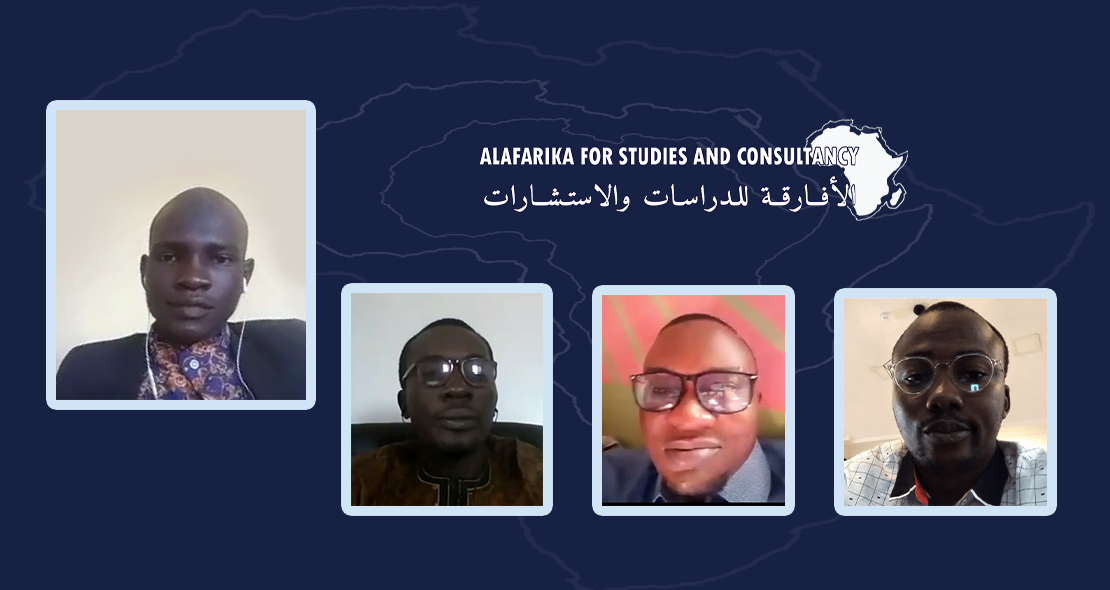
On December 10, 2022, Alafarika for Studies and Consultancy hosted via Zoom a symposium themed “Youths’ Participation in Politics and Governance in Nigeria,” in which some Nigerian journalists, social activists, and political analysts participated. The programme started at about 10:00 a.m. and was moderated by Mr. Hammed Sulaiman, a journalist and legal researcher at Alafarika for Studies and Consultancy.
The first speaker was Mr. Alao Abiodun, who spoke on the topic “Pros and Cons: Social Media as a Tool for the Activation of Youths’ Participation in Politics and Governance.” The second speaker, Mr. Lawal Toyin Muhammad, spoke on the topic “Violence, Security Challenges, and the Electoral Process in Nigeria: A Focus on Youths,” while the third speaker, Mr. Dotun Famoriyo, spoke on the topic “The Role of Youths in Contemporary Politics and Governance.”
All of the speakers, while presenting, revealed and agreed that “Youths’ Participation in Politics and Governance in Nigeria is Two Sides of the Same Coin.” They shared their opinion that youth participation could be positive or negative: positive in the sense that most youth are the engineers of good governance; they have potential and energy and are ready to serve. On the negative side, they revealed that some Nigerian youth are instruments of social vices to commit atrocities, especially whenever elections are around the corner.
The first speaker, while speaking on the topic of “pros and cons of social media as a tool for the activation of youth participation in politics and governance,” revealed how social media has become a tool for the activation of youth participation in politics and governance. He asserted that when we look at Nigeria today, social media has created so many situations that the country is now involved in political activity. that showed that youth are now more general—they are now more conscious of what is happening within their political environment.
“And when we look at the word social media, it stems from the social aspect of communication, and has now been used as an opportunity to demand accountability, transparency, and a sort of activism.”
Mr. Alao looked at the pros and cons of social media as a tool for youth participation in governance and politics. He focused his lens on Nigeria, and because the 2023 election is fast approaching, he said, “The youth of Nigeria are now getting more conscious of what is happening within the environment; people are getting involved, discussing issues, and also competing for their favourite candidates who would win an election.”
The first speaker also revealed that “social media has allowed people to feel that they can step up and take the reins of power. They can also step up to the mantle of leadership because, by virtue of what they see or what a person is doing, they’re also interested and motivated to see that yes, they can also do this.
The negative side is that people now misuse social media for different activities because journalists get to see different information on social media today, and they always wonder where the fake information emanated from. Although social media usage as a sort of activism promotes transparency and accountability, some people use it as an avenue to create some sort of misinformation and deformation in the information ecosystem. Nevertheless, this doesn’t mean that social media is not playing its role in ensuring that people have a voice to speak and also ask questions.
The first speaker concluded that “so basically, what I’m just trying to say is that, you know, social media discussion or discourse is a general discourse. You know, people use it every day, and people understand the importance of social media, in politics and governance. And that is, there are two sides to the coin in the use of social media today in Nigeria. Globally, people use it to demand accountability or transparency in governance, while some people use it, you know, to spread misinformation, disinformation, and fake news all over the internet. But that is not to say social media is not playing its role.”
On the part of the second speaker, Mr. Lawal Toyin Mohammed, he emphasised how most youth see violent opportunities in their political participation. He spoke on his topic, “Violence, Security Challenges, and the Electoral Process in Nigeria: A Focus on Youths,” by citing real-life examples in Nigeria. He claimed that the majority of these issues stem from childhood and family environments. Most parents believe that “nobody can get a white collar job without getting closer to politicians, and through this process, you enrol your child to be part of a political party system, and instead of them using them judiciously and wisely for the progressive development of the policies and the governance in Nigeria, they tend to use them to commit social vices.”
Mr. Lawal said the Nigerian youth need to learn the secret of contentment, which is the ability for somebody to understand or reduce the desire for something beyond their reach and go for something within their control. He said that with that, they will not be used as tools for political and electoral violence but will be recognised as full-potential citizens.
Mr. Alao Abiodun cleared up his question on the nexus between social media and new media. He said both are forms of digital media or electronic media, which are different from print media. They are a 21st-century approach pertaining to news and information spans, he explained, while saying most young people now find solace in them for their political participation.
While Mr. Dotun Famoriyo, the third speaker, presented on the topic “The Role of Youths in Contemporary Politics and Governance” and claimed that with over 60 percent of the African population being youths, by 2030, the youth population will rise by 42 percent, according to the United Nations Department of Economic and Social Affairs.
He said this demography, when spiced with the right human capital development for long enough, will be a huge advantage for the continent. But when left unharnessed, like in most African countries, a youthful population could spell disaster.
“Youth are the backbone of any nation. Their physical and intellectual energies matter for the growth of a developing nation such as Nigeria. One way the government can leverage the manifold talents of its youth is through meaningful engagement and dialogue.”
He clarified his question on the major setback affecting youth participation in politics and governance by saying that “the youth themselves must be willing to engage with the government. Of course, this is a question of trust. First, the government must have shown itself trustworthy in several respects, and the youth must have proven themselves capable through the exploits they have achieved independent of direct government support.
Mr. Lawal also cleared up his questions on politicians promising youth unavailable white-collar jobs to lure them to participate in the electoral process. He opined that youth shouldn’t attach themselves to politicians based on promises, but they should see themselves as agents of social change.
Also, Mr. Alao Abiodun cleared up his question about journalists being recruited as “data boys” to attack other political opponents on social media platforms. He acknowledged the fact that some youth who are journalists can go the extra mile to defend their principals, bosses, or government officials on social media, but as a journalist, he believes that there is a need to always report the truth, which is accuracy, fairness, and balance.
“You know, you’re already a mouthpiece for that person in particular. So if the information is bad, you will alter the narrative to suit your own perspective at that point, but by the way, misinformation, information disorder, propaganda, or disinformation cannot be eradicated. It can only be eliminated to the minimum level. What we must do as journalists is continue to report what is true and factual to society.That’s the best way to regain confidence in society.”
The symposium ended with the moderator applauding the speakers for their contributions to the electoral discourse as it relates to the Nigerian youth and for sharing their insightful ideas.
The discussions and details of the sessions are available on YouTube through the following links: