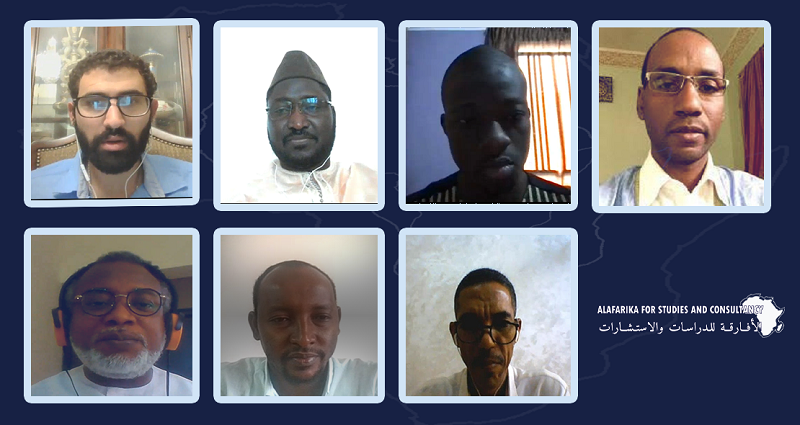
On August 26 and 27, 2022, Alafarika for Studies and Consultancy organized its first virtual symposium titled “Knowledge Creation and Dissemination in Africa“, in which researchers in African affairs from Morocco, Nigeria, Mali, Mauritania, Egypt, and the Central African Republic participated. The participants commended this initiative for giving great importance to knowledge, its creation and dissemination, and considering it an initial and basic building block for achieving development and progress in Africa.
The two-day session dealt with issues related to influencing African policy and politics with knowledge; the process of knowledge management for development; the role of the media in creating knowledge societies; and the challenges facing academic publishing and potential solutions to them. It also touched on the relationship between philosophy and human development in the African context and how revolutions and movements demanding change can be directed based on knowledge that provides answers to the state-building and development that the continent needs in the twenty-first century and the digital age, in addition to the potential of investigative and data journalism to contribute to Africa’s prosperity.
With regard to creating knowledge societies and influencing African politics, the speakers revealed that consultancy institutions are one of the means of influencing knowledge creation processes if these institutions are rooted in local issues and are experts in initiatives that touch the needs of the population and citizens. The speakers stressed that civilizations and advanced societies throughout history have depended on knowledge and actors in the dissemination of human sciences. Despite the lack of interest of some current African governments in knowledge, its means and tools for its dissemination, the history of Africa, its civilizations and kingdoms in different regions confirmed that Africa has rich experience in this regard, and what is required today is to study these historical achievements and support the creativity of young people that may limit the brain drain in many African countries, in addition to attaching the utmost importance to educational institutions and their outputs.
Knowledge management is a necessary process to achieve development because it relates to many sensitive areas and is an essential means of successful management. Knowledge management elevates knowledge to the forefront of any government or political system’s success by emphasizing the knowledge capabilities of individuals, universities, and research institutions that facilitate access to knowledge, participation in it, distribution, preservation, and retrieval.
The impact of globalization and the rapid technological change in human societies make knowledge the basis of domination and influence. All indicators show that the strength of tomorrow’s world will be determined by the interest in human capital and the exploitation of the energies and capabilities of the continent’s population in the process of sustainable human development. In terms of knowledge management and development, there is a need to move from theories to real-life applications so as to meet the challenges of the continent and the rapid transformations in all fields without neglecting data technologies, which collect and categorize information to enable users of knowledge systems and services to access them when necessary. All of this can be achieved through interviews and dialogues with experts and actors in national development policies, humanities, and modern methods that reflect positively on African societies and enable African countries to compete on a global level.
There are great tasks on the shoulders of African media institutions due to their relationship with the processes of creating knowledge societies at a time when global media ignore the role of Africans in crystallizing global knowledge and the information explosion. Today, digital media plays some of the roles of traditional media that influenced different African societies and stages. The role of the media should not be limited to the use of various means to highlight developments and experiences in African countries, their civilizations and history, or to just publicize their tourism sectors. The relationship between the media and the dissemination of knowledge is a relationship of mutual influence that can be observed in concepts related to human values, the crucible of communication and understanding, the information revolution, and technological innovations that the youth of the continent seize today in countries such as Nigeria, Kenya, South Africa, Egypt, and other African countries to develop the financial, agricultural, and health sectors.
The process of scientific research and academic publishing is one of the means of developing and changing a society. It is also one of the tools through which sustainable development can be achieved. Thus, the process of creating and influencing knowledge societies requires giving importance to addressing the challenges facing academic publishing in Africa and the weak governmental attention to the results of research projects and recommendations of conferences and research sessions that may contribute to promoting development.
A noticeable lack of publishing and distribution centers for works, academic books, and scientific journals within Africa is one indicator of the crisis in academic publishing in Africa, while education curricula and teaching methods in several African countries are rooted in the colonial era and ideas that strengthen Western scientific institutions while weakening African scientific institutions that are already short of the necessary infrastructural resources.
Speakers in the “Knowledge Creation and Dissemination in Africa” symposium also pointed out that African philosophy can help us understand the problems facing the creation of knowledge and that it can enhance the patterns of knowledge production that the continent needs. Studying African history and philosophy may determine the African position towards modern science and contemporary issues, especially since knowledge based on African philosophical foundations may transform African societies into freer societies and can provide answers to the most important factors contributing to political, social, and economic inequality.
The COVID-19 crisis has shown the repercussions of the lack of independent and effective scientific research, the lack of sufficient scientific and technological resources, and the lack of manufacturing capabilities in the global south in general and Africa in particular, as the result was that most African health care systems relied on the so-called “good will” of the global north and foreign vaccines.
The protests and political transformations that occurred in Africa in recent years indicated that most movements calling for change were not based on knowledge foundations that meet the state-building processes Africa needs in the twenty-first century. This is despite the fact that between 2005 and 2014, 40 out of 54 countries on the African continent witnessed popular protests and uprisings in their various forms at the local and national levels. The knowledge equation lies in the repeated mistakes of these movements and that some of these uprisings often exacerbate the situation in the countries in which they occur. Knowledge gaps can also be seen in the ideologies and parties that refuse to bring about the desired social and political changes in the continent.
In conclusion, the participants praised the role of investigative and data journalism in promoting African prosperity based on knowledge, as data and statistical information should contribute to achieving good governance and revealing corporate and institutional corruption and social injustice, in addition to presenting powerful and influential stories and revealing the truth. Thus, data is a mirror to confirm or deny a particular phenomenon or issue and a means of exploring its direction and foreseeing its future trend.
The discussions and details of the sessions are available on YouTube through the following links:
Day 1: August 26, 2022 (In Arabic Language)