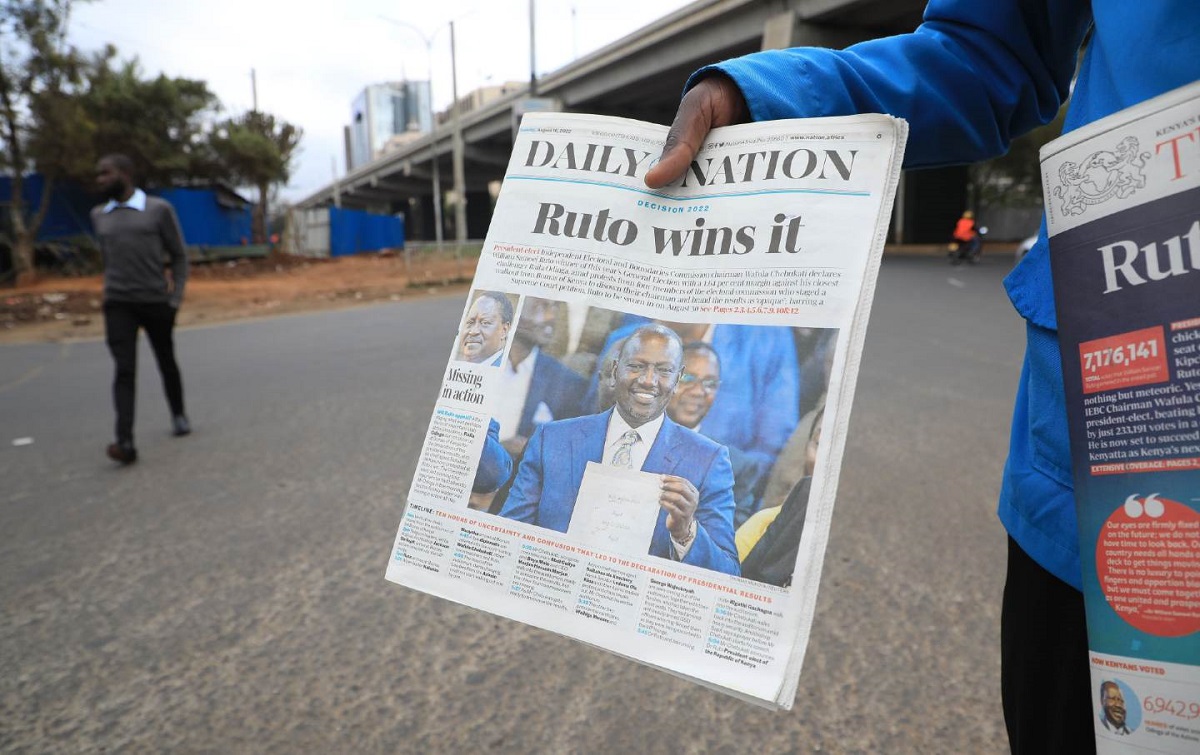
Last weekend, democracy swept through the land of Kenya. The people of Kenya voted in William Samoei Arap Ruto, who in the next few months will succeed the incumbent president, Uhuru Kenyatta, after having exhausted his constitutional limit of ten years.
Until becoming the presidential elect, William Ruto was Kenya’s current Vice President, whose life is a mixture of bittersweet experiences. He was born in Sambut village to a family whose main occupation is raising sheep, cows, and rabbits. Without a silver spoon, Ruto attended Kerotet Primary School for his elementary education before proceeding to Wareng Secondary School and later Kapsabet Boys High School for his secondary education.
After his primary and secondary education, Ruto headed to the University of Nairobi, where he bagged a bachelor’s degree in Botany and Zoology in 1990 before going further to bag a master’s and doctorate degree from the same university in 2011 and 2018 respectively. He worked as a teacher during his university days, in the North Rift region of Kenya, where he was also the leader of the local African Inland Church Choir.
Becoming a political enigma
Ruto got his first job in politics through his church leadership activities at university, where he met President Daniel Arap Moi, who fully introduced him to Kenyan politics. He was appointed to serve during the 1992 Kenya general election as the treasurer of the YK ’92-campaign team constituted for the re-election of President Moi. During that period, he played a key role and gained insight into Kenyan politics in the process.
Ruto was chosen to serve in Parliament in 1998 before becoming the nation’s Minister of Home Affairs in 2002, a position he held for five months. He announced in January 2006 that he intended to run for president of Kenya in the 2007 general election. At that time, there were reports that several of his leaders, particularly former President Moi, had unpleasant reactions towards his presidential ambitions. Amidst acrimonious political disputes, he was later appointed the Minister for Agriculture when Mwai Kibaki formed his Cabinet in 2008 following his victory at the 2007 polls. Later in 2010, Mwai Kibaki reshuffled his cabinet and Ruto was reappointed as a minister of higher education.
This wealth of experience so far paved the way for Ruto to become President Uhuru Kenyatta’s vice president in the 2013 presidential election, a position he held till 2022. Between October 5 and October 8, 2014, he presided over Kenya while President Kenyatta was away at the International Criminal Court, Hague.
ICC Case
Ruto, in several instances, has been involved in a pool of allegations such as Jacob Juma’s assassination, corruption, and land grabbing. However, the most prominent case against Ruto that almost brought his political career to an end was that of the International Criminal Court, which was due to the aftermath of the bloody incident of the 2007 elections. Then, supporters of the candidates that contested the election engaged in violence when the opposition candidate, Raila Odinga, accused Mwai Kibaki of rigging the elections.
Because both candidates were from separate ethnic groups (Luo and Kikuyi, respectively), the political violence metamorphosed into ethnic killings, with attacks and reprisals. It leaves around 600,000 people homeless and more than 1,300 killed. In what is considered the worst outbreak of communal violence since Kenya’s independence in 1963, Ruto and his co-defendants were accused of conspiring with other individuals to kill, expel, and harm members of opposition parties in the Rift Valley.
In 2016, these accusations against him were dropped, and he was discharged and acquitted. According to the presiding judge, Chile Eboe-Osuji, there was a “troubling incidence of witness interference and intolerable political meddling” which may result in miscarriages in the administration of justice.
Following his acquittal, Eldoret residents flocked to the streets, holding signs reading “Free At Last,” “No Case To Answer,” and “The Power of Prayer” in Kenya’s Rift Valley.
Ruto-Kenyatta’s political breakup
In 2013, when Kenyatta and Ruto won Kenya’s presidential and vice presidential seats, everything seemed like a perfect political coalition. They’d just defeated the incumbent, Raila Odinga. Ruto claimed the victory was a miracle and that “God had turned insurmountable hurdles into bridges for their coalition”.
Eight years later, what Kenyans saw as a perfect coalition got broken. The first sign of their breakup came in March 2018, when Kenyatta signed a peace treaty with his longtime opposition leader, Raila Odinga. The pact between both leaders was symbolized by the famous public handshake between them.
The broken coalition between Kenyatta and Ruto was followed by accusations and counter-accusations from both sides. On Ruto’s part, he sees that pact between his bods and Odinga as a move to limit his likely succession of his boss and, at the same time, as a betrayal of their pre-2013 pact that was reached while both of them were facing criminal charges at the International Criminal Court.
On the other hand, Kenyatta leveled accusations at his deputy, William Ruto, of conducting early campaigns to succeed him instead of focusing on their legacy projects. The falling out between both leaders later grew deeper when Kenyatta started building his new alliances around Ruto’s political opponents, bringing in Odinga’s Orange Democratic Movement (ODM). This actually led to the decimation of Ruto’s allies in Kenya’s political power ranks.
Election tussle
Despite the political differences between Ruto and his master, Kenyatta, Ruto defied all odds to get his name on the ballot in the recently concluded elections, after serving as the deputy president of Kenya for 10 years. It was a keenly contested election, which resulted in six days of vote counting, with anxiety and apprehension.
There were four major presidential candidates in the election, but the rivalry between Ruto and Odinga appears to give the election more competitiveness, as the other two candidates almost stood no chance.
At the end of voting and collation, William Ruto, candidate of the United Democratic Alliance (UDA), won 50.5% of the vote; that is 7.1 million votes. His closest challenger and the candidate of the Orange Democratic Movement, Raila Odinga, got 48.9%. At that, the chairman of the Independent Electoral and Boundaries Commission (IEBC), Mr. Wafula Chebukati, announced William Ruto as the winner of the fiercely contested election.
His victory was narrow and highly controversial as four of the seven members of the electoral commission rejected the result amid claims of rigging, but Mr. Chebukati insisted that the election was free and fair. An independent monitoring organization also supported Mr. Chebukati’s assertion, saying the commission’s final result was in line with its own projection.
What happens after the election?
Following the announcement of William Ruto as president-elect, an oath of allegiance to the constitution is expected to be taken by him within 14 days and to be administered by the chief justice of Kenya.
Given the tightly contested elections and arising controversies, legal battles are ongoing as expected and as has been the case in the last few electoral cycles, considering the refusal of Odinga’s agent to sign the required forms after the announcement and the already existing political rivalry.
In accordance with the constitution, a petition to dispute the election may be submitted to the Supreme Court within seven days after the announcement of results. This petition may be submitted by proxies or by any other aggrieved party, not simply Odinga’s team.
Any petition must be heard and decided upon by the apex court within 14 days of filing. Its judgment is lawful and enforceable. If the results are overturned by the court, a new election will be held within 60 days of the ruling. The swearing-in will take place if the petitions are rejected.
In this regard, Raila Odinga has filed a lawsuit to overturn the decision, calling it “fraudulent” in a scathing 70-page legal brief in which he claims there was a deliberate attempt to change the outcome.
One of Odinga’s legal documents refers to Mr. Chebukati as a “rogue” and claims that he lacked authority to declare a decision without the support of the other commissioners. It asserts that Mr. Chebukati participated in the scheme to “achieve a false outcome” with Mr. Ruto’s knowledge, but it offers no proof to support this. Odinga’s camp doubts the counting procedure, claiming there is proof that certain polling places’ results were tampered with. They contend that the voter turnout number was altered to guarantee Mr. Ruto exceeded the 50% plus one vote requirement to avoid a run-off election.
The 77-year-old Raila Odinga was running for president for the sixth time. And he has gone to court to get a result reversed three times in a row. The Supreme Court ordered a rerun after the seasoned politician in 2017 successfully disputed the outcome of the presidential election, which he lost to Mr. Kenyatta. But in 2013, his challenge was dismissed.
Other challenges facing William Ruto
If William Ruto manages to get over the election results squabble, he will still face formidable economic challenges. These include high youth unemployment, rising governmental debt, and high inflation (which is predicted to average 7.1% in 2022). He must also resolve the ongoing legal disputes, corruption problems, and land injustice cases that are associated with his name and the names of his accomplices.
Ruto’s relationships with foreign actors will also be significant, especially with China and the USA. China is Kenya’s largest import partners and a major investor in the country’s large-scale infrastructure projects. He and his coalition will also need to proffer practical economic solutions to the problem facing the “hustlers” who have been promised a transformation through bottom-up economics.
Ruto declared in his manifesto that his foreign policy would be centered on Africa. In order to increase the market for Kenya’s goods and services, his alliance also emphasized the necessity of giving regional organizations top priority. These include the East African Community, the African Continental Free Trade Area, and the Common Market for Eastern and Southern Africa. These indicate that Kenya may increase its impact as a technological powerhouse and support regional development technologies under Ruto’s leadership.
Finally, many Kenyans believe that the government’s approach would prioritize development issues such as youth unemployment, agriculture, healthcare, the environment, housing, sanitation, and technology. These issues continue to define the people’s way of life, indicating that Ruto must improve Kenyans’ well-being while still protecting the country’s economic powerhouse position and the international corporations that have chosen Nairobi as their East African headquarters.